❌

Vue normale

Reçu avant avant-hiercloud

How growing Latin American midsize businesses are building in the AI era

24 septembre 2026 à 16:30

Latin America’s small and medium-sized businesses are the heartbeat of the region's economy — accounting for more than 60% of total employment in the region, according to United Nations estimates. And just like their enterprise peers, everywhere you look, ambitious teams are moving fast to embrace AI. 

Many have already transitioned from experimenting with generative tools and agentic workflows to using them every day to work smarter, save time, and deliver exceptional customer experiences. These growing businesses are particularly focused on maximizing the benefit they get from their investments in AI, whether that’s using a fast, low-cost model to summarize daily emails or deploying an advanced model for complex data analysis, teams can match the right AI capability to their exact task and budget. 

It’s this range of options, and a familiarity with the broader suite of Google business, media, and advertising tools that has led many SMBs to choose Google Cloud, and Gemini Enterprise in particular, as their AI platform of choice. By doing so, they’re able to build custom AI agents, streamline daily tasks and paperwork, and offer customers instant support with the speed and reach needed to compete on a global scale. 

With our unique front row seat, we’ve seen the benefit SMBs are getting from leveraging Gemini Enterprise, not only for generative AI, but as a catalyst for adopting other essential cloud tools like Google Kubernetes Engine and BigQuery for complete end-to-end modernization. The number of Latin American-based small and medium businesses using Google Cloud AI tools has grown 8x year-over-year and the number of Brazil based small and medium businesses using Google Cloud AI tools has grown 9x year-over-year. This rapid adoption spans our Gemini models, Gemini Enterprise, and core Cloud infrastructure, and are helping businesses to:

  • Roll out better customer support systems to help escalate and resolve customer support calls more quickly.

  • Automate repetitive actions in areas like payroll and accounting.

  • Help more employees understand and leverage data at work — even those not trained as data analysts.

  • Rapidly create and implement new designs for marketing collateral.

  • Help more people build their own AI agents to help them in their everyday jobs.

As we head into today’s Google Cloud Summit in Brazil, we were proud to showcase nearly 20 of our newest Latin American SMB customers using Google AI to reduce busywork, serve their customers faster, and grow their businesses.

Announcing new Latin American customers putting Google AI to work

  • AdGoat, an Argentina-based adtech company processing more than 10 billion annual ad requests across more than 100 global websites. It uses Cloud Run, the Gemini API, and Gemini Enterprise to automate content analysis, ad bidding, and audience targeting to help e-commerce brands drive higher campaign returns.

  • Angelus, a Brazilian dental and healthcare manufacturing company, uses Gemini Enterprise to streamline project management across its research and development department. This enables its teams to automatically pull technical project data into pre-approved templates aligned with the company’s brand identity and regulatory requirements.

  • BunkerDB, a marketing science company operating across Latin America, uses Gemini Enterprise, Cloud Run, and Cloud Storage to power an AI platform that organizes marketing assets, checks brand compliance, generates or adapts multimodal content, and predicts ad performance before launch. All of this helps it reduce creative turnaround times from weeks to hours and cut cost per lead by up to 25%.

  • Caffeine Army, a Brazilian wellness and high-performance company that connects people with solutions in nutrition, sports, and well-being, deployed BigQuery and Gemini Enterprise on Google Cloud to unify customer purchase insights, enabling faster creative campaign turnarounds and boosting team productivity across the organization.

  • Convert, a Brazilian marketing and analytics provider, uses Looker, BigQuery, and Cloud Run to power five specialized AI agents that answer complex business questions in natural language, speeding up report deliveries by 65% and reducing operational costs by 32%.

  • Growth Digital, a Google Ad sales rep operating across 13 Latin American countries, used BigQuery and Gemini Enterprise to build over 113 AI agents, enabling teams to build proposals 5x faster, cut campaign reporting time by 80%, and reduce financial error rates to under 0.01%.

  • GrupoTusMaquinas.com, an equipment management platform based in Chile, deployed Google Cloud AI tools and Gemini models to create digital tracking profiles for trucks and machinery, allowing businesses to query fleet status in plain language and manage vehicles regardless of brand or location.

  • HealthAtom, a healthcare technology company, uses the Gemini API, Firestore, and Cloud Functions to power AI assistants across its clinical platforms, automating appointment scheduling and medical record reviews while supporting 80 million annual patient interactions.

  • KLog.co, a Chilean logistics technology company digitizing freight forwarding across Latin America, uses Gemini Enterprise, BigQuery, and Google Workspace to automate cargo tracking and shipping paperwork, cutting manual data entry errors by over 90% and increasing document processing capacity tenfold.

  • NEEOH, a leading Brazilian out-of-home advertising communication platform, uses Gemini Enterprise to standardize secure AI usage across its organization, enabling teams to generate campaign copy and build pitch proposals faster while keeping corporate client data secure.

  • Luxia Agro, an Argentinian foreign trade supplier of crop protection products, uses Gemini 3.5 Flash and Gemini Enterprise to automatically pull key details from complicated shipping emails and update their central business systems. This allows it to automate 80% of foreign trade operations and cut manual processing errors in half.

  • Macal, a Chilean auction company, uses the Gemini Enterprise, Cloud Run, BigQuery, and Security Command Center to automatically verify property records and modernize its technology systems, cutting software development times from weeks to days and lowering infrastructure costs by up to 30%.

  • Ninecon, a Brazilian tech consulting firm, deployed Gemini Enterprise to integrate AI directly into employee workflows, allowing managers to track usage patterns and optimize project turnaround times with real-time insights.

  • Nova Gestões, a customer service and operations provider in Brazil, uses Cloud Speech-to-Text and Gemini Enterprise to translate and analyze 100% of customer calls in real time, reducing post-call manual data entry and boosting team productivity by 30%.

  • Romi, a Brazilian industrial machinery manufacturer, uses the Gemini API and Gemini Enterprise to power an interactive chat assistant directly on CNC machine HMI (human machine iInterface), giving factory operators instant answers grounded in official manuals and generating QR codes for step-by-step instructional videos.

  • Supermercados El Dorado, a leading supermarket chain in Uruguay, leverages Google Compute Engine and Gemini Enterprise to modernize legacy testing infrastructure and connect custom AI agents within their daily workflows, boosting team productivity across departments.

  • Tryvia, a Brazilian IT and business solutions provider, uses Google Cloud, Looker, and Gemini Enterprise to move off legacy physical servers, giving teams real-time reporting dashboards and AI tools that speed up software development and daily tasks.

  • Via Cristais, a major highway operator in Brazil, leverages Google Contact Center as a Service to speed up emergency routing for highway accidents, reducing caller wait times, improving driver satisfaction, and mitigating the impact of call center staff turnover.

  • WeSpeak, an AI conversational platform for the hospitality industry in Latin America, uses Cloud Run, Gemini Pro, and Gemini Flash to automate end-to-end guest interactions across messaging channels like WhatsApp and Instagram. This has helped it achieve an 85% resolution rate and a 2x increase in overall sales volume for hotel clients.

Helping your team build AI skills

To help growing teams get the absolute most out of AI, we’ve created easy, no-cost learning programs that anyone can use:

  • Programs for small and medium businesses: Explore beginner-friendly training paths or join specialized programs to learn how to build custom AI assistants for your day-to-day work.

  • Google skills for organizations: Access thousands of free, on-demand AI courses and hands-on practice labs designed by experts at Google Cloud and Google DeepMind.

  • Get certified: Help your staff gain industry-recognized AI certificates through guided courses, expert mentoring, and skill badges.

By offering easy-to-use tools and free training — from everyday office apps in Workspace to advanced AI on Google Cloud — Google is here to help Latin American businesses thrive today and in the future.

[Launched] Generally Available: Logical replication slot sync status metric for Azure PostgreSQL Flexible Server

18 septembre 2026 à 18:44
You can now monitor the synchronization status of your logical replication slots in Azure Database for PostgreSQL – Flexible Server using the new logical_replication_slot_sync_status metric. This Azure Monitor metric shows whether each logical replication

[Launched] Generally Available: New and improved troubleshooting guides for Azure Database for PostgreSQL

18 septembre 2026 à 17:51
Updated troubleshooting guidance is now available for Azure Database for PostgreSQL flexible server. You can use the expanded documentation to diagnose high CPU, memory, IOPS, temporary file usage, and autovacuum issues, helping you identify root causes a

[Launched] Generally Available: PG18 support for Azure Database for PostgreSQL elastic clusters

18 septembre 2026 à 17:49
Azure Database for PostgreSQL elastic clusters now support PostgreSQL 18, bringing the latest PostgreSQL capabilities to distributed, cloud-scale workloads. You can build new applications or modernize existing ones with the performance, reliability, and d

[In preview] Public Preview: Azure SQL updates for mid-September 2026

16 septembre 2026 à 19:15
In mid-September 2026, the following updates and enhancements were made to Azure SQL:Configure soft delete for the Azure SQL logical server. When the logical server is deleted, it goes into a soft deleted state and is self-restorable during the configured

[In preview] Public Preview: PostgreSQL skills and MCP plugin for Azure Database for PostgreSQL

16 septembre 2026 à 16:07
The PostgreSQL skills and MCP plugin turns supported AI coding assistants into context-aware PostgreSQL experts that can both provide guidance and act on a connected database. The bundled plugin combines expert-curated skills for PostgreSQL and Azure Data

Google Cloud Summits 2022 [frequently updated]

15 juin 2022 à 22:00

Register for our 2022 Google Cloud Summit series, and be among the first to learn about new solutions across data, machine learning, collaboration, security, sustainability, and more. You’ll hear from experts, explore customer perspectives, engage with interactive demos, and gain valuable insights to help you accelerate your business transformation. 

Bookmark the Google Cloud Summit series website to easily find updates as news develops. Can’t join us for a live broadcast? You can still register to enjoy all summit content, which becomes available for on-demand viewing immediately following each event. 

Upcoming events


Data Cloud and Applied ML Asia Pacific Summit | June 21-22, 2022 

Join us for the Data Cloud and Applied ML Asia Pacific Summit on 21-22 June, bringing together technology leaders, machine learning engineers and data professionals to explore the many ways you can make smart decisions and solve complex challenges with data and ML.

Learn how you can speed up experimentation, solve your most complex challenges and deliver limitless innovation with Google data cloud and ML. Explore business use cases, the latest product demos, and access to curated learning resources. 

Register and attend five live sessions to receive a collectible Google Cloud digital badge in recognition of your participation and learning with us.


Sustainability Summit | June 28, 2022

Come together with business and technology leaders at the Google Cloud Sustainability Summit on June 28, 2022, to explore the latest tools and best practices that can help you solve your complex sustainability challenges.

At this digital event, you’ll have a chance to learn how top climate experts and change-makers are building for the future. Get insights in our keynote to help you enact sustainable change within your organization. Hear from the visionaries behind climate tech moonshots, and the leaders driving sustainable business transformations for their company. . And find out about product updates across Google Cloud, Earth Engine and Google Workspace that will help you accelerate progress.

Register today to make a difference at the Sustainability Summit.


Applied ML Summit | June 9, 2022

Professional machine learning engineers, researchers, data scientists, data analysts and developers are invited to connect at the Google Cloud Applied ML Summit on June 9, 2022. Come explore the latest product and feature updates, and unlock new skills to build, deploy, and manage meaningful ML models faster.

Attendees will have a chance to get insights from Google and partner executives and from the world’s leading ML engineers and data scientists that can help them speed up experimentation, quickly get into production, scale and manage models, and automate pipelines to deliver impact. Learn how to make the most of integrated data and ML solutions from Google Cloud, including cutting-edge capabilities across Vertex AI, BigQuery ML, AutoML and data services like BigQuery,  that can cut down context switching and speed up training.

Engage with the future and start solving your business’s biggest challenges at this digital event. 

Register today for the Applied ML Summit.


Startup Summit | June 2, 2022 

Take a trip to the future at our Google Cloud Startup Summit on June 2, 2022. You’ll hear the latest announcements about how Google Cloud is continuing to invest in the startup ecosystem with tailored programs and offers. Gain perspectives on trends from top investors, innovative founders, and technical change-makers that can help you unlock the potential of your startup.

You’ll also have the chance to attend sessions focused on running a startup like hiring developer talent, recruiting and retaining diverse teams, and more. And then discover how customers and partners are thriving with the products startups love – like Google Kubernetes Engine, Firebase, BigQuery, Cloud Run, and Looker.

Register today to discover how you can supercharge your startup’s growth with cost-effective, intelligent technology.


Security Summit | May 17, 2022

Security leaders and business professionals can meet at the Google Cloud Security Summit, May 17, 2022, for a chance to connect, explore new products and enhancements, and reimagine how to securely transform.

Find out from Google Cloud and partner security experts how you can move to zero trust architectures, bolster your software supply chain security, and defend against ransomware and other emerging threats. Dig deep into new solutions supporting cloud governance and digital sovereignty, and discover our bold vision for the future of SecOps.

Uncover innovative approaches to your toughest security challenges in customer spotlights, and learn how you can drive security forward with tools that only Google Cloud can provide. 

Register today for this digital event.


Google Workspace Summit | May 4, 2022

Join us for the Google Workspace Summit on May 4, 2022, to get insights directly from Google executives, customers, and partners that can help you empower your in-office, remote, and frontline teams. 

Collaboration today is about more than where you work. During our digital event, you can explore new ways to accelerate productivity, collaboration equity, and a healthy work-life blend across your business. Discover what the world’s leading security experts have to say about protecting your organization against security risks, and be among the first to learn about the latest collaboration tools and innovations. Also, find out how companies are using Google Workspace to transform communication and cooperation channels between frontline workers and corporate teams.

Mark your calendars to get guidance from IT and business leaders, and explore how Google technology can help solve your most pressing hybrid work challenge.

Register today for the Google Workspace Summit: Global & EMEA


Data Cloud Summit | April 6, 2022

Mark your calendars for the Google Data Cloud Summit, April 6, 2022. 

Join us to explore the latest innovations in AI, machine learning, analytics, databases, and more. Learn how organizations are using a simple, unified, open approach with Google Cloud to make smarter decisions and solve their most complex business challenges.

At the event, you will gain insights that can help move you and your organization forward. From our opening keynote to customer spotlights to sessions, you’ll have the chance to uncover up-to-the-minute insights on how to make the most of your data.

Equip yourself with the technology, the confidence, and the experience to capitalize on the next wave of data solutions. Register today for the 2022 Google Data Cloud Summit.

Celebrating our tech and startup customers

20 avril 2022 à 22:00

Our tech and startup customers are disrupting industries, driving innovation and changing how people do things. We’re proud of their success and want to showcase what they’re up to! You’ll hear about their new products, their businesses reaching new milestones and their ability to get things done faster and easier using Google Cloud’s app development, data analytics and AI/ML services.

Congrats to Impact Analytics for Closing PVH
With the COVID-19 pandemic, the rise of e-commerce, and supply chain crisis, Impact Analytics had to quickly offer enhancements on their platform that gave retailers access to intelligent, automated, and edge-aware solutions. Google Cloud's best in class AI and ML solutions and highly performant infrastructure gave Impact Analytics the scalability and building blocks to create Ada, a robust predictive algorithm to give PVH and other retailers the tools to enhance their inventory planning capabilities. And now, Impact Analytics just closed a strategic deal with PVH (parent company of luxury brands Tommy Hilfiger, Calvin Klein, True & Co) to build out AI solutions for assortment planning and pricing optimization. Impact Analytics' cutting edge AI and ML guided forecasting engine is built entirely on Google Cloud! Read more

Podimetrics raises $45M Series C round
Podimetrics, creator of the FDA-cleared SmartMat and integrated clinical care services team, is dedicated to early detection and prevention of diabetic amputations, one of the most debilitating and costly complications of diabetes. Its clinical care services platform leverages Google Cloud services to engage with patients, by helping save limbs, lives, and money - all while keeping vulnerable populations healthy in their own homes. Read more about their Series C funding round.

Anvyl raises +$15M in an oversubscribed Series B funding round
Congrats to Anvyl for raising a hugely successful Series B as they modernize & transform the supply chain technology market and more than doubled revenue in the last year. Read more.

Helios has kicked off 2022 in a big way
The audio tone analysis platform, Comprehend: Elite, that they provide to Wall Street quantitative hedge funds now covers all US equities and is fully available here. It’s entirely powered by Google Cloud!

Dapper Labs uses Google Cloud for performance, reliability and decentralization
In case you missed it before the holidays, Dapper Labs is working with Google Cloud as its hyperscale cloud partner to ensure performance, reliability and decentralization for the next wave of mainstream users on Flow, without needing to compromise on decentralization or sustainability. Find out more.

Geotab’s Intelligent Transportation Systems (Geotab ITS) is built on Google Cloud.
Geotab uses GKE, BigQuery, Dataflow and Cloud Composer to build an innovative solution combining analytics and access to massive data volumes so municipalities can make better transportation planning decisions. The sheer volume of information that it handles, along with a need for highly scalable and flexible tools to manage, store, and analyze that data, led Geotab to invest in Google Cloud technology. Read more.

Mux CEO shares advice for getting started with video
Mux CEO, Jon Dahl, sat down with Google Cloud Director, Nirav Sheth, to share best practices and strategies for getting started with video, along with insights and advice from his learnings as a startup founder. Listen to what he has to say.

Google Cloud is proud to support Unstoppable Women of Web3
Unstoppable Women of Web3 (UWOW3) is an action oriented community made of industry leaders supporting education & opportunities for girls, women, and minorities in this burgeoning industry. This International Women’s Day, March 8th, you can catch live interviews with Tech and Web3 leaders from all over the world, covering topics such as how to build communities, how to learn more about Web3, developing technology on the blockchain, how to talk about complex ideas with kids, and more! How you can engage:

Puppet CTO increases development speed
Hear Puppet CTO Deepak Giridharagopal discuss how they managed to build Puppet's first Saas product, Relay, fast while also ensuring they would be able to remain agile if growth was to happen quickly. Watch video.

Vimeo builds a fully responsive video platform on Google Cloud
The video platform @Vimeo leverages managed database services from Google Cloud to serve up billions of views around the world each day. Read how it uses Cloud Spanner to deliver a consistent and reliable experience to its users no matter where they are. Find out more. 

Nylas improved price-performance by 40%
You don't have to choose between price-performance and x86 compatibility. Hear from David Ting, SVP of Engineering and CISO at @nylas, to learn how Google's x86-based Tau VMs delivered 40% better price-performance than competing Arm-based VMs. Watch now.

Optimizely partners with Google Cloud on experimentation solutions 
Build the next big thing with @Optimizely Experimentation on Google Cloud - driving innovation and next-gen experimentation for enterprise companies and marketers. Check it out.

How to migrate from Apache HBase to Cloud Bigtable with Live Migrations

7 avril 2022 à 18:00

Cloud Bigtable is a natural destination for Apache HBase workloads, as it is a fully managed service that is compatible with the HBase API. As a result, many customers running business-critical applications with large-scale data and low-latency needs consider migrating to Bigtable.

However, migrating from HBase to Bigtable can still be challenging since you typically have to pause your applications for migration downtime. In addition, some companies choose to write custom tools, which require extensive resources to build and test, adding months to the migration process.

Today, we’re announcing that Live Migrations from Apache HBase to Cloud Bigtable are now generally available. This enables faster and simpler migrations from HBase to Bigtable to ensure accurate data migration, reduce migration effort, and provide a better overall developer experience.

HBase to Bigtable migrations just got easier 

Historically, you would need to manually create tables in Bigtable from your existing HBase tables and execute several steps to export and import data, define target tables, and validate data integrity. This process can be tedious, especially if the migration requires moving multiple tables or pre-splitting tables. 

At Google Cloud, we’re always trying to find ways to make migrations from HBase to Bigtable even easier for our customers. Our latest Live Migration features aim to provide a more straightforward, more efficient, and proven way to migrate data from HBase to Bigtable with minimal downtime. All together, they provide the necessary components to complete a seamless live migration.

We have built four new features:

Now, you can automate the migration process and facilitate end-to-end data pipelines. The Schema Translation Tool fully automates table conversion by connecting to HBase, copying the table schema, and creating similar tables in Bigtable. You can also import HBase snapshots and validate data migration for a more seamless migration process with our Snapshot Import and Migration Validation tools. 

The HBase Bigtable Replication Library, which becomes available today, removes the need for building custom migration tools. It allows you to use HBase replication to sequence bulk imports and live writes correctly, ensuring consistent performance during migration of large workloads.

How live migrations from HBase to Bigtable works

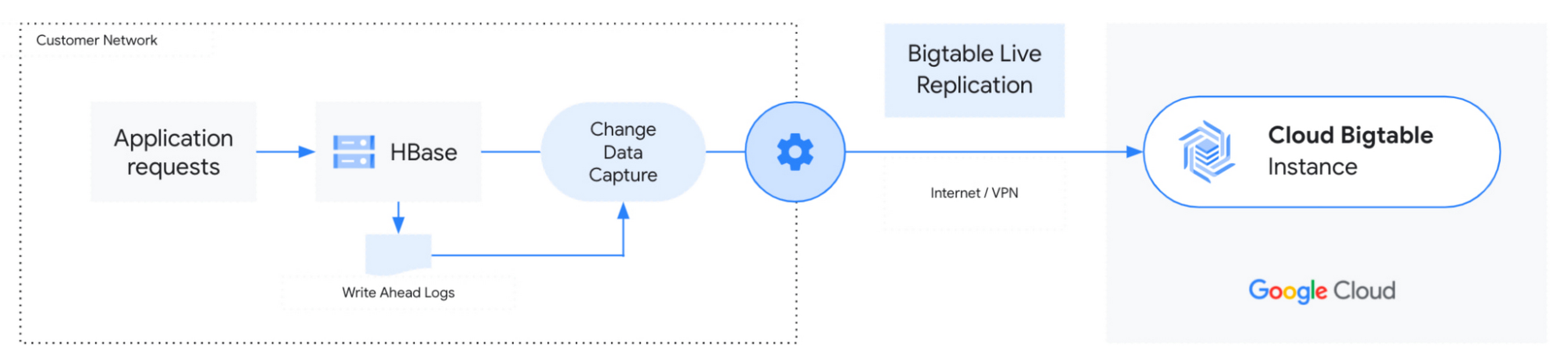
HBase provides asynchronous replication between clusters for various use cases like disaster recovery and data aggregation workloads. The HBase Bigtable Replication Library enables Bigtable to be added as an HBase cluster replication target. HBase to Bigtable replication enables customers to sync mutations happening on their HBase cluster to Bigtable, providing near-zero downtime migrations from HBase to Cloud Bigtable. 

The following diagram shows a live replication from HBase to Bigtable:

The HBase Cluster is the source database, which can be located in an on-premises network, another cloud provider, or managed data services. Once enabled, live replication allows all the writes happening on the source cluster to be replicated to the target Bigtable Instance.

Before enabling replication, you will need to create all the tables from HBase with the same column families in Bigtable. You can use the Schema Translation Tool to create target tables in Bigtable based on your existing HBase schema. To enable replication, the source cluster must be able to connect to the target Bigtable instance.

Get started with HBase to Bigtable live migrations

To learn more about HBase to Bigtable Live Migrations and how to get started, please visit our documentation page.

To learn more about Bigtable:

BigLake: unifying data lakes and data warehouses across clouds

6 avril 2022 à 18:02

The volume of valuable data that organizations have to manage and analyze is growing at an incredible rate. This data is increasingly distributed across many locations, including  data warehouses, data lakes, and NoSQL stores. As an organization’s data gets more complex and proliferates across disparate data environments, silos emerge, creating increased risk and cost, especially when that data needs to be moved. Our customers have made it clear; they need help. 

That’s why today, we’re excited to announce BigLake, a storage engine that allows you to unify data warehouses and lakes. BigLake gives teams the power to analyze data without worrying about the underlying storage format or system, and eliminates the need to duplicate or move data, reducing cost and inefficiencies. 

With BigLake, users gain fine-grained access controls, along with performance acceleration across BigQuery and multicloud data lakes on AWS and Azure. BigLake also makes that data uniformly accessible across Google Cloud and open source engines with consistent security. 

BigLake extends a decade of innovations with BigQuery to data lakes on multicloud storage, with open formats to ensure a unified, flexible, and cost-effective lakehouse architecture.

1 BigLake architecture.jpg
BigLake architecture

BigLake enables you to:

  • Extend BigQuery to multicloud data lakes and open formats such as Parquet and ORC with fine-grained security controls, without needing to set up new infrastructure.

  • Keep a single copy of data and enforce consistent access controls across analytics engines of your choice, including Google Cloud and open-source technologies such as Spark, Presto, Trino, and Tensorflow.

  • Achieve unified governance and management at scale through seamless integration with Dataplex.

Bol.com, an early customer using BigLake, has been accelerating analytical outcomes while keeping their costs low:

“As a rapidly growing e-commerce company, we have seen rapid growth in data. BigLake allows us to unlock the value of data lakes by enabling access control on our views while providing a unified interface to our users and keeping data storage costs low. This in turn allows quicker analysis on our datasets by our users.”—Martin Cekodhima, Software Engineer, Bol.com

Extend BigQuery to unify data warehouses and lakes with governance across multicloud environments

By creating BigLake tables, BigQuery customers can extend their workloads to data lakes built on Google Cloud Storage (GCS), Amazon S3, and Azure data lake storage Gen 2. BigLake tables are created using a cloud resource connection, which is a service identity wrapper that enables governance capabilities. This allows administrators to manage access control for these tables similar to BigQuery tables, and removes the need to provide object store access to end users. 

Data administrators can configure security at the table, row or column level on BigLake tables using policy tags. For BigLake tables defined over Google Cloud Storage, fine grained security is consistently enforced across Google Cloud and supported open-source engines using BigLake connectors. For BigLake tables defined on Amazon S3 and Azure data lake storage Gen 2, BigQuery Omni enables governed multicloud analytics by enforcing security controls. This enables you to manage a single copy of data that spans BigQuery and data lakes, and creates interoperability between data warehousing, data lake, and data science use cases.

Open interface to work consistently across analytic runtimes spanning Google Cloud technologies and open source engines 

Customers running open source engines like Spark, Presto, Trino, and Tensorflow through Dataproc or self managed deployments can now enable fine-grained access control over data lakes, and accelerate the performance of their queries. This helps you build secure and governed data lakes, and eliminate the need to create multiple views to serve different user groups. This can be done by creating BigLake tables from a supported query engine like Spark DDL, and using Dataplex to configure access policies. These access policies are then enforced consistently across the query engines that access this data - greatly simplifying access control management. 

Achieve unified governance & management at scale through seamless integration with Dataplex

BigLake integrates with Dataplex to provide management-at-scale capabilities. Customers can logically organize data from BigQuery and GCS into lakes and zones that map to their data domains, and can centrally manage policies for governing that data. These policies are then uniformly enforced by Google Cloud and OSS query engines. Dataplex also makes management easier by automatically scanning Google Cloud storage to register BigLake table definitions in BigQuery, and makes them available via Dataproc Metastore. This helps end users discover these BigLake tables for exploration and querying using both OSS applications and BigQuery. 

Taken together, these capabilities enable you to run multiple analytic runtimes over data spanning lakes and warehouses in a governed manner. This breaks down data silos and significantly reduces the infrastructure management, helping you to advance your analytics stack and unlock new use cases.

What’s next?

If you would like to learn more about BigLake, please visit our website. Alternatively, get started with BigLake today by using this quickstart guide, or contact the Google Cloud sales team.

Modernize your Oracle workloads to PostgreSQL with Database Migration Service, now in preview

6 avril 2022 à 18:00

Many organizations have been struggling with the complexity of their legacy databases. Unfortunately, they often find themselves locked into expensive licenses and restrictive contracts, which can limit their ability to modernize and introduce new functionality. Migrating to open-source databases, especially in the cloud, can solve many of these issues and help build modern, scalable, cost-effective applications.

However, database migrations are often highly complex and may require you to convert your schema and code to the new database engine, migrate your data, and switch over your applications, all while guaranteeing minimal downtime and disruption to the business.

Last year, we announced the general availability of Database Migration Service in our mission to help migrate your databases to the cloud with a simple and secure migration path. We launched support for homogeneous migrations, where the source and target databases use the same database engine (PostgreSQL, MySQL, or SQL Server). We saw adoption by customers migrating their workloads to Cloud SQL, Google Cloud’s fully managed relational database for PostgreSQL, MySQL, and SQL Server. More than 85% of the migrations using Database Migration Service are created and started underway in less than an hour.

Announcing Oracle to PostgreSQL support

Our customers shared that they’d like a similarly simple, easy-to-use experience for Oracle to PostgreSQL migrations. Today, we’re excited to announce the preview of Database Migration Service support for Oracle to PostgreSQL schema and data migrations.

Database Migration Service can integrate with the Ora2Pg open-source tool for schema conversion so you can migrate the schema and data of your Oracle workload from on-premises or other clouds to Cloud SQL for PostgreSQL. Ora2pg allows us to map the source to the target, and then our serverless change data capture-based mechanism can move your data securely and with minimal downtime. Database Migration Service can make database migrations fast, cost-effective, and reliable, and you can now use it to modernize from legacy databases to fully managed cloud databases.

Database Migration Service has you covered

Adopting a new database technology might appear to be a challenging task at first, but we can make the migration journey easier. We understand that effective and successful modernization can require a well-rounded approach: not only differentiated tooling but also integrated support and expert services you can trust.

Database Migration Service is highly reliable and serverless, meaning you don’t need to assign resources to the migration job or predict how many resources it will need. It can move your data from Oracle databases to Cloud SQL for PostgreSQL at scale and with low latency, which can mean minimal downtime at switchover and minimal disruption to your applications and customers.

Our integration with the proven Ora2Pg tool for schema migration means you can convert your Oracle schema to PostgreSQL with this popular open-source tool. You simply feed the configuration file after configuring, converting, and applying your converted schema with Ora2pg. Database Migration Service then creates the mapping and moves the data between the source and the target. Stay tuned for enhanced, built-in schema and code conversion capabilities in DMS to create an upgraded schema, code, and data migration experience.

“At MLB, we’re on a multi-year journey to modernize our applications with PostgreSQL as the database foundation,” says Shawn O’Rourke, manager of technology at MLB. “A key step in this journey is to reliably migrate our Oracle databases to Cloud SQL for PostgreSQL securely and without any disruption to our services. We’re excited to incorporate Database Migration Service, with its simple, serverless design, into our Oracle migration toolset.”

Expert services to help accelerate your migration

By working closely with experts from Google Professional Services and experienced migration partners, we help make sure you have access to the expertise and experience you need to facilitate successful migrations across your database fleet. From guidance on migration planning to turnkey end-to-end migrations, the combination of Database Migration Service and partner services can ensure a smooth transition to the cloud.

“We see tremendous demand from our customers for migrating away from proprietary databases onto cloud database technologies”, says David Yahalom, Managing Principal, Cloud Data Solutions at EPAM Systems. “One of the key success factors in application modernization is real-time continuous data replication within a heterogeneous database environment. Real-time data replication enables near-zero and zero downtime production switchovers while maintaining data integrity. We are very excited about the addition of Oracle to PostgreSQL migration support in Database Migration Service and believe it will be of great value to our customers. It will enable us to streamline database cloud migration initiatives to Google Cloud.”

Getting started with Database Migration Service

You can start migrating your Oracle workloads today using Database Migration Service:

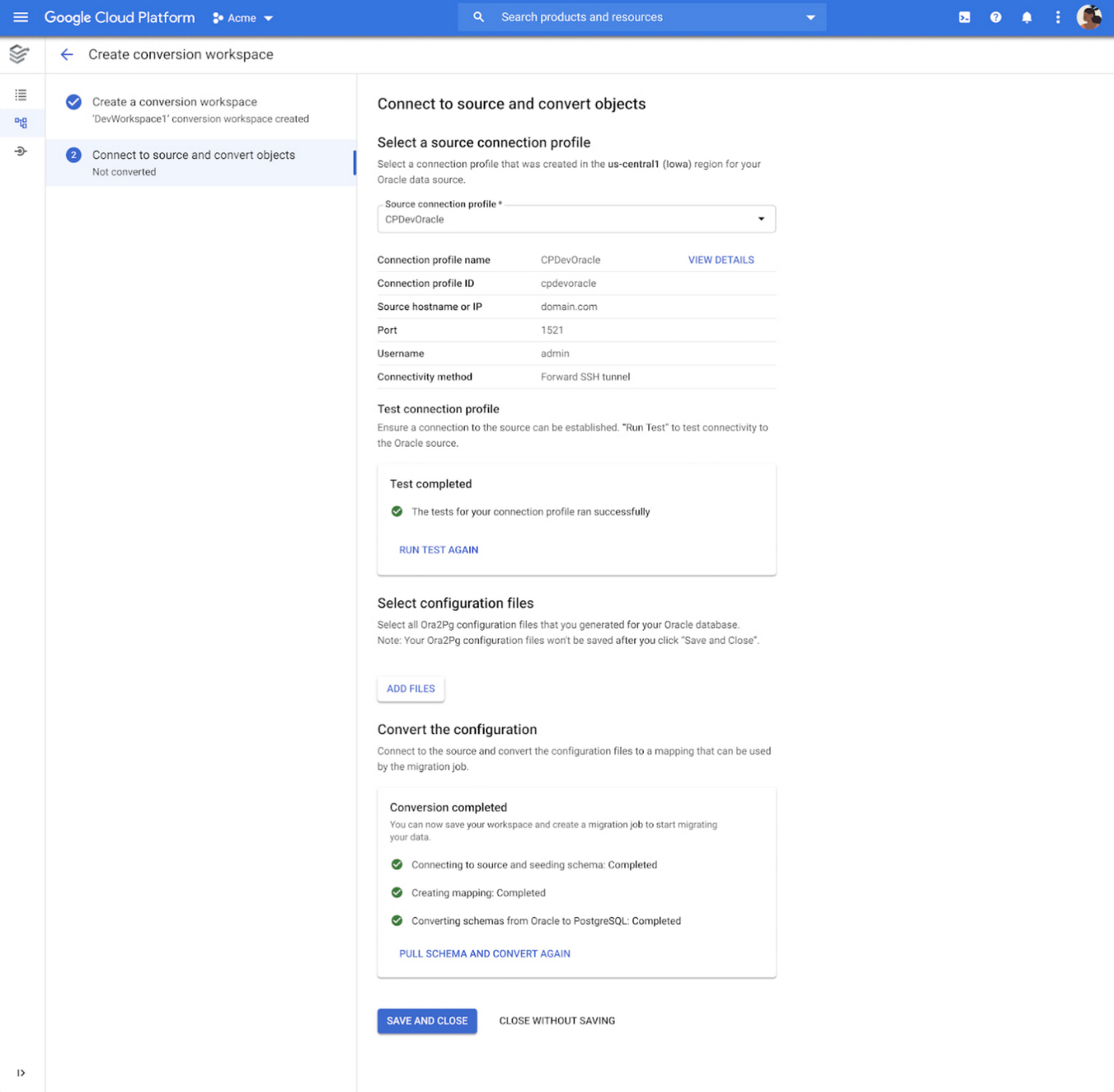
  1. Navigate to the Database Migration area of your Google Cloud console, under Databases, and click Create Conversion Workspace.

  2. Use the Conversion Workspace creation wizard to upload your Ora2PG configuration file.

  3. Create your source and destination connection profiles. You can use this profile again later for additional migrations.

  4. Create a migration job to connect the Cloud SQL destination Connection Profile, Oracle Connection Profile, and Conversion Workspace.

  5. Test your migration job and make sure the test was successful as displayed below, and start it whenever you're ready.

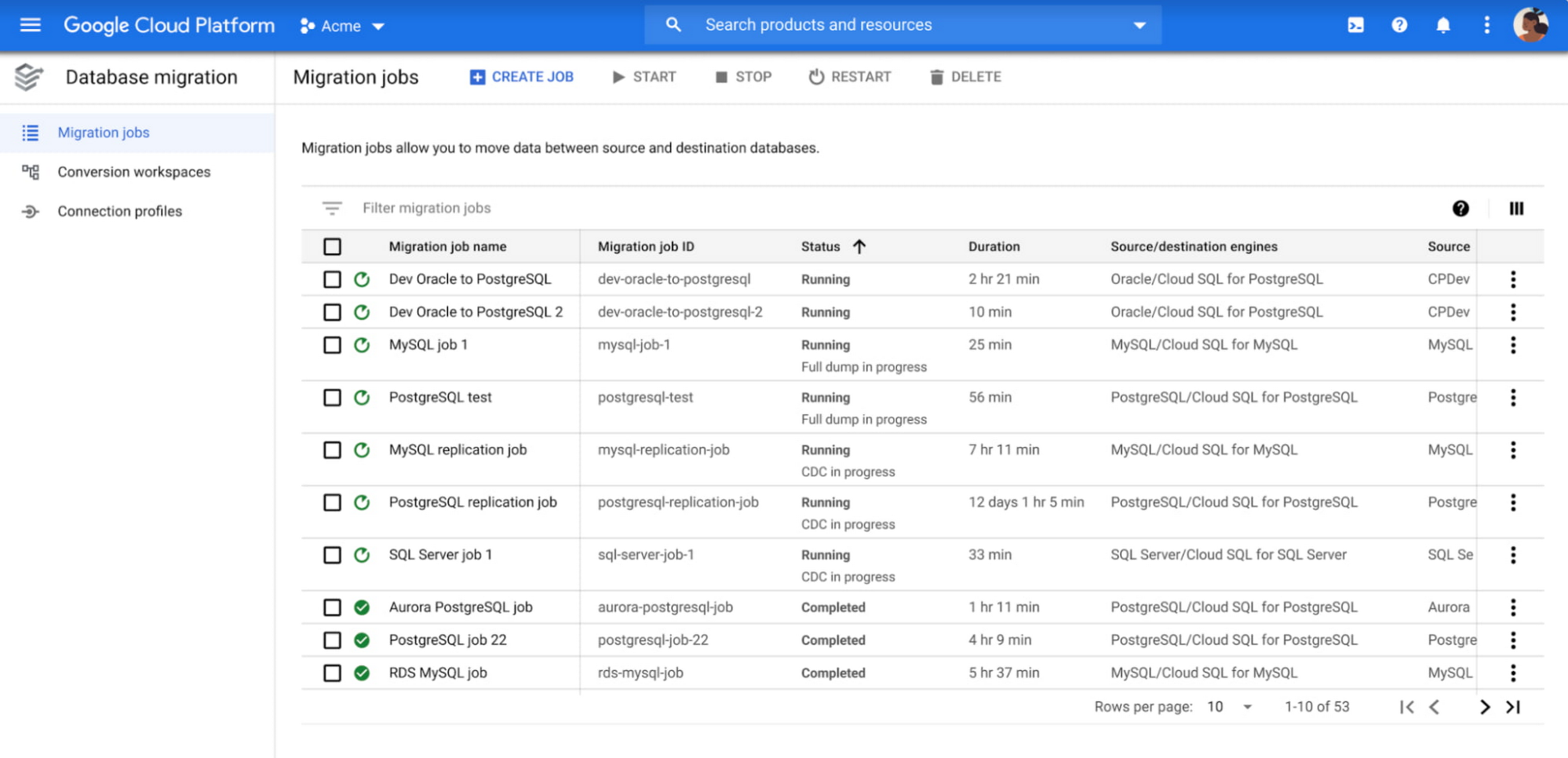
Once the initial snapshot of data has been migrated to the new destination, Database Migration Service will keep up and replicate new changes as they happen. You can then finalize the migration job, and your new Cloud SQL instance will be ready to go. You can monitor your migration jobs on the migration jobs list, as shown in the image below:

Learn more and start your database journey 

Database Migration Service schema and data migration from Oracle to Cloud SQL for PostgreSQL are available in preview in addition to the previously-announced SQL Server migration preview. If you’re interested in seeing it in action, you can request access now.

For more information to help get you started on your migration journey, head over to the documentation or start training with this Database Migration Service Qwiklab.

Boost the power of your transactional data with Cloud Spanner change streams

6 avril 2022 à 18:00

Data is one of the most valuable assets in today’s digital economy. One way to unlock the value of your data is to give it life after it’s first collected. A transactional database, like Cloud Spanner, captures incremental changes to your data in real time, at scale, so you can leverage it in more powerful ways. Cloud Spanner is our fully managed relational database that offers near unlimited scale, strong consistency, and industry-leading high availability of up to 99.999%. 

The traditional way for downstream systems to use incremental data that’s been captured in a transactional database is through change data capture (CDC), which allows you to trigger behavior based on changes to your database, such as a deleted account or an updated inventory count.

Today, we are announcing Spanner change streams, coming soon, that lets you capture change data from  Spanner databases and easily integrate it with other systems to unlock new value. 

Change streams for Spanner goes above and beyond the traditional CDC capabilities of tracking inserts, updates, and deletes. Change streams are highly flexible and configurable, letting you track changes on exact tables and columns or across an entire database. You can replicate changes from Spanner to BigQuery for real-time analytics, trigger downstream application behavior using Pub/Sub, and store changes in Google Cloud Storage (GCS) for compliance. This ensures you have the freshest data to optimize business outcomes. 

Change streams provides a wide range of options to integrate change data with other Google Cloud services and partner applications through turnkey connectors, including custom Dataflow processing pipelines or the change streams read API.

Spanner consistently processes over 1.2 billion requests per second. Since change streams are built right into Spanner, you not only get industry-leading availability and global scale—you also don’t have to spin up any additional resources. The same IAM permissions that already protect your Spanner databases can be used to access change streams queries.Change stream queries are protected by spanner.databases.select, and change stream DDL operations are protected by spanner.databases.updateDdl.

Change streams in action

In this section, we’ll look at how to set up a change stream that sends change data from Spanner to an analytic data warehouse in BigQuery.

Creating a change stream 

As discussed above, a change stream tracks changes on an entire database, a set of tables, or a set of columns in a database. Each change stream can have a retention period of anywhere from one day to seven days, and you can set up multiple change streams to track exactly what you need for your specific business objectives. 

First, we’ll create a change stream on a table called InventoryLedger. This table tracks inventory changes on two columns: InventoryLedgerProductSku and InventoryLedgerChangedUnits with a 7-day retention period.

Change records

Each change record contains a wealth of information, including primary key, the commit timestamp, transaction ID, and of course, the old and new values of the changed data, wherever applicable. This makes it easy to process change records as an entire transaction, in sequence based on their commit timestamp, or individually as they arrive, depending on your business needs. 

Back to the inventory example, now that we’ve created a change stream on the InventoryLedger table, all inserts, updates, and deletes on this table will be published to the InventoryStream change stream. These changes are strongly consistent with the commits on the InventoryLedger table: When a transaction commit succeeds, the relevant changes will automatically persist in the change stream. You never have to worry about missing a change record.

Processing a change stream

There are numerous ways that you can process change streams depending on the use case:

  • Analytics: You can send the change records to BigQuery, either as a set of change logs or by updating the tables.  

  • Event triggering: You can send change logs to Pub/Sub for further processing by downstream systems. 

  • Compliance: You can retain the change log to Google Cloud Storage for archiving purposes. 

The easiest way to process change stream data is to use our Spanner connector for Dataflow, where you can take advantage of Dataflow’s built-in pipelines to BigQuery, Pub/Sub, and Google Cloud Storage. The diagram below shows a Dataflow pipeline that processes this change stream and imports change data directly into BigQuery.

Alternatively, you can build a custom Dataflow pipeline to process change data with Apache Beam. In this case, we provide a Dataflow connector that outputs change data as an Apache Beam PCollection of DataChangeRecord objects. 

For even more flexibility, you can use the underlying change streams query API. The query API is a powerful interface that lets you read directly from a change stream to implement your own connector and stream changes to the pipeline of your choice. On the query API side, a change stream is divided into multiple partitions, which can be used to query a change stream in parallel for higher throughput. Spanner dynamically creates these partitions based on load and size. Partitions are associated with a Spanner database split, allowing change streams to scale as effortlessly as the rest of Spanner.

Get started with change streams

With change streams, your Spanner data follows you wherever you need it, whether that’s for analytics with BigQuery, for triggering events in downstream applications, or for compliance and archiving. Change streams are highly flexible and configurable —allowing you to capture change data for the exact data you care about, and for the exact period of time that matters for your business. And because change streams are built into  Spanner, there’s no software to install, and you get external consistency, high scale, and up to 99.999% availability.

There’s no extra charge for using change streams, and you’ll pay only for extra compute and storage of the change data at the regular Spanner rates.

To get started with Spanner, create an instance, or try it out with a Spanner Qwiklab.

We’re excited to see how Spanner change streams will help you unlock more value out of your data!

Introducing Topaz — the first subsea cable to connect Canada and Asia

6 avril 2022 à 15:00

There’s a new subsea cable in town: Topaz, the first-ever fiber cable to connect Canada and Asia. 

Once complete, Topaz will run from Vancouver to the small town of Port Alberni on the west coast of Vancouver Island in British Columbia, and across the Pacific Ocean to the prefectures of Mie and Ibaraki in Japan. We expect the cable to be ready for service in 2023, not only delivering low-latency access to Search, Gmail and YouTube, Google Cloud, and other Google services, but also increasing capacity to the region for a variety of network operators in both Japan and Canada. 

Google is spearheading construction of the project, joined by a number of local partners in Japan and Canada to deliver the full Topaz subsea cable system. Other networks and internet service providers will be able to benefit from the cable’s additional capacity, whether for their own use or to provide to third parties. And, similar to other cables we’ve built, with Topaz we will exchange fiber pairs with partners who have systems along similar routes. This is a longstanding practice in the industry that strengthens the intercontinental network lattice for network operators, for Google, and for users around the world.

topaz.jpg

Network infrastructure investments like Topaz bring significant economic activity to the regions where they land. For example, according to a recent Analysys Mason study, Google’s historical and future network infrastructure investments in Japan are forecasted to enable an additional $303 billion (USD) in GDP cumulatively between 2022 and 2026. 

The width of a garden hose, the Topaz cable will house 16 fiber pairs, for a total capacity of 240 Terabits per second (not to be confused with TSPs). It includes support for Wavelength Selective Switch (WSS), an efficient and software-defined way to carve up the spectrum on an optical fiber pair for flexibility in routing and advanced resilience. We’re proud to bring WSS to Topaz and to see the technology is being implemented widely across the submarine cable industry.  

While Topaz is the first trans-Pacific fiber cable to land on the West Coast of Canada, it’s not the first communication cable to connect to Vancouver Island. In the 1960s, the Commonwealth Pacific Cable System (COMPAC) was a copper undersea cable linking Vancouver with Honolulu (United States), Sydney (Australia), and Auckland (New Zealand), expanding high-quality international phone connectivity. Today, COMPAC is no longer in service but its legacy lives on. The original cable landing station in Vancouver — the facility where COMPAC made landfall on Canadian soil — has been upgraded to fit the needs of modern fiber optics and will house the eastern end of the Topaz cable.

Traditional and treaty rights, and local communities, are deeply important to our infrastructure projects. The Topaz cable is built alongside the traditional territories of the Hupacasath, Maa-nulth, and Tseshaht, and we have consulted with and partnered with these First Nations every step of the way. 

"Tseshaht is very proud of this collaboration and our partnership with Google, who has been very respectful and thoughtful in its engagement with our Nation. That’s how we carry ourselves and that's how we want business to carry themselves in our territory.“ — Tseshaht First Nation - Elected Chief Councillor-Ken Watts 

“The five First Nations of the Maa-nulth Treaty Society are pleased that we have concluded an agreement with Google Canada and have consented to the installation of a new, high-speed fiber optic cable through our traditional territories. This agreement, in which both Google Canada and our Nations benefit, is based on respect for our constitutionally protected treaty and aboriginal rights and enhances the process of reconciliation. We would also like to acknowledge the sensitivity that Google Canada expressed during our talks in regard to the pain and trauma experienced by our people as a result of residential school experience. We look forward to a long and mutually beneficial relationship with Google Canada.” —Chief Charlie Cootes, President of the Maa-nulth Treaty Society

“Google's respect towards our Nation is appreciated and has good energy behind it.” —Hupacasath First Nation - Elected Chief Councilor - Brandy Lauder 

With the addition of Topaz today, we have announced investments in 20 subsea cable projects. This includes Curie, Dunant, Equiano, Firmina and Grace Hopper, and consortium cables like Blue, Echo, Havfrue and Raman — all connecting 29 cloud regions, 88 zones, 146 network edge locations across more than 200 countries and territories. Learn about Google Cloud’s network and infrastructure on our website and in the below video.

Limitless Data. All Workloads. For Everyone

6 avril 2022 à 07:00

Today, data exists in many formats, is provided in real-time streams, and stretches across many different data centers and clouds, all over the world. From analytics, to data engineering, to AI/ML, to data-driven applications, the ways in which we leverage and share data continues to expand. Data has moved beyond the analyst and now impacts every employee, every customer, and every partner. With the dramatic growth in the amount and types of data, workloads, and users, we are at a tipping point where traditional data architectures – even when deployed in the cloud – are unable to unlock its full potential. As a result, the data-to-value gap is growing. 

To address these challenges, we are unveiling several data cloud innovations today that allow our customers to work with limitless data, across all workloads, and extend access to everyone. These announcements include BigLake and Spanner change streams to further unify customer data while ensuring it’s delivered in real-time, as well as Vertex AI Workbench and Model Registry to close the data to AI value gap. And to bring data within reach for anyone, we are announcing a unified business intelligence (BI) experience that includes a new Workspace integration, along with new programs that further enable our data cloud partner ecosystem. 

Removing all data limits 

Today, we are announcing the preview of BigLake, a data lake storage engine, to remove data limits by unifying data lakes and warehouses. Managing data across disparate lakes and warehouses creates silos and increases risk and cost, especially when data needs to be moved. BigLake allows companies to unify their data warehouses and lakes to analyze data without worrying about the underlying storage format or system, which eliminates the need to duplicate or move data from a source and reduces cost and inefficiencies. 

With BigLake, customers gain fine-grained access controls, with an API interface spanning Google Cloud and open file formats like Parquet, along with open-source processing engines like Apache Spark. These capabilities extend a decade’s worth of innovations with BigQuery to data lakes on Google Cloud Storage to enable a flexible and cost-effective open lake house architecture. 

Twitter already uses storage capabilities with BigQuery to remove the limits of data to better understand how people use their platform, and what types of content they might be interested in. As a result, they are able to serve content across trillions of events per day with an ads pipeline that runs more than 3M aggregations per second. 

Another major innovation we’re announcing today is Spanner change streams. Coming soon, this new product will further remove data limits for our customers, allowing them to track changes within their Spanner database in real time in order to unlock new value. Spanner change streams tracks Spanner inserts, updates, and deletes to stream the changes in real time across a customer’s entire Spanner database. This ensures customers always have access to the freshest data as they can easily replicate changes from Spanner to BigQuery for real-time analytics, trigger downstream application behavior using Pub/Sub, or store changes in Google Cloud Storage (GCS) for compliance. With the addition of change streams, Spanner, which currently processes over 2 billion requests per second at peak with up to 99.999% availability, now gives customers endless possibilities to process their data. 

Remove the limits of your data workloads

Our AI portfolio is powered by Vertex AI, a managed platform with every ML tool needed to build, deploy and scale models, and is optimized to work seamlessly with data workloads in BigQuery and beyond. Today, we're announcing new Vertex AI innovations that will provide customers with an even more streamlined experience to get AI models into production faster and make maintenance even easier.

Vertex AI Workbench, which is now generally available, brings data and ML systems into a single interface so that teams have a common toolset across data analytics, data science, and machine learning. With native integrations across BigQuery, Serverless Spark, and Dataproc, Vertex AI Workbench enables teams to build, train and deploy ML models 5X faster than traditional notebooks. In fact, a global retailer was able to drive millions of dollars in incremental sales and deliver 15% faster speed to market with Vertex AI Workbench.

With Vertex AI, customers have the ability to regularly update their models. But managing the sheer number of artifacts involved can quickly get out of hand. To make it easier to manage the overhead of model maintenance, we are announcing new MLOps capabilities with Vertex AI Model Registry. Now in preview, Vertex AI Model Registry provides a central repository for discovering, using, and governing machine learning models, including those in BigQuery ML. This makes it easy for data scientists to share models and application developers to use them, ultimately enabling teams to turn data into real-time decisions, and be more agile in the face of shifting market dynamics.

Extending the reach of your data

Today, we are launching Connected Sheets for Looker, and the ability to access Looker data models within Data Studio. Customers now have the ability to interact with data however they choose, whether it be through Looker Explore, from Google Sheets, or using the drag-and-drop Data Studio interface. This will make it easier for everyone to access and unlock insights from data in order to drive innovation, and to make data-driven decisions with this new unified Google Cloud business intelligence (BI) platform. This unified BI experience makes it easy to tap into governed, trusted enterprise data, to incorporate new data sets and calculations, and to collaborate with peers.

Mercado Libre, the largest online commerce and payments ecosystem in Latin America, has been an early adopter of Connected Sheets for Looker. Using this integration, they have been able to provide broader access to data through a spreadsheet interface that their employees are already familiar with. By lowering the barrier to entry, they have been able to build a data-driven culture in which everyone can inform their decisions with data. 

Doubling down on the data cloud partner ecosystem

Closing the data-to-value gap with these data innovations would not be possible without our incredible partner ecosystem. Today, there are more than 700 software partners powering their applications using Google’s data cloud. Many partners like Bloomreach, Equifax, Exabeam, Quantum Metric, and ZoomInfo, have started using our data cloud capabilities with the Built with BigQuery initiative, which provides access to dedicated engineering teams, co-marketing, and go-to-market support. 

Our customers want partner solutions that are tightly integrated and optimized with products like BigQuery. So today, we’re announcing Google Cloud Ready - BigQuery, a new validation that recognizes partner solutions like those from Fivetran, Informatica and Tableau that meet a core set of functional and interoperability requirements. Today, we already recognize more than 25 partners in this new Google Cloud Ready - BigQuery program that reduces costs for customers associated with evaluating new tools while also adding support for new customer use cases. 

We're also announcing a new Database Migration Program to help our customers efficiently and effectively accelerate the move from on-premise and other clouds to Google’s industry-leading managed database services. This includes tooling, resources, and knowledgeable experience from alliances like Deloitte, as well as incentives from Google to offset the cost of migrating databases.

We remain committed to continued innovation with the leading data and analytics companies where our customers are investing. This week Databricks, Fivetran, MongoDB, Neo4j, and Redis are all announcing significant new capabilities for customers on Google Cloud.

All of these announcements and more will be shared in detail at our Data Cloud Summit. Be sure to watch the data cloud strategy sessions, breakouts, and get access to hands on content. There is no doubt the future of data holds limitless possibilities, and we are thrilled to be on this data cloud journey.

3 Highlights from Thomas Kurian’s Keynote at the Goldman Sachs Communicopia & Technology Conference

11 septembre 2026 à 11:00

On Tuesday, September 8, Thomas Kurian participated in the Goldman Sachs Tech Conference, providing an update on Google Cloud’s business and strategy. Here are the highlights:

  1. Full Stack Approach: Google Cloud is the only provider to offer solutions across the entire AI stack, which expands our total addressable market, differentiates our products from the point of view of performance, cost and quality; and enables us to diversify our revenue streams as the market grows. We have 17 product lines with more than $1 billion in revenues and our customers on average exceeded their commitments by more than 50%. We have also seen more than 2x quarter-over-quarter and year-over-year growth in the number and value of $100 million to $1 billion deals. And we have more than 300 customers each with $100 million-plus contractual commitments.
  2. Benefits of Google Cloud’s AI Infrastructure: Our AI Infrastructure is built on highly differentiated products in a large expanding market which helps us lower cost and improve performance and margins for our AI models. We have a 2-year AI server payback period, and TPUs have a much faster expected payback period than GPUs. The majority of our AI infrastructure total contract value is from committed five-year contracts.
  3. Benefits of Google Cloud’s broad AI solutions: We have seen strong adoption of Gemini Enterprise, which provides customers with insight across their businesses in a highly cost efficient manner with enterprise control and governance. We have also seen that Google Cloud customers that use our AI products use 1.8 times as many products as those who do not.

For more information, please refer to the slide presentation and transcript from the event. This blog post includes statements that could be considered forward-looking. These statements involve a number of risks and uncertainties that could cause actual results to differ materially. Any forward-looking statements in the presentation are based on assumptions as of September 8, 2026, and Alphabet undertakes no obligation to update them.

[In preview] Public Preview: Azure Multicloud Interconnect

31 août 2026 à 20:36
Announcing the public preview of Azure Multicloud Interconnect, a managed service that provides private connectivity between Azure and supported cloud providers, with Amazon Web Services (AWS) available as the first supported provider in preview. As organ

How Uber improves network reliability while unblocking cloud migration

26 août 2026 à 18:00

Uber has a lot in common with the cities it serves. Both are always changing and growing, both must carefully manage the resulting traffic to prevent congestion and sprawl.

Uber has continuously evolved its technical strategies to manage its expanding network, and this careful planning and constant evolution helps ensure that application traffic across its entire platform runs smoothly. Ultimately, maintaining a reliable, high-scale platform that operates seamlessly at any given time is key to preserving user trust.

One important solution in this effort has been application awareness on Cloud Interconnect. An industry-first tool for application prioritization across hybrid networks, application awareness on Cloud Interconnect has helped Uber prioritize critical traffic to ensure business continuity during potential network congestion events. 

Uber acted as an early design partner for application awareness on Cloud Interconnect, helping ensure that this capability met the demands of Uber’s global-scale operations. It not only improved Uber’s daily operations, it also gave Uber the confidence to move forward with a Google Cloud migration, with confidence that there would be less risk of service interruptions during switchovers. 

In this post, we’ll explain the features Uber most sought and why, the inner workings of application awareness on Cloud Interconnect, and how it can help other organizations as well.

Prioritizing critical traffic

When migrating distributed, hybrid, or multicloud applications at a global scale, network reliability becomes a primary concern. Even the most worthwhile migrations may not seem worth it if such migrations interrupt ongoing service. For organizations like Uber, moving vast amounts of data to support large data analytics workload — including emerging AI use cases — can saturate network links, resulting in increased reliability risk for their critical application traffic. 

With standard cloud interconnect approaches, enterprises typically apply simple bandwidth overprovisioning to meet extreme infrastructure needs. But with today's hybrid cloud demands, and given the size of an organization like Uber, overprovisioning network capacity for peak usage is often too costly and unreliable. 

The shortcomings of overprovisioning only become magnified with the integration of cutting-edge AI innovations. Uber needs systems in place that can take on massive data transfers without congesting its network and protecting the performance of business-critical applications.

With the benefit of application awareness on Cloud Interconnect, including the four major features of application awareness — traffic handling, congestion response, latency management, and cost efficiency — Uber was able to achieve the networking optimization its modern tech stack requires.

aai concept value prop with_without picture

Starting with a private preview, Uber deployed this feature across its infrastructure, beginning with Google Cloud Interconnect deployments in Phoenix, Arizona, and Ashburn, Virginia. Application awareness on Cloud Interconnect allows Uber to classify and prioritize end-user application traffic over less time-sensitive data using DSCP marking and configured queuing profiles.

In the following chart, we look at the four key features of application awareness on Cloud Interconnect, how they differ from legacy approaches, and how they help provide better operational continuity for organizations like Uber. 

Feature

Standard interconnect solutions

Application awareness on Cloud Interconnect

Traffic handling

All traffic treated equally (first-in, first-out)

Traffic classified into six distinct traffic classes

Congestion response

High-priority application traffic may be dropped during bursts

Business-critical traffic is protected via strict priority or bandwidth sharing policies

Latency management

Unpredictable latency for high priority applications

Predictable and consistent low-latency for time-sensitive workloads

Cost efficiency

Requires expensive overprovisioning to absorb peaks

Efficient bandwidth utilization and lower TCO

Uber's key takeaways

For Uber, the business value of being able to prioritize business-critical traffic on its networks by deploying application awareness on Cloud Interconnect was immediate. And in doing so, Uber has also created a blueprint that other enterprises with similar hybrid cloud challenges can replicate. The core elements of that blueprint include:

  • Ensuring business continuity: Uber can decide in real time which application traffic to prioritize during major, high-traffic events. This means that mission critical applications stay up and running during even extreme events (both planned and unplanned). Uber leadership has called application awareness on Cloud Interconnect important for its global operations. 

  • Efficient bandwidth utilization: Instead of blindly overprovisioning bandwidth to prevent congestion, application awareness allows Uber to better utilize their existing Cloud Interconnect capacity aligned with their expected network bandwidth needs. The result is lower total cost of ownership for network infrastructure.

  • Unblocked workload migration: By protecting critical applications from network congestion, Uber was able to migrate significant workloads to Google Cloud and, in the process, dramatically reduce operational overhead.

"Application awareness on Cloud Interconnect was the key that unlocked our ability to migrate more strategic workloads to Google Cloud and is critical for maintaining service reliability during peak global demand. By allowing us to intelligently prioritize traffic, it helps us ensure that we can protect our higher priority services and make our infrastructure more efficient, lowering our total cost of ownership. This wasn't just a feature deployment; it was a deep engineering partnership that delivered a solution critical to our business." – Harry Liu, Director of Engineering, Uber

Securing network reliability for AI and beyond

As more enterprises integrate cloud-based AI models, distributed applications, and data analytics, it's becoming a business imperative to be ready to handle the massive data transfers that follow. But in doing so, they also have to ensure they never compromise the reliability of their critical applications. 

With application awareness on Cloud Interconnect, Uber demonstrated that moving beyond simple bandwidth overprovisioning to protect business-critical traffic was an essential step to building the stability required to embrace modern hybrid and multicloud strategies.

You can read our blog about the potential of Cloud Interconnect across industries to learn more about what the service can bring to your organization, and if you’re ready to explore more, our team of networking and industry experts are ready to help.

Announcing: Extended Support for Azure Database for PostgreSQL Flexible Server

24 août 2026 à 21:15
Extended Support for Azure Database for PostgreSQL Flexible Server helps you maintain secure, supported workloads while transitioning to newer PostgreSQL versions. With access to critical security updates, critical bug fixes, and technical support for eli

[Launched] Generally Available: Summarized advertised gateway prefixes for route advertisement

20 août 2026 à 19:02
Summarized advertised gateway prefixes for route advertisement is now generally available. You can specify aggregated (summarized) prefixes for an Azure gateway to advertise to your on-premises networks, rather than having every individual virtual network

[Launched] Generally Available: Azure SQL updates for mid-August 2026

19 août 2026 à 23:01
In mid-August 2026, the following updates and enhancements were made to Azure SQL: You can customize keyboard shortcuts for Quick Queries, the Results Grid, and the Query Editor directly within Visual Studio Code—without leaving your editor. Shortcut Conf
❌