❌

Vue normale

Reçu avant avant-hierCloud Blog

Introducing GKE agentic migration for AI-assisted EKS-to-GKE migrations with built-in governance

24 septembre 2026 à 18:00

Enterprises are increasingly standardizing on Google Kubernetes Engine (GKE) to run their most critical and AI-driven workloads. From Cloud Storage FUSE for high-throughput data access to custom compute classes (CCC) and advanced GPU slicing, GKE provides the scale and efficiency required for modern applications.

However, migrating complex Kubernetes environments from AWS EKS to GKE has traditionally been a daunting, high-friction engineering endeavor. Your platform teams must manually dissect sprawling infrastructure-as-code (IaC), navigate cloud-specific architectural differences, and build custom translation scripts.

While your engineering teams often experiment with general-purpose LLMs to draft conversions, ad-hoc prompting quickly can become an operational trap. Raw models hallucinate non-existent resource properties, drop critical network or identity configurations, and lose context across interdependent files. The time platform engineers spend auditing, untangling, and debugging model errors ends up cannibalizing any upfront speed gains, creating manual toil and unpredictability. 

Today, we are excited to announce the open-source release of GKE agentic migration, a purpose-built agent plugin that replaces brittle, ad-hoc prompting with an AI-assisted migration pipeline protected by deterministic guardrails. 

“For large enterprise clients, the biggest barrier to cloud modernization is execution risk and unpredictability. Unlike raw chat prompts that lose context and hallucinate configurations, Google’s GKE agentic migration pairs the speed of generative AI with the deterministic guardrails enterprises need: structured state persistence, multi-persona boundaries between platform and app teams, and non-negotiable human approval gates. It gives our global engineering practice a provable, compiler-grade migration factory that slashes delivery risk.- Rahul Shrivastava, EVP, Persistent

The challenges of infrastructure migrations

When talking to customers about their infrastructure migration journeys, we consistently hear about several governance challenges:

  • The automation trust gap: Refactoring Kubernetes configurations manually can be agonizingly slow. Yet, using generic AI coding assistants introduces unacceptable risk. Standard LLMs can hallucinate infrastructure code, use deprecated API fields, or omit critical security rules. Generating code that is "almost right" simply shifts the bottleneck from writing code to debugging it.

  • The danger of live cluster mutability (ClickOps): Legacy migration tools often connect directly to live clusters and deploy via API calls. This bypasses the organization's Git repository (the true source of truth), breaks CI/CD pipelines, and makes rollbacks incredibly difficult.

  • The siloed handoff bottleneck: Migrations are often long-running, multi-week operations. Platform engineers build the landing zone and your application developers migrate the workloads. Standard AI tools lose context across the handoff.

  • The fragmented toolchain: Backup tools like Velero are excellent for disaster recovery but capture exact AWS-specific configurations (like ALBs) without translating them for Google Cloud. Reverse-engineering tools, meanwhile, generate flat configurations that strip away the developer's original logical intent.

Introducing the GKE agentic migration

The GKE agentic migration addresses these challenges by combining the reasoning capabilities of LLMs with strict, deterministic tooling. Designed as a compilation of agent skills and a local Model Context Protocol (MCP) server, it uses AI to translate complex AWS EKS IaC and Kubernetes manifests directly into GKE landing zones via automated Pull Requests.

Here are the key capabilities that set the GKE agentic migration apart:

1. Hybrid verification — LLM-generated, deterministically validated. To combat dangerous IaC hallucinations, LLM workers handle the complex authoring of Terraform and Kubernetes YAML, while the server runs deterministic transforms for exact mappings such as Workload Identity annotations and image registries. Crucially, these AI-generated translations are then submitted to strict deterministic validations (e.g., terraform validate, Kubernetes manifest contracts) before they are presented to the user. This approach helps maintain safety against hallucinations while gating everything behind human-in-the-loop (HITL) approval.

2. GitOps-native PR workflows: The plugin never applies changes directly to a live cluster. Instead, it reads your source of truth, generates the target state, and opens a Pull Request. This helps route all changes through your standard human-in-the-loop (HITL) CI/CD review process. No "ClickOps."

3. Protected separation of translation vs. transport: The plugin automates the tedious logic of architectural translation, but it intentionally does not transport stateful data. To protect your most sensitive assets, the plugin generates contextual runbooks that guide your team in using purpose-built, SLA-backed tools (like Google Cloud's Database Migration Service or Storage Transfer Service).

4. Multi-persona state management: Migrations are team efforts. The plugin persists the long-running migration state.  This enables protected, asynchronous handoffs: Platform engineers establish the baseline landing zone, while app developers independently join the workspace from their own machines to translate individual workloads within permission-isolated folders.

How it works: The migration lifecycle

Under the hood, the GKE agentic migration utilizes a migration state graph of executable functions, systematically passing context down the chain. Packaged as an open-source agent plugin, there are no custom CLI binaries to install and no central control planes to manage — your team collaborates through your existing development harness, delivering validated pull requests and actionable runbooks directly into your source repositories. This provides:

  • Deep EKS repository discovery: The plugin clones the source Git repository or performs a live scan of your EKS cluster, programmatically indexes the source manifests, maps dependencies, and builds an inventory
  • Assessment & blocker governance: It generates a readiness report identifying architectural incompatibilities. Before design can unlock, every blocker must have an assigned owner and target resolution date. The Platform Engineer signs off on the migration boundaries before translation begins.
  • Landing zone design: The plugin scaffolds the foundational Google Cloud Terraform modules (VPC, subnets, GKE cluster, org policies) based on explicit platform decisions (such as GKE Autopilot vs. GKE Standard).
  • AI-assisted cloud translation: The plugin handles proprietary shifts, including translating AWS IRSA to Workload Identity, mapping ALB ingress to the Gateway API, and converting Karpenter node claims to GKE Node Auto Provisioning (NAP) or Custom Compute Classes (CCC).
  • Offline validation: Generated modules and manifests are compiled and verified offline (terraform validate, manifest structure checks, and output contracts). 
  • Deployment via Pull Request: The finalized configuration is verified locally and opens a PR for review. 

Getting started

The GKE agentic migration transforms cloud migrations from disjointed refactoring exercises into predictable, AI-assisted, and reviewable GitOps workflows. Ready to accelerate your journey to GKE?

How to migrate from Apache HBase to Cloud Bigtable with Live Migrations

7 avril 2022 à 18:00

Cloud Bigtable is a natural destination for Apache HBase workloads, as it is a fully managed service that is compatible with the HBase API. As a result, many customers running business-critical applications with large-scale data and low-latency needs consider migrating to Bigtable.

However, migrating from HBase to Bigtable can still be challenging since you typically have to pause your applications for migration downtime. In addition, some companies choose to write custom tools, which require extensive resources to build and test, adding months to the migration process.

Today, we’re announcing that Live Migrations from Apache HBase to Cloud Bigtable are now generally available. This enables faster and simpler migrations from HBase to Bigtable to ensure accurate data migration, reduce migration effort, and provide a better overall developer experience.

HBase to Bigtable migrations just got easier 

Historically, you would need to manually create tables in Bigtable from your existing HBase tables and execute several steps to export and import data, define target tables, and validate data integrity. This process can be tedious, especially if the migration requires moving multiple tables or pre-splitting tables. 

At Google Cloud, we’re always trying to find ways to make migrations from HBase to Bigtable even easier for our customers. Our latest Live Migration features aim to provide a more straightforward, more efficient, and proven way to migrate data from HBase to Bigtable with minimal downtime. All together, they provide the necessary components to complete a seamless live migration.

We have built four new features:

Now, you can automate the migration process and facilitate end-to-end data pipelines. The Schema Translation Tool fully automates table conversion by connecting to HBase, copying the table schema, and creating similar tables in Bigtable. You can also import HBase snapshots and validate data migration for a more seamless migration process with our Snapshot Import and Migration Validation tools. 

The HBase Bigtable Replication Library, which becomes available today, removes the need for building custom migration tools. It allows you to use HBase replication to sequence bulk imports and live writes correctly, ensuring consistent performance during migration of large workloads.

How live migrations from HBase to Bigtable works

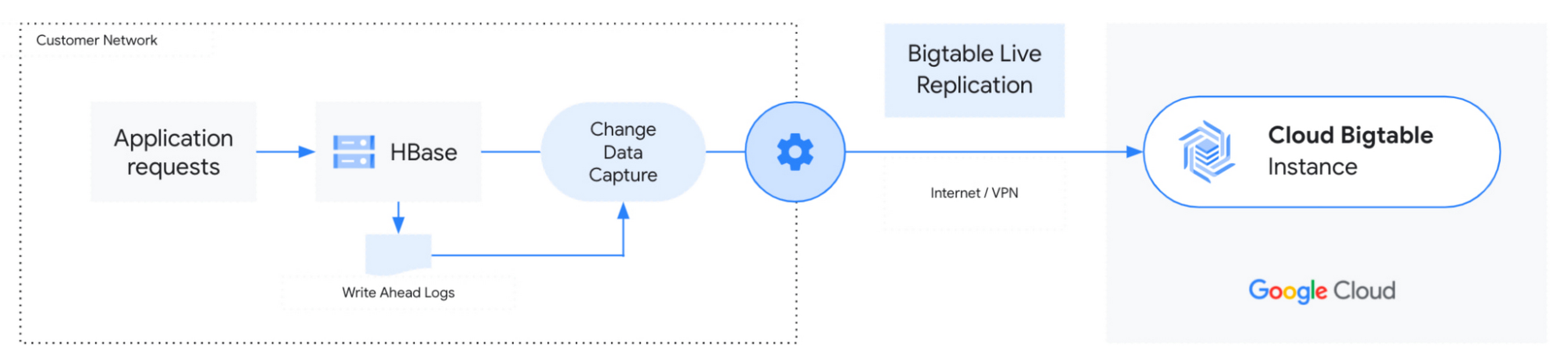
HBase provides asynchronous replication between clusters for various use cases like disaster recovery and data aggregation workloads. The HBase Bigtable Replication Library enables Bigtable to be added as an HBase cluster replication target. HBase to Bigtable replication enables customers to sync mutations happening on their HBase cluster to Bigtable, providing near-zero downtime migrations from HBase to Cloud Bigtable. 

The following diagram shows a live replication from HBase to Bigtable:

The HBase Cluster is the source database, which can be located in an on-premises network, another cloud provider, or managed data services. Once enabled, live replication allows all the writes happening on the source cluster to be replicated to the target Bigtable Instance.

Before enabling replication, you will need to create all the tables from HBase with the same column families in Bigtable. You can use the Schema Translation Tool to create target tables in Bigtable based on your existing HBase schema. To enable replication, the source cluster must be able to connect to the target Bigtable instance.

Get started with HBase to Bigtable live migrations

To learn more about HBase to Bigtable Live Migrations and how to get started, please visit our documentation page.

To learn more about Bigtable:

Accelerate your move to the cloud with the new Database Migration Program

6 avril 2022 à 18:00

Today, we’re announcing the Database Migration Program, a new and stress-free approach to migrating existing open source and proprietary databases, whether on-premises or in the cloud, to Google Cloud’s industry-leading, managed database services. With the Database Migration Program, you benefit from assessments, tooling, best practices, and resources from our network of specialized database technology partners. The program also offers special incentive funding to offset migration costs, helping you to quickly and cost-effectively migrate your databases to Google Cloud. Get started today with the Database Migration Program.

Over the past decade, companies big and small have realized the benefits of the cloud for their application modernization journey, helping them become more efficient, scalable, agile, and innovative. Furthermore, managed cloud databases typically result in an overall lower cost of ownership while upskilling database administrators to focus on higher-value work like data modeling and deriving additional value from data with AI and machine learning.

Since modernizing to GKE, Istio and Cloud SQL, Auto Trader’s release cadence has improved by over 140% (year over year), enabling an impressive peak of 458 releases to production in a single day. Auto Trader’s fast-paced delivery platform managed over 36,000 releases in a year with an improved success rate of 99.87%, and it continues to grow Mohsin Patel
Principal Database Engineer, Auto Trader UK

Still, many companies continue to self-manage databases on cloud instances or leave databases on premises even when the application is running in the cloud. The primary reason is the complexity of database migrations. Databases are at the core of every enterprise’s day-to-day operations, making them more challenging to move without careful planning and execution. In addition, migrations can be expensive, time-consuming, and risky. Timelines can drag on and scope regularly increases, leaving customers frustrated. 

Our new Database Migration Program seeks to address database migration complexity by providing comprehensive guidance and support for your migrations. Our assessments help you understand the footprint of your database fleet, its dependencies and architecture, and our specialized database partners can help with their expert knowledge of tooling and resources to move data and code without disrupting your business. Additionally, Google Cloud offers special incentive funding to offset migration costs, helping you to quickly and cost-effectively migrate your databases with the minimum amount of financial risk.

The secret to stress-free database migrations

What’s unique about this program is that you have access to a one-stop shop for all things database migrations. You can break your migrations into smaller sprints and execute one migration after another, allowing you to achieve business outcomes faster. With the Database Migration Program, you can accelerate your move from on-premises, other clouds, or self-managed databases over to Cloud SQL, Cloud Spanner, Memorystore, Firestore, and Cloud Bigtable.

Already, the Database Migration Program is transforming the way our customers and partners approach their database migrations to the cloud, allowing them to reimagine the time and resources required to deliver on their digital transformation goals without the burden of uncertain timelines and high costs.

Google Cloud’s new Database Migration Program provides a streamlined approach to seamlessly and efficiently migrate on-premise or in-cloud databases to Google’s industry-leading managed databases. This innovative program helps customers fast-track their database migration by leveraging Google Cloud’s assessments, tools, best practices, and resources. Shiwanand Pathak
Global Practice Head of Data & AI Services, Google Cloud Business, Tata Consultancy Services
Cloud and digital transformation continues to shape the strategic agenda for our clients. Data estate modernization is a key enabler for this transformation journey and clients that choose Google Cloud products typically utilize Cloud SQL for operational application databases and BigQuery for analytics. We collaborate with Google Cloud and provide strategy, implementation and operate services that enable our clients to achieve tangible business outcomes from their transformation journey using Google Cloud products. Navin Warerkar
Managing Director, US Google Cloud Data & Analytics GTM Leader, Deloitte Consulting

Three steps for a successful database migration

The Database Migration Program guides you from the initial assessment and planning phase to eventual migration with the expert assistance of qualified database partners. 

Here’s how Google Cloud helps at each stage of the database migration journey: 

  1. Assess: Request a database assessment to discover and analyze your existing databases and applications. Leverage specialized tools and resources, along with assistance from Google Cloud database experts who provide guidance based on your specific needs and requirements.

  2. Plan: Connect with specialized database partners who can help you create a migration plan, including engineering resources and cost estimates, and identify the right workload to kick off your migration. 

  3. Execute: Get special incentive funding to offset some of your migration costs by helping to pay for the specialist technology partner who performs your migration. There’s no need to move everything over at once—you can move one department or database at a time and use the program again as many times as you need.

Interested in learning more? Complete this form to get started.

Modernize your Oracle workloads to PostgreSQL with Database Migration Service, now in preview

6 avril 2022 à 18:00

Many organizations have been struggling with the complexity of their legacy databases. Unfortunately, they often find themselves locked into expensive licenses and restrictive contracts, which can limit their ability to modernize and introduce new functionality. Migrating to open-source databases, especially in the cloud, can solve many of these issues and help build modern, scalable, cost-effective applications.

However, database migrations are often highly complex and may require you to convert your schema and code to the new database engine, migrate your data, and switch over your applications, all while guaranteeing minimal downtime and disruption to the business.

Last year, we announced the general availability of Database Migration Service in our mission to help migrate your databases to the cloud with a simple and secure migration path. We launched support for homogeneous migrations, where the source and target databases use the same database engine (PostgreSQL, MySQL, or SQL Server). We saw adoption by customers migrating their workloads to Cloud SQL, Google Cloud’s fully managed relational database for PostgreSQL, MySQL, and SQL Server. More than 85% of the migrations using Database Migration Service are created and started underway in less than an hour.

Announcing Oracle to PostgreSQL support

Our customers shared that they’d like a similarly simple, easy-to-use experience for Oracle to PostgreSQL migrations. Today, we’re excited to announce the preview of Database Migration Service support for Oracle to PostgreSQL schema and data migrations.

Database Migration Service can integrate with the Ora2Pg open-source tool for schema conversion so you can migrate the schema and data of your Oracle workload from on-premises or other clouds to Cloud SQL for PostgreSQL. Ora2pg allows us to map the source to the target, and then our serverless change data capture-based mechanism can move your data securely and with minimal downtime. Database Migration Service can make database migrations fast, cost-effective, and reliable, and you can now use it to modernize from legacy databases to fully managed cloud databases.

Database Migration Service has you covered

Adopting a new database technology might appear to be a challenging task at first, but we can make the migration journey easier. We understand that effective and successful modernization can require a well-rounded approach: not only differentiated tooling but also integrated support and expert services you can trust.

Database Migration Service is highly reliable and serverless, meaning you don’t need to assign resources to the migration job or predict how many resources it will need. It can move your data from Oracle databases to Cloud SQL for PostgreSQL at scale and with low latency, which can mean minimal downtime at switchover and minimal disruption to your applications and customers.

Our integration with the proven Ora2Pg tool for schema migration means you can convert your Oracle schema to PostgreSQL with this popular open-source tool. You simply feed the configuration file after configuring, converting, and applying your converted schema with Ora2pg. Database Migration Service then creates the mapping and moves the data between the source and the target. Stay tuned for enhanced, built-in schema and code conversion capabilities in DMS to create an upgraded schema, code, and data migration experience.

“At MLB, we’re on a multi-year journey to modernize our applications with PostgreSQL as the database foundation,” says Shawn O’Rourke, manager of technology at MLB. “A key step in this journey is to reliably migrate our Oracle databases to Cloud SQL for PostgreSQL securely and without any disruption to our services. We’re excited to incorporate Database Migration Service, with its simple, serverless design, into our Oracle migration toolset.”

Expert services to help accelerate your migration

By working closely with experts from Google Professional Services and experienced migration partners, we help make sure you have access to the expertise and experience you need to facilitate successful migrations across your database fleet. From guidance on migration planning to turnkey end-to-end migrations, the combination of Database Migration Service and partner services can ensure a smooth transition to the cloud.

“We see tremendous demand from our customers for migrating away from proprietary databases onto cloud database technologies”, says David Yahalom, Managing Principal, Cloud Data Solutions at EPAM Systems. “One of the key success factors in application modernization is real-time continuous data replication within a heterogeneous database environment. Real-time data replication enables near-zero and zero downtime production switchovers while maintaining data integrity. We are very excited about the addition of Oracle to PostgreSQL migration support in Database Migration Service and believe it will be of great value to our customers. It will enable us to streamline database cloud migration initiatives to Google Cloud.”

Getting started with Database Migration Service

You can start migrating your Oracle workloads today using Database Migration Service:

  1. Navigate to the Database Migration area of your Google Cloud console, under Databases, and click Create Conversion Workspace.

  2. Use the Conversion Workspace creation wizard to upload your Ora2PG configuration file.

  3. Create your source and destination connection profiles. You can use this profile again later for additional migrations.

  4. Create a migration job to connect the Cloud SQL destination Connection Profile, Oracle Connection Profile, and Conversion Workspace.

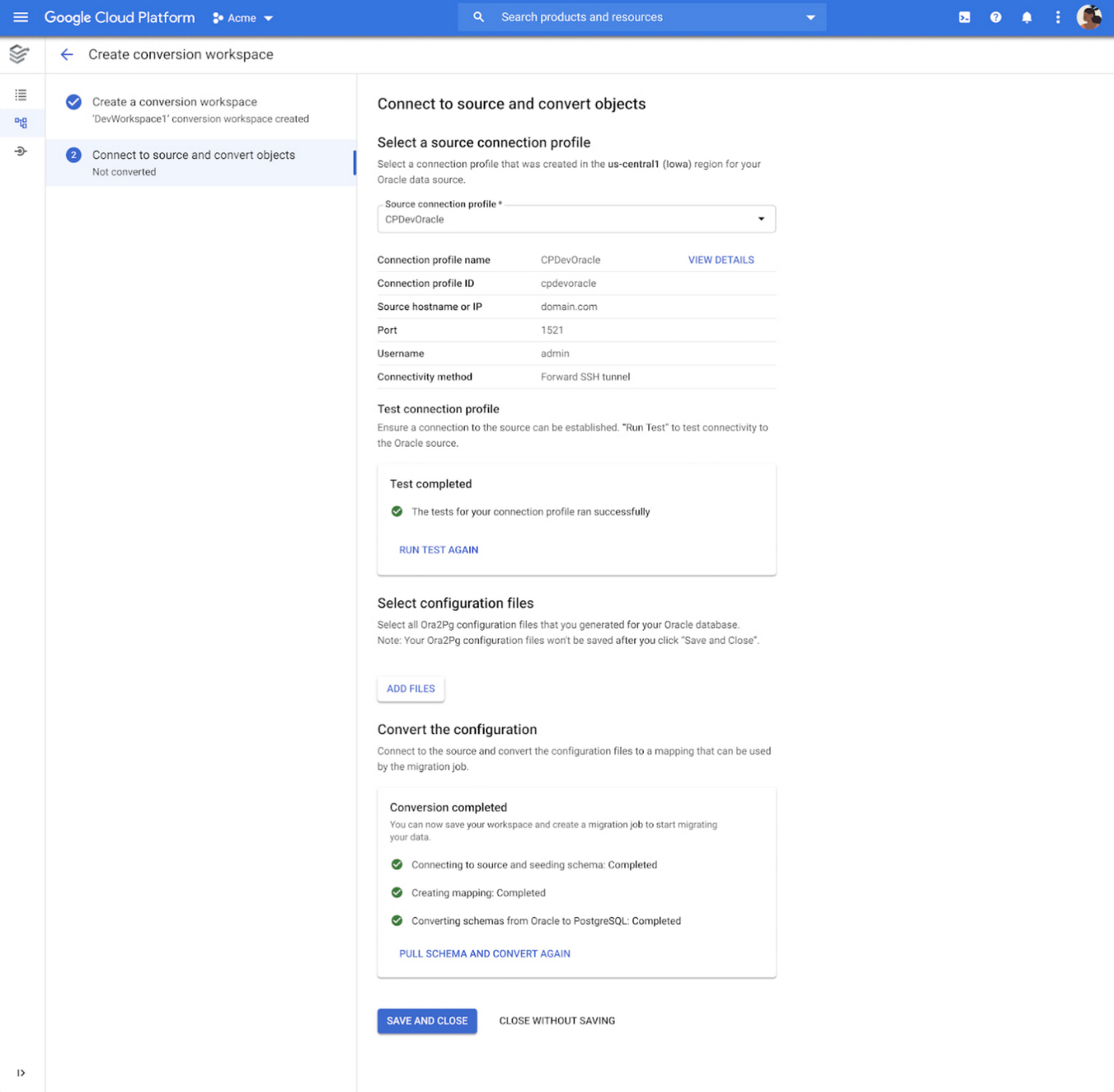
  5. Test your migration job and make sure the test was successful as displayed below, and start it whenever you're ready.

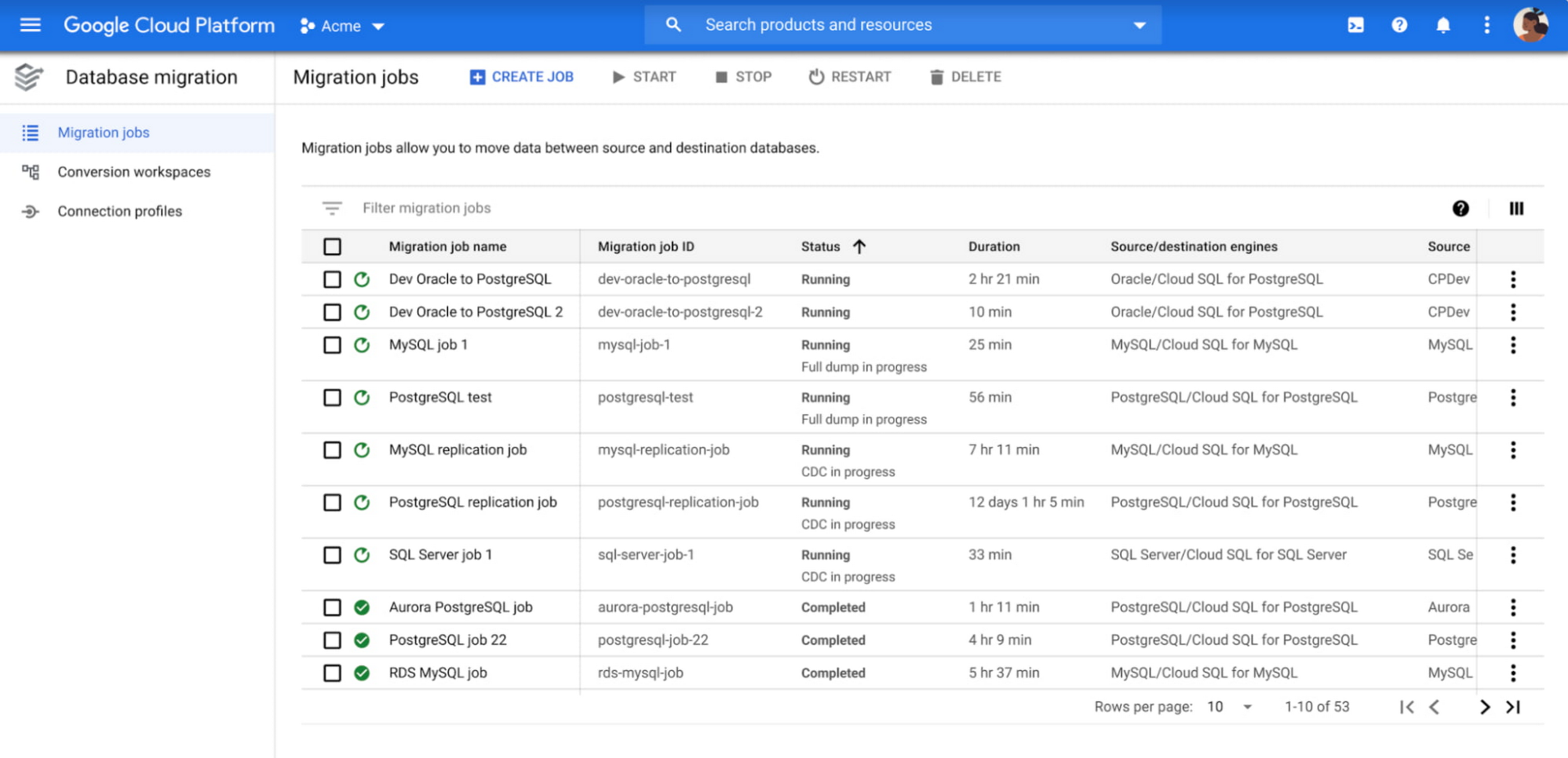
Once the initial snapshot of data has been migrated to the new destination, Database Migration Service will keep up and replicate new changes as they happen. You can then finalize the migration job, and your new Cloud SQL instance will be ready to go. You can monitor your migration jobs on the migration jobs list, as shown in the image below:

Learn more and start your database journey 

Database Migration Service schema and data migration from Oracle to Cloud SQL for PostgreSQL are available in preview in addition to the previously-announced SQL Server migration preview. If you’re interested in seeing it in action, you can request access now.

For more information to help get you started on your migration journey, head over to the documentation or start training with this Database Migration Service Qwiklab.

Spanner migrations: Automating dual-write with Antigravity CLI for minimal disruption

4 septembre 2026 à 18:00

When Google's Finance Engineering team needed to modernize their legacy data layer, they chose Spanner, a globally distributed, strongly consistent, multi-model database with high availability capabilities. But migrating to Spanner without taking production services offline was a daunting engineering challenge: As the internal team responsible for the application, we needed to manually rewrite dual-write logic across dozens of Data Access Objects (DAOs), a process that is slow and prone to human error. Further, doing so without disruption would have required implementing multi-phase dual-write architectures across every DAO in our codebase. 

To solve this, we took an alternative approach: We built an automated refactoring pipeline powered by Antigravity CLI in headless mode. This helped us accelerate our migration velocity significantly while maintaining strict data parity in our staging environments as we prepare for production. 

The challenge: Anatomy of a dual-write migration

When migrating high-throughput production services where financial accuracy is essential, simple cutover scripts do not work. You must verify that both the legacy datastore and Spanner receive identical writes simultaneously until all the historical data backfills and verifications are complete.

We structured our migration across three distinct phases:

  • Historical backfill: Copying existing historical records to Spanner while maintaining referential integrity.

  • Dual-write / dual-read implementation: Modifying every DAO to write mutations to both the primary store and Cloud Spanner in parallel during the migration window.

  • Automated API verification and parity checking: Intercepting RPC traffic and verifying end-to-end that every write lands with byte-for-byte equivalence across both stores.

1 - Dual Write Architecture

The architectural pattern is clean, but at our scale, we began to encounter friction. That’s because each DAO requires:

  • A dedicated MutationConverter class mapping complex domain models to Spanner schema columns

  • Dual-write branch handling and rollback or error-reporting logic

  • A suite of unit tests verifying both primary and Spanner writes using fake time sources and test doubles (FakeTimeSource)

Performing these identical, high-precision code changes across 30+ DAOs by hand would have taken months of engineering time.

The solution: Standardized mutation converter patterns

To verify that our automation pipeline could reliably generate clean code, we first standardized our DAO refactoring pattern around a decoupled MutationConverter interface.

Instead of embedding raw Spanner table names and column assignments directly inside core DAO business logic, we isolate Spanner schema translation into dedicated converter units:

code_block
<ListValue: [StructValue([('code', '// Example of the standardized pattern generated by our pipeline\r\n\r\ntype BpcTransferAmountsMutationConverter interface {\r\n ToInsertMutation(entity *model.BpcTransferAmount) (*spanner.Mutation, error)\r\n ToUpdateMutation(entity *model.BpcTransferAmount) (*spanner.Mutation, error)\r\n}\r\n\r\ntype bpcTransferAmountsMutationConverterImpl struct {\r\n tableName string\r\n}\r\n\r\nfunc (c *bpcTransferAmountsMutationConverterImpl) ToInsertMutation(entity *model.BpcTransferAmount) (*spanner.Mutation, error) {\r\n if entity == nil {\r\n return nil, errors.New("entity cannot be nil")\r\n }\r\n \r\n // Map domain fields to Cloud Spanner table schema\r\n cols := []string{"TransferId", "AmountCents", "CurrencyCode", "LastModifiedTimestamp"}\r\n vals := []interface{}{\r\n entity.TransferId,\r\n entity.AmountCents,\r\n entity.CurrencyCode,\r\n spanner.CommitTimestamp, // Use Spanner commit timestamps\r\n }\r\n \r\n return spanner.Insert(c.tableName, cols, vals), nil\r\n}'), ('language', ''), ('caption', <wagtail.rich_text.RichText object at 0x7f8e31a4f0d0>)])]>

By establishing a rigid, deterministic contract between the DAO and the Spanner SDK (spanner.Mutation), we created an exact target specification that an AI coding agent could reason about and generate reliably.

Why use Antigravity CLI in headless mode?

Interactive AI chat interfaces in IDEs work well for exploratory coding, but they are poorly suited for systematic, multi-file code updates across an entire codebase. When you need to apply repeatable refactoring to dozens of targets without missing edge cases, you need automated workflows.

We addressed this by building an orchestration script (migration_ui.py) that runs Antigravity CLI in headless mode (-p).

Headless mode lets Antigravity run directly inside shell scripts, continuous integration pipelines, and background automation jobs without requiring manual terminal prompts. This approach helped us scale our work in three key ways:

  • Deterministic prompt architectures: We treated our prompts as version-controlled engineering artifacts. We codified precise rules handling common Spanner edge cases — such as timestamp serialization, nullability conversions, mutation ambiguity, and FakeTimeSource test injection — directly into reusable prompt templates.

  • Batch execution and automated verification: Our orchestration script takes a target DAO name as input, retrieves the existing single-write source code and schema, and feeds it to headless Antigravity alongside our structural conventions. Antigravity generates the new converter, the refactored dual-write DAO, and corresponding unit tests. The script then runs blaze test. If a linter error or test assertion fails, the error log feeds directly back into Antigravity for self-correction.

  • Overnight execution at scale: Because the loop runs unattended, engineers can queue up 10 DAOs at the end of the day. By morning, the pipeline generates, tests, and validates 10 clean changelists ready for human code review.

Results and key takeaways for cloud engineers

Combining Spanner's distributed database primitives with Antigravity CLI's headless automation produced clear benefits across our engineering organization:

  • Significant reduction in migration effort: DAO dual-write migrations that previously required extensive manual coding and testing were completed and reviewed in a fraction of the time 

  • Highly reliable data migration: Because every generated DAO adhered to the exact same tested MutationConverter pattern and underwent automated unit testing against Spanner test doubles, we sustained high data fidelity during our extensive migration testing. 

  • Focus on higher-value engineering: Engineers avoided repetitive boilerplate refactoring, giving them time to focus on data modeling, architectural resilience, and performance optimization.

Three tips for your next database migration

  1. Decouple schema translation first: Before writing migration scripts, define a strict interface (like our MutationConverter) that isolates your new cloud database SDK requirements from your existing business logic. AI agents work best when given clear, bounded design patterns.

  2. Move from interactive chat to headless automation: When executing repetitive refactoring across more than three or four files, invest in scripted, headless workflows. Treating prompt inputs and test verifications as automated build steps help maintain quality and consistency.

  3. Let the build system act as your guardrail: Connect your AI generation loop directly to your build and test harness (bazel test or go test). This lets the model fix compile and assertion errors before a developer reviews the code.

Get started

Whether you’re migrating financial systems or building cloud-native applications from scratch, Spanner and Antigravity provide a foundation for scalable software development.

How Uber improves network reliability while unblocking cloud migration

26 août 2026 à 18:00

Uber has a lot in common with the cities it serves. Both are always changing and growing, both must carefully manage the resulting traffic to prevent congestion and sprawl.

Uber has continuously evolved its technical strategies to manage its expanding network, and this careful planning and constant evolution helps ensure that application traffic across its entire platform runs smoothly. Ultimately, maintaining a reliable, high-scale platform that operates seamlessly at any given time is key to preserving user trust.

One important solution in this effort has been application awareness on Cloud Interconnect. An industry-first tool for application prioritization across hybrid networks, application awareness on Cloud Interconnect has helped Uber prioritize critical traffic to ensure business continuity during potential network congestion events. 

Uber acted as an early design partner for application awareness on Cloud Interconnect, helping ensure that this capability met the demands of Uber’s global-scale operations. It not only improved Uber’s daily operations, it also gave Uber the confidence to move forward with a Google Cloud migration, with confidence that there would be less risk of service interruptions during switchovers. 

In this post, we’ll explain the features Uber most sought and why, the inner workings of application awareness on Cloud Interconnect, and how it can help other organizations as well.

Prioritizing critical traffic

When migrating distributed, hybrid, or multicloud applications at a global scale, network reliability becomes a primary concern. Even the most worthwhile migrations may not seem worth it if such migrations interrupt ongoing service. For organizations like Uber, moving vast amounts of data to support large data analytics workload — including emerging AI use cases — can saturate network links, resulting in increased reliability risk for their critical application traffic. 

With standard cloud interconnect approaches, enterprises typically apply simple bandwidth overprovisioning to meet extreme infrastructure needs. But with today's hybrid cloud demands, and given the size of an organization like Uber, overprovisioning network capacity for peak usage is often too costly and unreliable. 

The shortcomings of overprovisioning only become magnified with the integration of cutting-edge AI innovations. Uber needs systems in place that can take on massive data transfers without congesting its network and protecting the performance of business-critical applications.

With the benefit of application awareness on Cloud Interconnect, including the four major features of application awareness — traffic handling, congestion response, latency management, and cost efficiency — Uber was able to achieve the networking optimization its modern tech stack requires.

aai concept value prop with_without picture

Starting with a private preview, Uber deployed this feature across its infrastructure, beginning with Google Cloud Interconnect deployments in Phoenix, Arizona, and Ashburn, Virginia. Application awareness on Cloud Interconnect allows Uber to classify and prioritize end-user application traffic over less time-sensitive data using DSCP marking and configured queuing profiles.

In the following chart, we look at the four key features of application awareness on Cloud Interconnect, how they differ from legacy approaches, and how they help provide better operational continuity for organizations like Uber. 

Feature

Standard interconnect solutions

Application awareness on Cloud Interconnect

Traffic handling

All traffic treated equally (first-in, first-out)

Traffic classified into six distinct traffic classes

Congestion response

High-priority application traffic may be dropped during bursts

Business-critical traffic is protected via strict priority or bandwidth sharing policies

Latency management

Unpredictable latency for high priority applications

Predictable and consistent low-latency for time-sensitive workloads

Cost efficiency

Requires expensive overprovisioning to absorb peaks

Efficient bandwidth utilization and lower TCO

Uber's key takeaways

For Uber, the business value of being able to prioritize business-critical traffic on its networks by deploying application awareness on Cloud Interconnect was immediate. And in doing so, Uber has also created a blueprint that other enterprises with similar hybrid cloud challenges can replicate. The core elements of that blueprint include:

  • Ensuring business continuity: Uber can decide in real time which application traffic to prioritize during major, high-traffic events. This means that mission critical applications stay up and running during even extreme events (both planned and unplanned). Uber leadership has called application awareness on Cloud Interconnect important for its global operations. 

  • Efficient bandwidth utilization: Instead of blindly overprovisioning bandwidth to prevent congestion, application awareness allows Uber to better utilize their existing Cloud Interconnect capacity aligned with their expected network bandwidth needs. The result is lower total cost of ownership for network infrastructure.

  • Unblocked workload migration: By protecting critical applications from network congestion, Uber was able to migrate significant workloads to Google Cloud and, in the process, dramatically reduce operational overhead.

"Application awareness on Cloud Interconnect was the key that unlocked our ability to migrate more strategic workloads to Google Cloud and is critical for maintaining service reliability during peak global demand. By allowing us to intelligently prioritize traffic, it helps us ensure that we can protect our higher priority services and make our infrastructure more efficient, lowering our total cost of ownership. This wasn't just a feature deployment; it was a deep engineering partnership that delivered a solution critical to our business." – Harry Liu, Director of Engineering, Uber

Securing network reliability for AI and beyond

As more enterprises integrate cloud-based AI models, distributed applications, and data analytics, it's becoming a business imperative to be ready to handle the massive data transfers that follow. But in doing so, they also have to ensure they never compromise the reliability of their critical applications. 

With application awareness on Cloud Interconnect, Uber demonstrated that moving beyond simple bandwidth overprovisioning to protect business-critical traffic was an essential step to building the stability required to embrace modern hybrid and multicloud strategies.

You can read our blog about the potential of Cloud Interconnect across industries to learn more about what the service can bring to your organization, and if you’re ready to explore more, our team of networking and industry experts are ready to help.

New AI-powered quick assessments in Migration Center turbocharge modernization

24 août 2026 à 18:00

Technology leaders are under mounting pressure to modernize infrastructure, control multi-cloud operational spend, and build data foundations for generative AI. However, the discovery required for that level of transformation can entail weeks of manual spreadsheet analysis, mapping in-house infrastructure, and reconciling siloed, piecemeal cost estimates across disparate teams and sources. To help, we’re announcing AI-powered Quick Assessments in Migration Center, which delivers near-instant total cost of ownership (TCO) modeling and automated service mapping.

Compare this to legacy assessment processes, which can stall digital transformation initiatives before they even launch. Manual discovery can delay migration timelines by months, increase engineering overhead, and often miscalculates complex financial models. By replacing manual discovery with AI-assisted automation, IT gains instant, actionable visibility into the TCO and return on investment (ROI) for a given migration initiative. 

Now, organizations can generate comprehensive migration financial models in minutes rather than months. Teams ingest raw infrastructure data or cloud billing reports and quickly receive an optimized target bill of materials (BOM), service mapping coverage, and projected savings. Decision makers interact with an agentic assistant that explains underlying financial assumptions, recommends technical cost optimizations, and exports ready-to-share executive reports.

Inside the AI-powered Migration Center

This is made possible with AI-assisted Quick Assessments alongside enhanced Cloud Billing assessment capabilities, both integrated into the new AI-powered Migration Center.

AI-assisted Quick Assessment for on-premises workloads

Designed for enterprise customers and partners, AI-assisted Quick Assessment automates on-premises infrastructure evaluation to provide rapid financial modeling. Let’s walk through these new capabilities: 

  • Instant Compute Engine TCO estimates convert VMware inventory exports (such as RVTools) or aggregated infrastructure inputs into precise Compute Engine cost targets:

1

Migration Center’s Quick TCO Estimator

2

Migration Center’s Quick TCO Estimator results page

  • Advanced architecture modeling supports latest-generation Gen4 compute instances and high-performance Hyperdisk storage pools:
3

Migration Center’s Quick TCO Estimator detailed results page

  • Customizable financial controls allow teams to adjust on-premises baseline cost assumptions to match internal accounting standards:
4

Migration Center’s Quick TCO Estimator detailed results page (continued)

  • Context-aware agentic chat recommends tailored technical cost optimizations aligned with your specific business constraints (such as regional location or compliance needs), clearly explaining the underlying logic and financial assumptions.
5

Migration Center’s agentic chat capabilities

6

Migration Center’s agentic chat capabilities (continued)

7

Migration Center’s agentic chat capabilities (continued)

  • Automated Business Case and Google Sheets export generates ready-to-use reports capturing the complete recommended BOM, TCO comparison, and ROI analysis:
8

Migration Center’s business case

9

The path forward

Modernizing your infrastructure starts with fast and accurate data. Migration Center’s Gemini-powered features simplify cloud evaluation, empowering IT decision makers to build defensible business cases generated by machine-learning.

Try Migration Center directly in the console today, or take a free migration and modernization assessment to evaluate your workloads and accelerate your strategic cloud journey with Google Cloud.

❌