 Connexion
Secure, intelligent experiences across every endpoint
For years, the workday looked remarkably consistent. Employees logged into devices, opened browsers and toggled across a dozen disconnected applications. Users acted as the bridge between apps, copying from one tab and pasting into another. Now, agentic workflows that are faster and allow employees to be even more productive are on the rise. Employees take the lead in defining outcomes of workflows, and autonomous AI agents can execute multi-step business processes end-to-end. This saves time spent on manual redundant tasks and allows the workforce to focus on more complex and strategic work.

Employees’ endpoints require an updated approach and architecture to enable the productivity benefits of this new way of working while ensuring security. Our collection of Google Intelligent Endpoints support this evolution by offering secure end-user computing solutions across our enterprise browser, operating systems, and hardware, all unified by built-in contextual intelligence, powerful AI models, and flexible management options for enforcing policies. An intelligent endpoint strategy transforms workforce productivity, reduces security risks, and prepares enterprises for the agentic AI era and beyond.
![[WIP] Enterprise Summit 2026 Breakout - Securing the Intelligent Endpoint_ Defending against shadow AI and increasing vulnerabilities (1)](https://storage.googleapis.com/gweb-cloudblog-publish/images/WIP_Enterprise_Summit_2026_Breakout_-_Secu.max-1000x1000.png)
Scaling daily workflows for time savings
Supercharging productivity by embedding intelligence directly into the platforms and apps where work naturally happens is at the core of Google’s end user computing strategy, making the browser a critical intelligent endpoint.
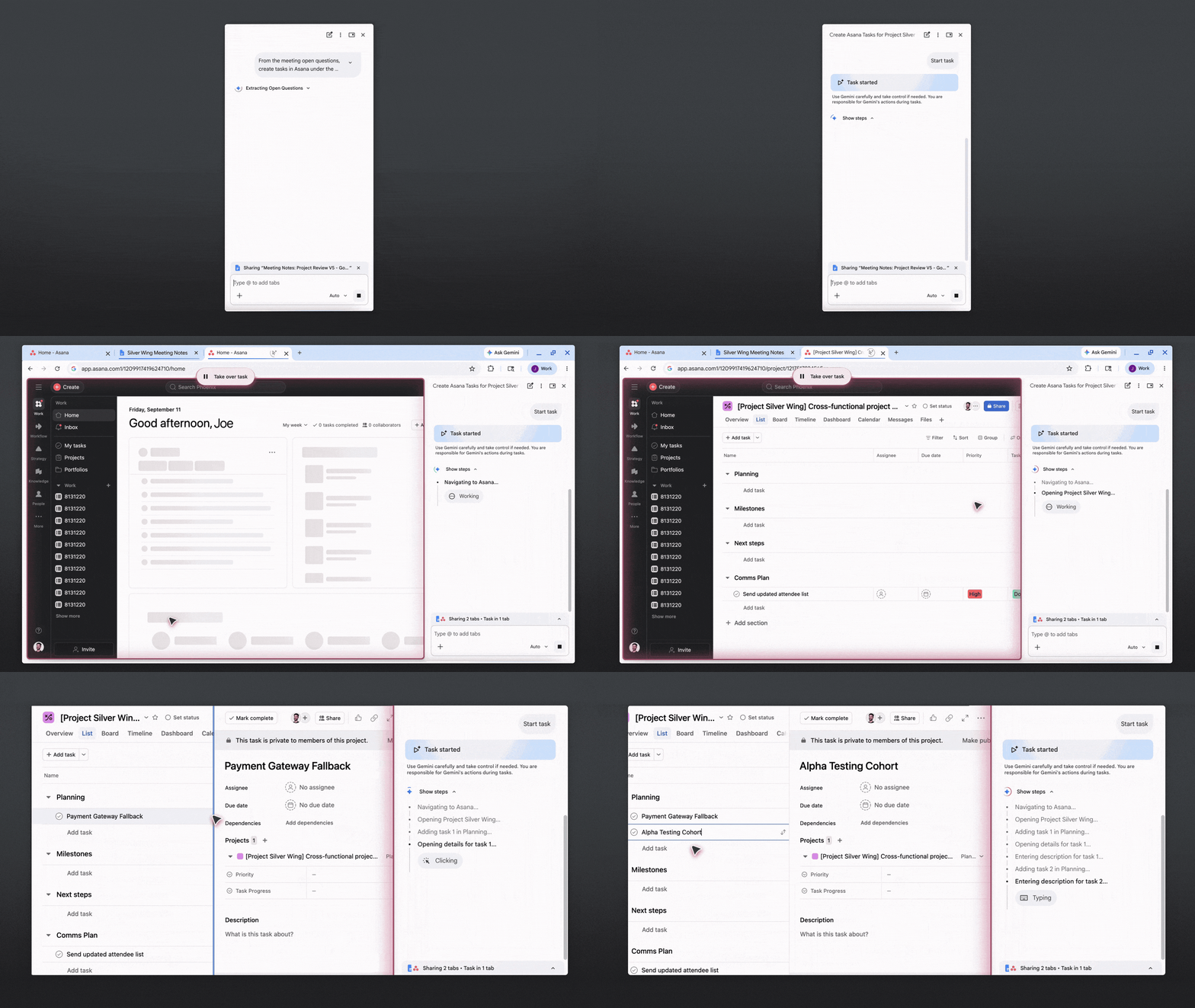
Earlier this year, we brought agentic capabilities directly to the browser in Chrome to allow employees to automate complex, multi-step tasks across multiple tabs natively. Whether it’s automating lead tracking in CRM tools or orchestrating workflows in tools like Asana, task automation built into the browser gives employees time back from repeated tasks that take place across the web.
The new enterprise Skills library also helps Gemini in Chrome offer business users more help for repeatable tasks. Through our trusted tester program, IT teams can now also publish pre-configured, IT-vetted AI Skills directly to a dedicated library, giving managed users a central hub to discover and deploy standardized, company-approved workflows. This makes it easier for employees to get help with everyday tasks, without having to write prompts from scratch.

Gemini in Chrome capabilities are being made available to businesses in even more regions and to more Google Workspace customers. See the full list here.
Moving to modern, secure endpoints doesn't mean compromising on your core business tools or existing systems. Chrome Enterprise Premium provides a seamless, highly secure foundation for your legacy applications as well. Cameyo by Google allows organizations to stream any legacy application directly inside a Chrome tab.
This powerful combination ensures your legacy apps inherit browser-based security protections through Chrome Enterprise Premium, alongside the productivity-boosting AI and agentic capabilities of Gemini in Chrome, breathing new life into older tools without forcing employees to leave the browser.
Strengthening proactive security and visibility
Today, a new threat vector has emerged. Employees who want to get work done, but accidentally leak sensitive data into public AI tools. In fact, nearly 80% of workers are bringing their own AI tools to work, and over half report pasting sensitive intellectual property and corporate data directly into public systems.* Google Intelligent Endpoints help keep organizations more secure by protecting data across the operating system, browser, and user levels, offering a scaled defense against modern threat vectors, without slowing down employees.
Using Chrome Enterprise Premium, IT and security teams can already enforce strict, granular data loss prevention rules to protect corporate data within the browser. While native third-party LLM applications may offer basic data privacy settings, they lack the active DLP controls needed to prevent data exfiltration. Without Chrome Enterprise Premium, enterprises are forced to use complex security solutions, and even those solutions often fail to cover unmanaged or personal devices.
IT departments can soon deploy DLP rules that actively detect and block attempts to copy sensitive records at the copy trigger level in the browser, ensuring that sensitive data is prevented from even reaching the system clipboard. This capability is even more critical in protecting company intellectual property across AI services. Many more browser-based DLP capabilities have also been extended to mobile devices, including file downloads, pasted content and screenshot blocking and sharing, further closing the security gap across devices.
We’ve also made improvements to Chrome Enterprise’s GenAI reporting capabilities. IT and security teams can view comprehensive, real-time breakdown of AI and SaaS usage across the web, and now they can also take corrective action right from the report. With a few clicks, IT can block access to risky apps, update security policies, or redirect users to company-approved AI alternatives.

Powering your workforce with next-gen devices
Google Intelligent Endpoints deliver continuity for employees across a wide variety of modern devices designed for the next-generation workloads. They bring together the benefits of proactive and consistent experiences as people work across different devices throughout their work day.
Chromebook Plus already offers the performance and integrated Gemini capabilities on managed devices to assist users within their existing workflows today, bringing more help to employees right in the app, file or tab they are working in. And earlier this week, we announced the Googlebook, the perfect companion for those building and working at the frontier. They will be available in October, with enterprise capabilities coming in the second half of 2027.
Googlebooks will bring even more interoperability benefits across our Android ecosystem, including mobile devices. The latest Google Pixel 11, Pixel 11 Pro, Pixel 11 Pro XL, Pixel 11 Pro Fold and Samsung Galaxy S26 Ultra, Samsung Galaxy Z Fold 8, Samsung Galaxy Z Fold 8 Ultra, and Samsung Galaxy XCover7 Pro are all devices that increase productivity and allow for seamless work. With Android Enterprise, IT teams can manage the AI capabilities on all of these devices to ensure that while their company is advancing, data remains secure and protected.
Android continues to expand its multi-form factor offerings to help employees extend their work effortlessly across different device types. Our Android XR platform transforms lightweight enterprise-grade smart headsets and wired glasses into private, multi-monitor workstations anywhere employees go. IT departments can seamlessly provision, secure, and deploy these spatial computing devices using the exact same mobile enterprise controls they already use to manage corporate smartphones and tablets. Check out our blog for more news on Android Enterprise.
Intelligent endpoints can also drive more human-to-human connection. To bridge the distance for distributed teams, Google Beam, our true-to-life 3D video communication platform powered by Google AI, delivers an immersive meeting experience that makes employees feel as if they are together in the same room. These devices are expanding to more countries through a wider partner network to help more organizations elevate their virtual meeting experiences.
How to get started with Google Intelligent Endpoints
There are several ways to learn more about Google Intelligent Endpoints.
- Learn more about how our platforms and devices come together as Google Intelligent endpoints here.
- Ready to get started? Start your Chrome Enterprise Premium trial to get advanced in-browser protections.
- Lenovo Digital Workplace Solutions with Google is also bringing the entire workplace together as one secure, modular solution. You can simplify IT and govern AI with confidence, extending at your own pace, with one accountable partner doing the heavy lifting.
*Forbes 2026 "BYO AI" Workplace Report & Airia Shadow AI Statistics Report