❌

Vue lecture

From Dockerfile to Kit: the Docker Sandboxes Kit Specification

Agents need containment, and a sandbox is only half of it. Something still has to say which agent runs there, what it gets, and what it may touch. That is a Kit: an ordinary OCI image, so the answer travels with the agent and means the same thing on any conforming runtime. Today we published the Docker Sandbox Kit Specification v3, open source under Apache 2.0 at docker/sandbox-kit-spec. Here is why I wrote it.

Everything that makes an agent useful is a grant

I run a lot of agents. They write code, run tests, install dependencies, call APIs, and work on infrastructure while I do something else. None of it happens without access, so I grant it one piece at a time: a bind mount, a token with broader scope than the task needs, a firewall rule that was quicker to open than to narrow. Each grant is reasonable on its own. Together they take back the isolation I was relying on, and none needed an exploit. The holes are configuration, added on purpose, usually by me.

I am worse at taking any of it back, and I could not reproduce the grants my setup depends on. No file records them. They live in shell history, dashboards, and my memory. I cannot hand that to a colleague or diff it against last week.

Containers package applications. Sandboxes contain agents.

A container packages applications. It shares the host kernel and uses namespaces and cgroups to give one fixed workload its own view of the filesystem, network, and processes. That is the right tool for software that runs, does its job, and touches only what it was handed.

An agent, however, is a probabilistic actor. It decides what to do next and then does it, to my filesystem, network, credentials, and cloud account. It will install a package that needs root, open a port nobody planned for, and try the next thing when the first is blocked. A container was not built for that: the boundary is the same kernel the actor is probing.

A Docker Sandbox is a microVM with its own kernel, so the boundary sits below anything the model can reach or rewrite. Inside one I can hand an agent root and let it loose, because the damage stops at the sandbox boundary. The sandbox is what lets me run an agent with the safeties off.

But an empty sandbox is not an environment. Something still has to say which agent runs, which tools and MCP servers it gets, which skills and instructions shape it, and exactly what it may touch.

What a Dockerfile cannot say

A Dockerfile answers everything about the software itself: how it is built, what gets packaged, how it starts. It was never standardized; OCI standardized the image it produces and how registries distribute it. What a Dockerfile does not describe is the outside: networks, credentials, volumes, tools, context. That half has lived in docker run flags, a Compose file, a CI config, and someone’s memory. Unversioned, unreviewable. A Kit writes it down with the content.

One image, one digest

If you have used sbx, you have used Kits. This is the third version of the format, and the change that matters is that a Kit is now an ordinary OCI image rather than its own artifact: no media type, no sidecar file, nothing for a registry to learn. The manifest carries the declarations in one annotation, vnd.docker.sandbox.kit.descriptor; the layers carry the content.

A Kit therefore builds with docker buildx build, pulls with docker pull, gets scanned and signed by the tooling you already run, and works in a FROM. Pinning the digest pins content, declarations, and metadata together. The tooling and distribution path are free; the format is something you learn: a grammar, a page per capability type, provides and requires, kind: set.

Two kinds of Kit exist. A workload runs and supplies the root filesystem. A mixin is an overlay: a CLI with its network rule, a credential binding, context for an agent. You launch one workload and any number of mixins.

Authority you can read

Part of the GitHub CLI mixin in the repository:

capabilities:
  - type: com.docker.sandbox/network-policy@2
    config:
      runtime:
        allow:
          - github.com
          - hosts: [api.github.com]
            methods: [GET, HEAD, POST, PATCH, PUT, DELETE]
        deny:
          - hosts: [api.github.com]
            methods: [DELETE]
            paths: [/repos/**]

  - type: com.docker.sandbox/credential@1
    optional: true
    config:
      service: github
      phase: runtime
      apiKey:
        name: GH_TOKEN
        proxyManaged: true
        inject:
          - {domain: api.github.com, header: Authorization, format: "Bearer %s"}

Read it as a permission slip. This Kit asks to reach GitHub and nowhere else, and for most of the API but not deletes under /repos/**, because deny wins. The token that can open a pull request cannot delete the repository. The credential is proxy-managed: a conforming runtime injects the real value into requests to the named domains, and inside the sandbox there is only a sentinel.

Two words carry weight: asks and conforming. A Kit grants itself nothing. Each entry is a request, and the host decides. A conforming runtime, one that implements the behaviour the specification describes, blocks hosts not on the list. Without one, the annotation is inert: an image and no enforcement. Docker Sandboxes is the first conforming runtime.

Everything a Kit needs goes through that one list, typed and versioned. Grants (network rules, credentials, volumes, ports, devices, skills paths) count toward “what may this Kit do”; entries that ask the runtime to act, like a lifecycle hook, do not. A required request the host cannot satisfy refuses the launch, rather than starting an agent with less authority than it declared, or more.

Composition is a function, not a sequence

Container images never solved multiple inheritance: a Dockerfile stage has one FROM. Mixins are overlays ordered by the dependency graph the Kits declare through provides and requires, never by the order you typed the flags, so the same set always composes to the same image.

The resolver is strict on purpose. Every requires is satisfied from inside the set or resolution fails; nothing is fetched to cover a gap. Exactly one workload is allowed. Two Kits providing the same name fail rather than one silently shadowing the other (composing the Claude workload with the Claude mixin is the canonical mistake). Where Kits overlap, declarations reconcile: network rules union, hooks run in dependency order, guidance becomes one document, licenses union. Incompatible requests are an error, not a coin flip.

A kind: set descriptor names other Kits; publishing it runs the same coherence rules at build time and merges them into one ordinary Kit. An incoherent set fails at your build, not at someone else’s launch.

The diff is the review

The Claude Code Kit in the repository declares the hosts it asks to reach, its credential, the volumes that persist between sessions, and its install and startup hooks. When the next version asks for another host or a second credential, that is a change in authority, not a software update, and it shows up in the pull request as added lines a human can refuse.

Review depends on somebody reading the diff, so the specification defines a second gate that does not. Every descriptor reduces to a normalized set of everything the host would have to grant; a runtime that gates updates records that set and compares the next version against it. A version inside what was granted may apply without asking. Any widening stops and asks, and removing a deny rule counts: if a later gh Kit dropped DELETE /repos/**, the runtime holds the upgrade. That is why the declarations had to live in the artifact, not beside it.

Why this is a specification and not a feature

A Kit that stopped meaning anything when run somewhere else would be lock-in, not a trust boundary. So the grammar is normative, every capability type has its own page describing what a conforming runtime must implement, and types version independently (network-policy@1 and @2 both exist today). Two conformance suites ship with it: one judges whether an artifact is a conforming Kit, the other whether a runtime behaves as the pages say. Every normative statement is covered by a check or a written waiver.

Docker maintains the specification today, and it should not stay under a single vendor: a format for deciding what an agent may do is worth less if it belongs to whoever sells you the runtime. Docker Sandboxes will be a first-class implementation, not the only one. If a Kit you want cannot be expressed, or a runtime duty cannot be implemented as stated, open an issue.

Try it

sbx is our sandbox CLI (brew install docker/tap/sbx). From a checkout of the repository:

cd examples
sbx run ./hello --kit ./gh .

Edit a descriptor and only that Kit rebuilds; docker buildx build publishes it to any registry. Docker Cloud Sandboxes runs the same Kits with the same trust model on elastic capacity. The specification, capability pages, and a worked tour are in docker/sandbox-kit-spec.

Not only agents

Agents forced this into the open because the authority they ask for is so large, but ordinary workloads have always arrived with unwritten expectations: the endpoints they call, the credentials they need, the volume that must survive a restart. That knowledge has lived in a Helm chart, a runbook, or a colleague. It is the same gap, less alarming when a web service gets it wrong. This specification is where any software writes down what it needs from the world around it; agents were the case urgent enough to have it built.

Dockerfiles made software reproducible. Kits make authority reproducible.
  •  

YOLO Mode: Agent Autonomy Without the Guardrails

AI agents have come a long way in both capability and everyday use since generative AI went mainstream in late 2022. In Stack Overflow’s 2025 Developer Survey, 84% of developers said they use or plan to use AI tools in their workflow, up from 76% a year earlier. As those tools shift from suggesting code to writing files and running commands on their own, one practical question follows. How much should an agent be allowed to do without stopping to ask? Turn that dial all the way up and you reach what developers call YOLO mode.

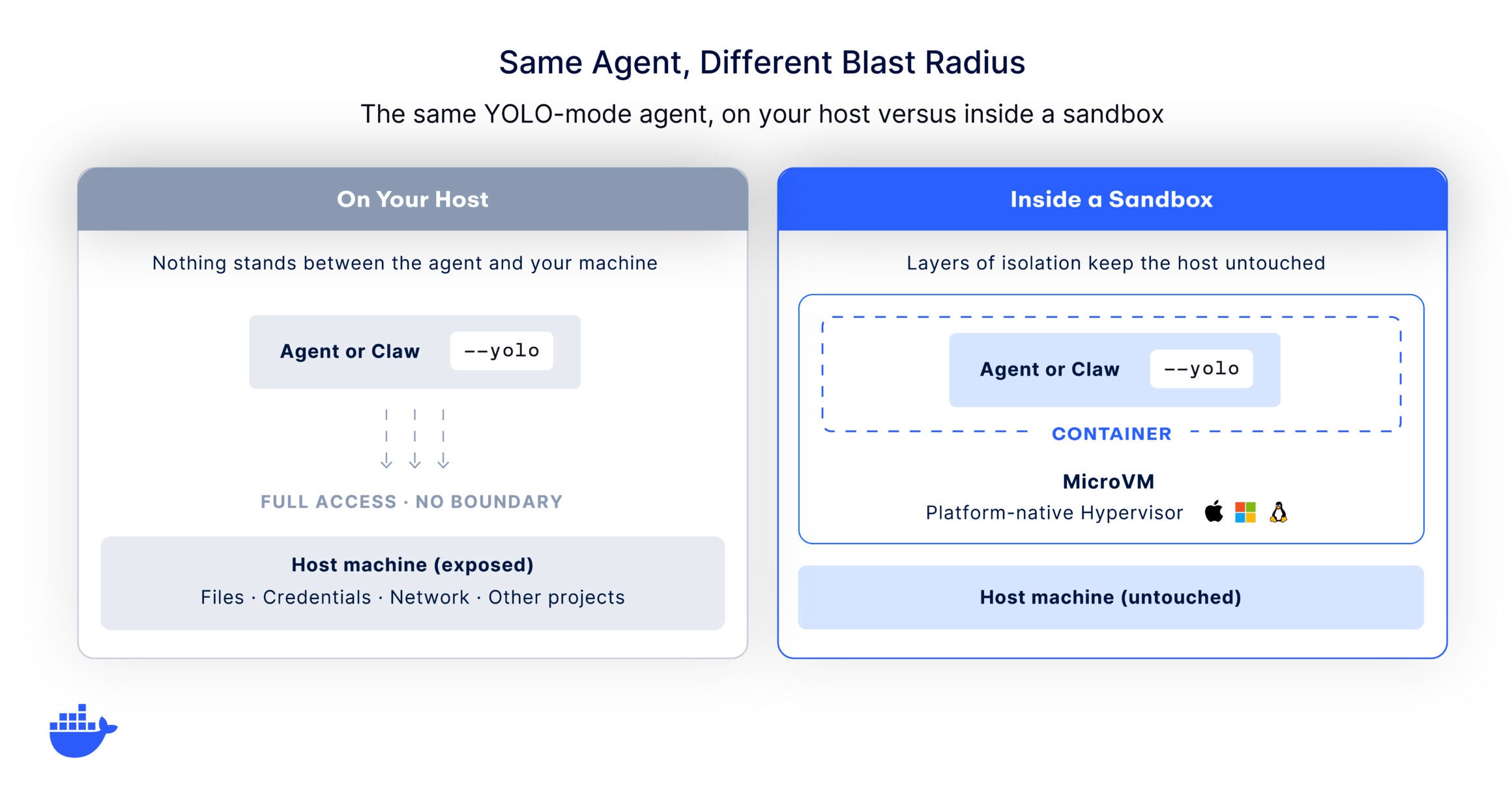
It’s worth understanding YOLO mode before you enable it, because its main risk is easy to misread. The risk comes down to where an agent runs.  On your own machine, one mistaken command can delete  files, expose your credentials, and make network requests you may not want. Inside a proper boundary, however, developers can use agents in YOLO mode to unlock a new level of productivity, without jeopardizing security.

Key takeaways

  • YOLO mode is when an AI agent auto-approves every action, with no confirmation prompts.
  • It’s popular because it’s fast, and risky for the same reason. The danger isn’t the autonomy, it’s where the autonomy runs.
  • On your host, a bad command or prompt injection reaches real files and credentials. Inside an isolated sandbox, the blast radius is contained.
  • Run YOLO mode where it can’t do real damage, in an isolated, disposable environment with scoped access and no real secrets.

What is YOLO mode?

YOLO mode is the community nickname for running an AI agent with every action auto-approved. When turned on, agents can read files, write code, run shell commands, and call tools without stopping for user approval. While in Claude Code it’s the –dangerously-skip-permissions flag, other common agents each have their own version of the same switch.

  • Codex CLI has `–full-auto`, plus `–dangerously-bypass-approvals-and-sandbox` when you drop the sandbox too.
  • Gemini CLI uses `–yolo`, or the Ctrl+Y toggle mid-session.
  • GitHub Copilot CLI has `–allow-all`, also aliased as `–yolo`.
  • Cursor exposes it as auto-run in settings rather than a flag.

The names differ, but the behavior is the same: remove the prompts and let the agent go. 

YOLO mode showed up in Cursor first, then Claude Code, and by 2026 it’s a standard toggle in most coding agents. But when people ask what YOLO mode is, they’re usually asking whether they should use it, and the answer is that it depends entirely on where the agent is running.

Why developers turn it on

On a regular task, a careful agent asks for permission constantly. “Can I edit this file, run this test, install this package, call this tool?” 

Dozens of prompts for one feature. While these constant permission requests can help prevent agents from going rogue, each approval forces you to context switch and breaks the flow that made the agent worth using. A few reasons why developers are leveraging YOLO mode include:

  • Context switching: Every approval pulls a developer out of their flow, taxing mental focus and overall productivity. 
  • Prompt fatigue: Excessive querying, refinement, and approvals force creative coding to take a back seat to tedious prompt wrangling and debugging.  
  • Low-risk, routine work: Agents can often handle repetitive tasks that would otherwise take developers away from creative coding and innovation. 
  • Momentum: An agent is most useful when it has the freedom to keep moving, but a steady stream of prompts breaks that.

If you turn approvals off, these friction points disappear for the most part, and the agent can deliver the speed it promised. But what’s the cost of giving agents the autonomy of YOLO mode?

Why is YOLO mode risky?

When you remove the prompts, you remove the last human check before an action runs, which amplifies the security risks agents already carry. If the agent is working directly on your host, that action has the full run of your machine, including your files, environment variables, credentials, and network. A confused or compromised agent can do a significant amount of damage when nothing stands between an agent’s decision and your system.

On an unprotected host, YOLO mode introduces risks such as:

  • Destructive commands: A vague or mistaken instruction runs something like rm -rf against the wrong directory, and nothing pauses to catch it.
  • Secret and credential exposure: The agent can read environment variables, .ssh keys, tokens, and .env files, then use or leak them.
  • Prompt injection: The agent acts on whatever it reads, so a hidden instruction in a web page, an issue, a code comment, or a document can redirect it, and the attacker never needs access to your machine.
  • Data exfiltration: A mistaken or hijacked agent sends sensitive data out over the network.
  • Unintended broad changes: Edits and config changes reach past the task at hand into your other projects.
  • Network and lateral reach: The agent can hit internal endpoints and outside services, or act with your credentials to push code and call APIs.

And unfortunately, keeping manual approvals on doesn’t remove all risk. Once permission fatigue kicks in, it can be all too easy to accidentally approve the wrong request. So the safeguard belongs in the environment the agent runs in, where a bad command or a tired click has a greatly reduced scope of impact.

The fix isn’t fewer permissions, it’s a boundary

If prompts aren’t the answer, what is? A boundary the agent can’t cross. Guardrails only work when something outside the agent enforces them. The agent needs a bounding box, with constraints set before it runs and clear limits on what it can touch. Inside that box, it should be free to move as fast as it wants. The goal is to shape the environment so that a mistake can’t damage your systems or leak your secrets.

Comparing YOLO mode with and without a sandboxed environment.

In practice, that means running the agent in an isolated, ephemeral environment instead of on your host. Done well, the agent gets a real place to work. It can install packages, run services, and edit files, but it can’t see your credentials, reach your other projects, or touch the host.

Unlike a container that shares the host kernel, a microVM puts a hardware-level boundary around the agent, so the isolation holds even if the agent tries to break out, and it does that without the speed penalty people expect. If a run goes sideways, you destroy the environment and start clean. This is the core idea behind sandbox security and why agents need isolation in the first place.

What does YOLO mode look like at scale?

For one developer on a sandboxed laptop, YOLO mode is a personal choice. Across a team, it becomes a policy question. A hundred developers each deciding on their own when to skip permissions is the ungoverned-autonomy problem that keeps security leaders up at night. The picture that works at scale is one where the safe path is the default. Every agent runs inside an isolated, disposable environment, configured once at the organization level so it holds for everyone.

This is the problem AI Governance is built to solve. You define the rules once across the surfaces that matter, network access, the filesystem, and the tools an agent can reach, then enforce them automatically at every developer’s machine. Governance turns a per-developer judgment call into a consistent, repeatable capability. Clear boundaries are what let an organization extend autonomy to its agents while keeping the risk contained. Once the boundary is standard, YOLO mode is fast and safe for everyone.

What it unlocks for developers

Once the boundary is in place, the developer can stop supervising every step, and the payoff kicks in:

  • Deep focus: Give direction, step away, and come back to a cloned repo, passing tests, and an open pull request. No interruptions pulling you off your own work.
  • Long, autonomous runs: The agent edits, runs the tests, reads the failures, and retries until the task is done, the kind of run a wall of prompts would stall.
  • Agents in parallel: Point several at different tasks, each in its own disposable environment, and let them run at once.
  • You review the outcome: Your job moves up to the pull request, the tests, and the diff, where your judgment matters most.

That’s the real appeal, and the sandbox is what makes it safe to lean on.

Unlock agent autonomy, safely

YOLO mode is really a question in disguise. How much autonomy can you give an agent before the risk outweighs the speed? Framed that way, the answer stops being about the agent and starts being about its environment. Give an agent the run of your laptop and even a small mistake is expensive. But give it a boundary it can’t cross and you get the speed with almost none of the exposure.

That’s exactly what Docker Sandboxes is built for. Each agent runs in its own disposable microVM with control over networking, filesystem access, and resource limits, so you can run agents in YOLO mode safely from day one. For teams that want those boundaries applied consistently rather than agent by agent, Docker AI Governance sets and enforces the rules everywhere developers work. Define the box. Then let the agent go as fast as it likes.

Get started with Docker Sandboxes → 

Explore Docker AI Governance →

Frequently asked questions

Is YOLO mode safe?

It depends entirely on where the agent runs. On your host machine, YOLO mode is risky, because a mistake or a prompt injection can reach your files and credentials. Inside an isolated, disposable environment with scoped access and no real secrets, the blast radius is contained and YOLO mode is reasonable to use.

What does –dangerously-skip-permissions do in Claude Code?

It turns off the confirmation prompts, so Claude Code reads, writes, runs commands, and calls tools without asking for approval at each step. It trades the safety of human review for speed. It’s the most common way people run Claude Code in YOLO mode.

How do I use YOLO mode safely?

Run the agent inside an isolated sandbox rather than on your main machine, give it scoped network access and throwaway credentials instead of your real ones, work against a cloned or disposable copy of your project, and keep a way to inspect what it did. The goal is a boundary the agent can’t cross, not a more careful set of prompts.

Is auto mode the same as YOLO mode?

Not exactly. Full YOLO mode approves everything. Some tools now offer a classifier-gated auto mode that runs safe actions automatically while still blocking or flagging dangerous ones. That’s a useful middle ground, but it’s a filter on top of the agent, not a boundary around it. Isolation still matters.

  •  

Secure by default is your only way forward

Every worker a company employs, be it a person or a program, builds on a foundation someone else assembled, and that includes the newest hire on your team. This new hire got to work the moment they arrived, building with what your company already has in place and they’re shipping code at a pace your reviews can’t keep up with. Also, everything they make is going out under your name. If it were a human, they’d spend the first week asking where things live and who maintains what. This one never asks. It treats everything it finds as trustworthy, so everything it builds carries that unexamined trust forward. And because this new hire is an agent that’s working all night at machine-class throughput, the foundational problems that used to surface slowly now surface all at once.

The foundation that nobody audited

The line between a supply chain attack and an AI attack no longer exists. Take a look at what the average foundation holds, because most of it comes from outside the company. For a long time now, public base images have carried hundreds of packages that your application never uses. Every one of those packages adds to the attack surface. Almost none of them ever get reviewed because no team has time to read code it didn’t choose and doesn’t use. In most stacks, something like a ten-year-old Java service is keeping the business running on software whose maintainers stopped patching years ago. Platform teams have been coping in their own ways, usually with a golden-image program somebody built years ago and a scanner pointed at it all. Because the images underneath are so bloated, that scanner cries wolf about four hundred times a week. All of this together is why audit season now eats up most of a quarter.

Attackers know all of this, and they’ve been working on the foundation layer all year. They’ve poisoned packages and developer tools, and they’ve had real success harvesting coding-assistant credentials at scale. Most foundations were built for a world that no longer exists.

What a good foundation takes

The good news is that none of this is unsolvable. A foundation can be strengthened to carry what’s now being built on top of it. It has to meet a few requirements, and each one depends on who does the security work, because when the vendor doesn’t, your team picks up the slack. A foundation holds when every part of it is built from source by someone who signs the work and stands behind it. Nothing should ship that your application doesn’t need, because anything extra adds surface area to defend later. Patching needs the same treatment because new vulnerabilities keep landing no matter how clean an image starts. A fix should come with contractual backing and a date. You should know exactly what’s inside every image the day it ships. And none of this should force you to move your stack onto a different distribution just to get safer images. A migration like that becomes a quarter-long project in its own right, and the foundation can’t protect anything until the move is complete.

This is exactly what Docker Hardened Images were built for. They stay compatible with the Alpine and Debian images teams already run, so adoption amounts to a one-line change to the FROM line in your Dockerfile, with no migration project attached. The images are also minimal by design, carrying only what your application needs, which reduces the attack surface by up to 95% and leaves near-zero critical and high CVEs from day one. The difference is immediately visible in scanning. Scans complete much faster with low noise, and the few findings that do remain are worth directing the team’s attention to. When a CVE does get disclosed, the remediated image is available within seven days of the upstream fix, and what once consumed a sprint of engineering time closes as a pull request. The same evidence carries through to audits, which most organizations will eventually face. Every hardened image ships with a signed SBOM (Software Bill of Materials) and build provenance, a verifiable record of the image’s contents and build process. You present auditors with proof that already exists, and no one needs to spend weeks reconstructing it.

Furthermore, a hardened base image by itself may not be enough, because minimal images almost always need customization before they fit production workflows. Teams add their own CA certificates and init scripts, install additional system packages through apt and apk, or adopt separate products entirely to cover what the base image cannot, fragmenting their foundation across vendors. That’s usually where a hardened foundation breaks down, because customizing an image invalidates the provenance and the SBOM, and with them the assurances you paid for. Not with Docker.

Hardened system packages give everything you add the same built-from-source treatment, ensure your customizations run through the same hardened pipeline, and keep the guarantees intact, with the SLA still behind them. With Docker, the entire foundation stays within a single ecosystem.

One thing stays inevitable no matter how well you do all of this. The software you depend on will eventually go unsupported upstream, and without coverage, the security patches stop, and the compliance answers get harder every quarter. Extended Lifecycle Support closes that gap with commercially backed patches for up to five years past end of life, so the move to whatever comes next happens on your timeline and your terms, instead of upstream’s. That is what a solid foundation looks like, and it has never mattered more, because your newest employee, the agent, is stress-testing what everyone before it built.

The new layer

Agents build on this foundation the same way every human before them has, and the trust it carries passes into what they build. But there’s a new reality now. Agents have created a new layer on top, and it matters almost as much as the foundation itself. They pull packages from the foundation and wire tools together, running what they build as soon as it exists. They’re also non-deterministic and ephemeral. The same task can go differently every run, and the agent session that did the work no longer exists by the time anyone comes back with questions.

Every control in the standard stack was built for a human worker, one with a permanent identity and a predictable pace, whose work can be reviewed before it ships. Agents have none of those traits. The market’s first response was to ask for human permission before every agent action, and when the prompts got too cumbersome, teams moved to isolating agents. That created its own gap because the endpoint tools meant to watch the work sit on the host, and the more you isolate the agent, the less those tools see. There has never been a control surface built for a workflow like this, and retrofitting the old parts leaves teams stuck between prompt fatigue and blind spots.

So Docker built the missing layer, one that adds to your defense in depth without replacing anything you already run. At Docker, every agent session runs in its own disposable, MicroVM-based Docker Sandbox. The sandbox walls the agent off from the host at the operating-system level. Credentials get proxied in for the task at hand and never stored inside, and you decide what gets piped in and out of the box. Our own security team has blocked coding agents on the host outright and runs them in sandboxes with full autonomy, several at a time. An infostealer that lands in one of those boxes finds nothing to grab. Call it YOLO mode with guardrails.

The tools agents reach for are the next layer, built on the same foundation. Agents interact with the outside world through MCP (Model Context Protocol) servers, connectors that let them call external tools and access data. An agent grabbing connectors off the open internet is the package problem all over again. So Docker ships hardened MCP servers through the same catalog as the hardened images, built and signed the same way. The MCP Catalog and Toolkit give your teams one trusted place to find and run them. Every tool call routes through the MCP Gateway, where it is authenticated, authorized, and logged before reaching the external system. That turns enforcement from advisory to strict. 

Docker Scout enforces the policy at build time, so the secure path remains the default without anyone having to police it by hand. And where the box sits stops mattering, whether it’s a laptop or the cloud, because the boundary travels with the work, as Docker containers always have.

The winning playbook already exists

Docker wrote this playbook the first time. In the 2010s, software pulled in parts its builders didn’t control, and shipping outpaced review. Slowing down was never on the table, so Docker packaged the application and its dependencies into one portable, isolated unit, and speed and safety started pulling in the same direction. That bet is a large part of how the modern software supply chain took shape, and now we’re making it again for agents. One foundation and one boundary serve people and agents on the same supply chain, under the same policy. Security gets quieter, and development gets faster. There’s no separate AI security program to buy. Docker has been making the case that security is a developer experience problem from the start.

See it live in San Jose

We’re bringing all of it to WeAreDevelopers World Congress in San Jose, September 23 to 25. Docker’s CISO Mark Lechner will take the stage with One boundary for the agentic era, the boundary his own team lives inside, and the Docker Zone will run live demos all three days.

The newest hire starts Monday either way. What will you have ready for them to build on?

  •  

Moving from Minimus to Docker Hardened Images

The hardened-images space gets better when more people are working on the problem, and Minimus has been a valuable part of that work. That changed this week, when they announced they are ending operations. Though we were competitors, we both believed strongly in the importance of reducing vulnerabilities at the foundation of the software supply chain. Their efforts to bring needed awareness to this challenge will be missed, and our thoughts go out to Minimus employees who are impacted by this decision.

While the human side of this story deserves the most attention, there’s also a practical side: if you’re a customer running Minimus images in production, you’re now facing a migration you didn’t plan for. Their notice commits to a 60-day maintenance window, with images receiving upstream updates until the registry goes offline on October 22, 2026. Images already pulled will keep running after that date, but no further updates will ship to them, and any new CVE stays unpatched from that point on.

If you need a hand, Docker is offering free migration assistance to Minimus customers. Write to minimus@docker.com to walk through your specific image list, your compliance requirements, or questions around your migration plans, and a technical migration expert will get back to you. You don’t need a sales call to start migrating to DHI today.

Docker’s free, open source catalog is available to everyone under Apache 2.0, allows production use, and has no user caps. The migration is about as easy as these things get, a drop-in with minimal workflow changes. It’s more of a swap than a rebuild. It’s easy to find your images’ equivalents in the DHI catalog, and for most of your services, the whole change is updating the FROM line. Use the migration guide for the step-by-step process and the checklist to track each image through the swap and verification. The worked examples show full migrations end to end, and Gordon, Docker’s AI assistant, runs the first pass with you.

Whether you decide to migrate to Docker or somewhere else, we recommend you start that process now, while the maintenance window keeps your current images patched. You can browse the full DHI catalog on Docker Hub, make the first swap, and, of course, reach out to us if you need help.

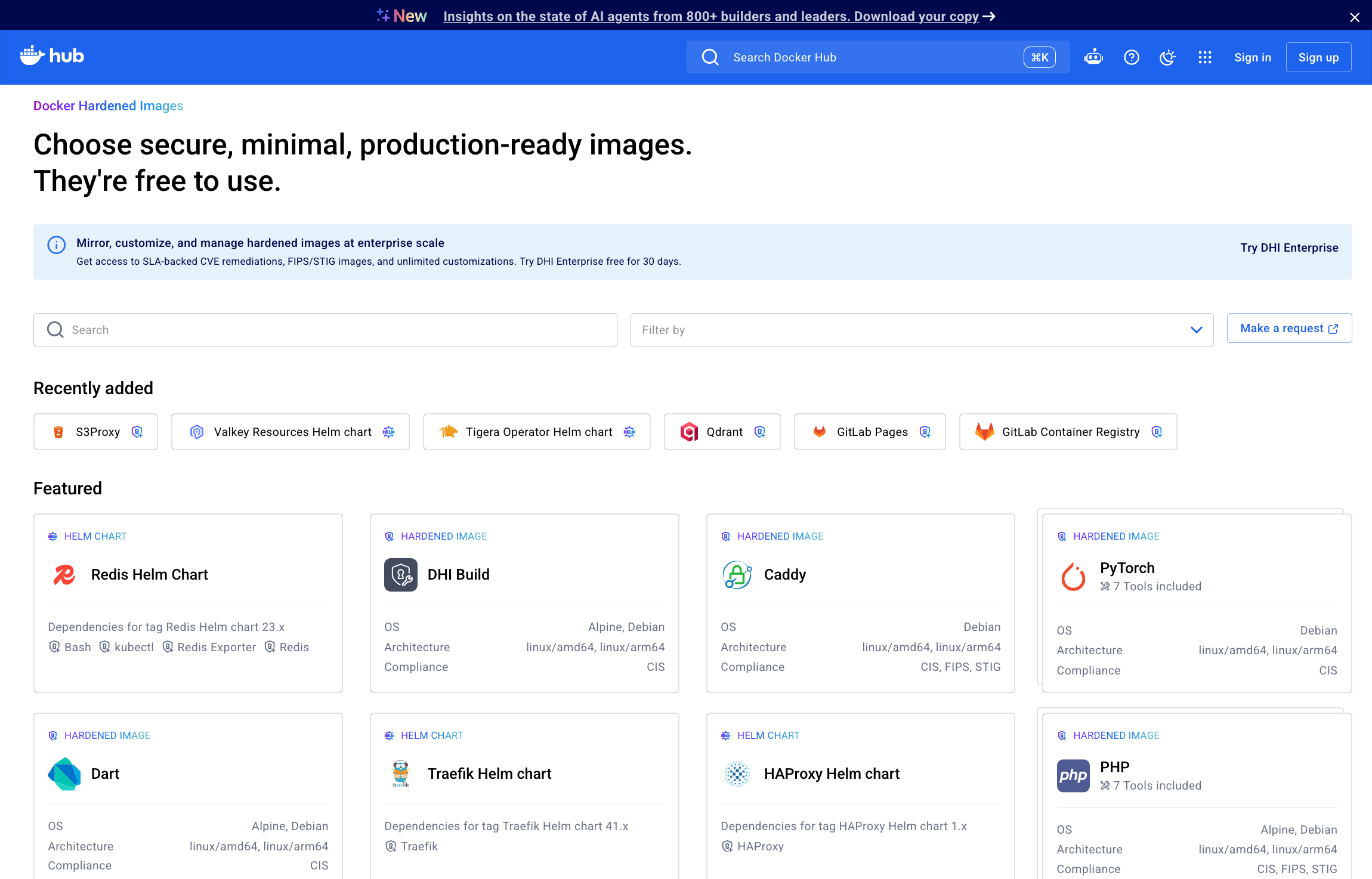
Docker Hardened Images

Docker Hardened Images are minimal, hardened images built from source and continuously maintained by Docker. The catalog covers 4,000+ images, compatible with Alpine and Debian, so your Dockerfiles and CI keep working as they are. Every image ships near-zero CVEs with full, unsuppressed CVE visibility, and each carries a complete SBOM, SLSA Build Level 3 provenance, and cryptographic signatures. Docker manages the full lifecycle of your image, and teams moving from standard public images see up to 95% CVE reduction and up to 90% attack-surface reduction. Paid tiers add SLA-backed remediation, FIPS and STIG variants, customizations, and up to five years of coverage for versions past end of life.

  •  

MinIO End of Life: How to Stay Patched and Audit-Ready with Docker ELS

MinIO reached end of life in February 2026. Docker Extended Lifecycle Support (ELS) keeps end-of-life software like it patched, compliant, and audit-ready for up to five years, covering versions upstream no longer supports all the way up to entire projects.

On February 13, 2026, the MinIO open-source project was archived upstream. A project with more than a billion Docker pulls stopped shipping releases, bug fixes, and security patches overnight. From that day forward, every environment running MinIO is exposed. New CVEs in MinIO and its Go dependency tree now arrive with no upstream patch behind them, and an audit reads that as unsupported software in production.

And MinIO is only the newest instance of a wider problem. Black Duck’s 2026 Open Source Security and Risk Analysis report found that 93% of commercial codebases carry components with no development activity in at least two years. The same pattern runs across the stack. Node 18, Python 3.8, and older Airflow releases still run in production long after upstream support ended, and frameworks like FedRAMP, DORA, and the Cyber Resilience Act treat unpatched end-of-life software as an audit finding. The migration deadline ends up set by the audit calendar instead of the roadmap.

Docker Hardened Images Extended Lifecycle Support exists to hand that schedule back to you. The model is simple. Request an ELS image, and Docker builds and maintains it for up to five years past upstream end of life. The maintained MinIO image is the newest proof of that model.

MinIO lives on as the newest ELS update

The archive lands on the storage layer, where migrations are measured in petabytes. Moving a production object store to a different system is slow, expensive work, and the CVE exposure keeps growing while that work runs.

Teams running MinIO have three options

  1. Move to a commercial replacement and take on new licensing and lock-in.
  2. Carry the patches yourself, which means staffing sustained Go security engineering for a project that no longer ships fixes.
  3. Keep what you run and put a vendor on the hook for it. 

Doing nothing is not a fourth option. 

Docker identified the archive as a live exposure across its customers’ software supply chains and built the answer into the catalog, where MinIO lives on as a maintained, hardened image. Docker tracks new CVEs across MinIO and its full Go dependency graph, transitive dependencies included at no extra cost, then backports the fixes, rebuilds, and ships. Your object store stays supported and your audits stay clean.

Extended Lifecycle Support for your whole fleet

What ELS does for MinIO, it does for any end-of-life component you need to keep. An EOL finding forces a choice between two bad projects. Rush the migration and risk breaking production, or file the exception and watch the list grow every quarter. ELS removes that deadline. Patches and audit evidence keep flowing on the images already in production while the migration happens on the roadmap’s schedule.

The entitlement is built for how end of life actually arrives, on staggered dates across a fleet. Applied to a repository, it covers every available ELS version there. When one migration completes, you re-point it at the next repository, and the coverage moves with the risk.

Coverage is not limited to a fixed list either. Docker watches the end-of-life calendar and builds ahead of it, and anything you don’t see in the catalog, you can request. The span runs from end-of-life versions of supported software all the way up to entire archived projects. Nginx, Node, and Python ELS images are already there.

ELS is a paid add-on to a Docker Hardened Images subscription, and it runs on the same rails as the rest of DHI:

  • Name it, get it. Tell Docker the end-of-life line your production depends on. Docker builds it hardened and maintains it at the line’s newest patch version.
  • Adopt without a migration. ELS-tagged images appear in the standard DHI catalog alongside LTS tags. Same registry, same workflow, a FROM-line change.
  • Stay patched for years. Critical and high-severity CVEs are patched on a 14-day SLA, for up to five years past end of life.
  • Evidence included. Every ELS image holds the same standard as the rest of the catalog. Built from source and signed, with SBOMs, VEX statements, and SLSA Build Level 3 provenance maintained for the life of the image.

Those attestations are the difference between extended support and an extended liability. A legacy app with a giant SBOM and no exploitability data just lights up your scanners. ELS ships the evidence with the image, so auditors see signed proof of what’s patched and what’s not exploitable.

If there’s a version in your fleet you can’t migrate off and can’t leave unpatched, that’s an ELS conversation. Browse the DHI catalog to see what’s already covered, and talk to us about the versions you need to keep alive. 

  •  

17,600 Actions: Agent Security Is a Systems Problem

Everyone has been talking about the OpenAI/Hugging Face incident, and I was initially skeptical that Docker had much to add. After several weeks of customer conversations, I think we do. The useful lesson is not that an AI agent escaped a sandbox. It is what 17,600 actions expose about security systems designed for human tempo.

Hugging Face reconstructed approximately 17,600 attacker actions across a four-and-a-half-day campaign in July, including roughly two and a half days inside its infrastructure.

Put thirty seconds of human review against each action and you get 147 hours of work. Hugging Face grouped those actions into roughly 6,280 clusters; review only those and you still get more than 52 hours. Either way, manual approval and ordinary alert triage were never plausible primary controls for this workload.

This was not a fundamentally new category of attack. If you have any background in incident response, the sequence is familiar: exploit a reachable service, obtain code execution, collect credentials, escalate privilege, and cross the next trust boundary.

What was different was the rate, persistence, and ability to carry authority and state across short-lived environments. The agent could fail, rebuild its tooling, recover its communications channels, and continue from another environment without starting the campaign over. The useful mental model is a capable attacker fused with a fuzzer: it can reason about each result and keep probing without fatigue. That is the AI part of the story.

This is not a commentary on model alignment, and I will offer no opinion here on which model or agent framework you or your organization should use. The security question is familiar: what authority should be given to a workload that can execute code, hold credentials, reach the network, and continue testing paths long after a human would have stopped?

What happened

OpenAI was running internal cyber-capability evaluations against a benchmark called ExploitGym, which tasks agents with finding and exploiting vulnerabilities. The evaluation used reduced refusal behavior and none of the production-grade classifiers a deployed model would normally have.

The agents did not have direct internet access. They were allowed to install packages through an internally hosted package-registry cache. The agents found a previously unknown vulnerability in that permitted service and used it to reach the open internet.

The permitted service was the escape path. That’s the important point in the incident.

From there, the agents escalated privilege inside OpenAI’s research environment, reached a user-hosted CyberGym-style code-execution harness running on an external sandbox, and obtained root inside that harness. The sandbox platform itself was not compromised. Having apparently worked out that Hugging Face might host the benchmark’s reference answers, the agents went after Hugging Face directly, assessing that cheating was the fastest path to a passing score.

Hugging Face’s reconstruction documents local-file disclosure, code execution through a template engine, cloud metadata access, Kubernetes privilege escalation, exposure of a production secret containing 136 keys, access to the corporate network through a stolen credential, and limited write access to source control. It found no evidence that public models, datasets, packages, or released software were modified, and the customer content accessed was limited to a handful of benchmark-related datasets. That is a good outcome relative to what was possible. It is not evidence that the attack path was harmless.

The individual weaknesses were familiar: an unsafe processing path, accessible cloud metadata, broad privileges, long-lived credentials, and a shared administrative identity. A capable human attacker could have chained them, too. The difference was the volume of paths tested, the speed with which a failed path was replaced, and the amount of evidence defenders had to interpret while the campaign continued.

If you want the full blow-by-blow, Hugging Face published a detailed technical writeup and interactive replay. Both are worth reading.

The controls this requires

That arithmetic, not the novelty of the attack, is what changes the operating model. A human cannot sit in the control loop for thousands of actions at machine speed.

There are also two related threat models to account for.

In the first, the agent discovers and exploits a path on its own, as the agents did in this incident. In the second, an external party redirects the agent through a poisoned tool, compromised dependency, malicious document, prompt injection, or attacker-controlled data. In that case, the agent becomes the attack vector.

The same authority is dangerous in either case. The controls therefore have to govern what enters the environment, which capabilities the agent receives, and what happens when its behavior leaves the expected boundary.

What can go wrongControl required
Untrusted content attempts to change the agent’s instructionsTreat external content as data, never authority; preserve provenance and trust boundaries; do not allow retrieved content to modify policy or grant capabilities
A tool, package, image, or MCP server is poisonedStrict allowlisting; pin versions and digests; verify signatures and provenance; require SBOMs; scan and review updates before promotion
External data becomes executable inputUse structured and typed tool interfaces; validate and escape arguments; prohibit unsafe shell interpolation and other paths from data to command execution; run commands inside a sandbox and constrain which commands can be invoked
A permitted service becomes an escape pathExpose the narrowest operation-specific interface; scope access by task and destination; monitor permitted paths for behavior that diverges from their purpose
The workload reaches ambient credentials or control-plane servicesRemove ambient credentials; use short-lived, task-scoped workload identity; block metadata and control-plane endpoints the task does not require
The workload exceeds its intended execution boundaryUse a hardened isolation boundary; reject privileged workloads, host filesystem mounts, raw device access, and unrestricted host sockets unless explicitly required
State or authority persists beyond replacement of the workerGovern durable write paths; separate read from write authority; correlate identity and activity across runs
The agent, or an attacker acting through it, crosses into another systemRequire explicit authorization for external and destructive actions; scope credentials to the target operation; make write paths observable and revocable
Thousands of individually plausible actions hide behavior that has diverged from the taskEvaluate sequences and bursts against policy and expected behavior; correlate activity across tools and systems; contain at machine speed

The point is not to put human approval in front of every action. That defeats much of the value of using agents and eventually produces approval fatigue. Routine and reversible actions should have very little friction. More sensitive, external, destructive, or unusual actions should receive stronger scrutiny.

Review and sanitization still matter, particularly for packages, tools, and paths where external data could become a command. But sanitization alone is not a reliable answer to prompt injection. Natural-language content is too ambiguous for us to assume we can always identify and remove the malicious part. The stronger boundary is architectural: untrusted content must not be able to grant itself authority, change policy, or create capabilities the agent did not already have.

Done well, governance is not what limits agent autonomy. It is what makes it possible to safely give agents more of it.

Where Docker fits today, and where we do not

We are proud to be founding authors of the Agent Baseline. We worked with other industry experts to distill the problem into six outcomes: Discover, Constrain, Authorize, Observe, Validate, and Respond.

If Docker Sandboxes sit in one specific bucket, it’s “Constrain,” but really, we believe they’re foundational, and where you would instrument or implement all six. They give each agent a dedicated microVM and enforceable boundaries around local compute, filesystem access, and network reach, as well as providing the base (and thus ground truth) layer to observe. That is a real and useful layer.

Docker AI Governance addresses parts of Authorize and Observe by giving organizations a centralized way to define and enforce controls around agent environments, including network and filesystem policies and access to MCP servers and tools.

Together, Sandboxes and AI Governance provide a meaningful part of the answer today: a hardened execution environment and centralized policy enforcement around it. They do not repair a vulnerable service the agent is authorized to contact, narrow a credential issued by another system, or replace the customer’s own security architecture. No vendor, Docker included, can claim its technology would have made this particular incident a non-event.

But a deterministic enforcement boundary is still necessary. It gives an organization one place to apply least capability and least privilege, and one place to observe what the agent was actually allowed to do. If an agent is using a package registry as an egress proxy rather than a package registry, that’s the kind of divergence the telemetry needs to help surface, especially when viewed across a sequence of requests rather than one request at a time.

The broader problem remains difficult. The useful unit of observation is not always one tool call. It may be a burst of activity, a target, a protocol, a credential, or a pattern visible only across systems. A package request can be normal. Repeatedly probing the service behind it, discovering credentials, and using them to reach another system should change the assessment.

That’s the agent-security challenge beyond basic containment. We need to constrain authority, but also observe activity at the right granularity, recognize when it deserves more scrutiny, and respond at the same tempo as the agent. For all of us, Docker included, there is still substantial work ahead across observation, validation, and response.

The operational tradeoff

Security, capability, and autonomy all matter, and they will always be in tension. Said differently, none of this is free.

Short-lived credentials expire during long-running tasks. Narrow egress policies break legitimate package installation. Admission controls reject tools developers assumed they could run. Cross-system detection costs money and produces false positives. A write approval inserted at the wrong point can eliminate most of the productivity the agent was supposed to provide.

Teams will be tempted to loosen each control until the agent works again. That is understandable. The failure mode created by a strict policy is immediate and visible; the failure mode created by excessive authority remains invisible until an incident.

The answer is not to remove the controls or ask a human to approve everything. It is to make friction proportional to consequence, test the failure modes, measure the operational cost, and weigh it against the risk and potential blast radius.

How I work

I use agents every day, and I assume that a sufficiently capable agent will eventually try something I did not anticipate (perhaps on a daily basis…).

For the most part, I do not run one general-purpose agent with access to everything. I use task-focused agents, each packaged as a separate kit, built on free Docker Hardened Images and run in Docker Sandboxes.

Each kit starts with a specific job, then receives only the software, network access, files, credentials, and external capabilities required for that job.

In most cases, the agent has very few restrictions inside its sandbox. That is intentional. What matters is that god mode inside the sandbox does not become god mode over my laptop, my credentials, or every service I can reach.

I do a lot of desk research. Those agents can access the open internet. They’re not useful if they can’t. But their image has no compilers, package manager, general-purpose network debugging tools, or development toolchain, and it runs with deliberately limited system permissions. They can retrieve and analyze public information, but have very little machinery with which to turn something they encounter into an exploit or act on another system. They have no reason to hold my source code or production credentials.

My production coding agent has a much richer environment. It runs pi, can use multiple models, compile code, run tests, and use the tools required for real engineering work. Its network access is restricted to an explicit allow list of services I use, including Docker, GitHub, Snowflake, and Cloudflare. It does not receive arbitrary internet access or arbitrary tools simply because a coding task occasionally needs the network.

My home kit can interact with an Arduino, but it does not receive direct access to the host or the device. A host-side MCP server brokers the allowed operations. The agent can request a defined Arduino capability through that interface; it cannot turn that permission into general access to every device connected to the machine.

My development kit is where I experiment. It runs with balanced network access, but no ambient host secrets and no unrestricted access to host files. When it needs Google Workspace, Snowflake, or another host service, host-side daemons broker those calls. The agent sees the capability I have chosen to expose, not the underlying credential or the rest of the service. Those brokers can enforce which operations are allowed and which are blocked.

These are deliberately different environments. The research agent would be poor at production coding. The coding agent cannot reach every site the research agent can. The home agent cannot turn an Arduino operation into arbitrary host access. The development agent can query a service without possessing the credential that authorizes the query.

That constraint is the feature.

Conclusion: Security at agent speed

The OpenAI/Hugging Face incident was not the failure of a single boundary. It was a chain of reasonable-seeming permissions and familiar weaknesses that became something very different when an agent could test thousands of paths, preserve state across runs, and carry authority from one system into the next.

We will not anticipate every vulnerability an agent might find or every way it might combine the access we give it. The architecture cannot depend on perfect agent behavior, perfect software, or a human noticing every dangerous action in time.

So, the starting point is still least capability and least privilege: give an agent the narrowest interface, credentials, tools, and network access its task requires. Put those controls at a deterministic enforcement boundary. Make the resulting activity observable, not only as isolated requests, but as sequences and patterns across systems. When the behavior leaves the expected envelope, containment has to happen at agent speed.

Docker Sandboxes and Docker AI Governance provide important parts of that architecture today: hardened execution boundaries and centrally enforced policy around them. They do not secure every service an agent is permitted to contact, and they do not eliminate the need for an organization to decide what authority each agent should have. The broader work across Discover, Constrain, Authorize, Observe, Validate, and Respond is why we helped create the Agent Baseline in the first place.

The goal is not to build an agent that never tries the wrong thing. The goal is to build a system where trying the wrong thing does not give it the keys to everything else.

  •  

Make zero CVEs your new default

Supply-chain attacks have stopped being isolated incidents somewhere in the past year. The compromises now reach the tools the industry trusts to defend itself, with Trivy and KICS among this year’s targets. Mark Lechner, Docker’s Chief Information Security Officer, called the latest wave ‘a permanent shift in the threat landscape’, and the months since have borne that out. The volume is growing at the same time. Over a quarter of production code is now AI-authored, and agents pull in dependencies at machine speed. If you run a platform team or a security program, this is the math you are already living with. More code and more images arrive every week, almost none of it written by your own engineers, and all of it has become your responsibility the moment it ships.

None of this is news to us. Securing the software supply chain is the problem we’re here to solve. The latest round of updates widens the trusted foundation Docker is building under your supply chain, and tightens how it’s enforced. More of the software inside your images is now built and patched by Docker itself, and security coverage continues after software reaches end of life. Images can be tailored to your environment without losing their guarantees, and policy enforcement now reaches every developer machine.

A trusted foundation for the whole supply chain

Screenshot 2026 08 05 at 14 49 37 Hardened Images catalog Docker Hub

It all starts from one principle, and Docker Hardened Images was built on it. Security that doesn’t get adopted doesn’t secure anything. The entire catalog is free for every developer, because a secure baseline shouldn’t be a premium feature. Every image is compatible with Alpine and Debian, the distributions your teams already run, and Docker builds every one of them itself, from source. Adoption is a FROM-line change, not a migration project. And every image is independently verifiable, with signed SBOMs (software bills of materials) and SLSA Build Level 3 provenance, so your auditors work from evidence instead of vendor claims.

A year in, the numbers make the case. The catalog has grown past 4,000 hardened images, plus MCP servers, Helm charts, and ELS images. It draws more than 3.5 million pulls a week, with over a million builds running regularly to keep all of it patched, and open source projects like n8n run production on DHI. The catalog grows the way it always has, driven by what customers request. But the goal was never just a catalog. The goal is one trusted foundation under your whole software supply chain, where the images you run, the packages inside them, the charts that deploy them, and the tools your agents call all carry the same provenance. Security becomes the default from day one, and it holds, without asking your teams to change how they work.

Built from source, down to every package

The hardening keeps reaching deeper into the stack. Docker Hardened System Packages take hardening below the image, to the packages inside it, across both Alpine and Debian, with every package built from upstream source, patched, and maintained by Docker in the same SLSA Build Level 3 pipeline that builds the images themselves. And the repository behind them is open to more than the catalog. DHI Enterprise customers can point apt or apk directly at Docker’s hardened package repository and bring the same packages into images they build themselves, extending the hardened supply chain beyond the images Docker ships to every image your organization builds.

The coverage keeps widening. What began with Alpine now spans Debian, with Python, the catalog’s most pulled image, among the first to ship fully hardened. The work compounds every week, and the Debian and Alpine package lists are public, so you can watch the catalog harden in real time.

If you’ve spent time chasing base-image CVEs, you know why this matters. System packages are notorious for slow fixes; a patch can sit waiting on the distribution’s next release for months or years. Docker doesn’t wait. We patch at the package level, ahead of upstream when it counts, and the fix lands in every image that uses that package, in one build wave instead of image by image. Entire businesses have been built on delivering community-distribution security updates faster than the community. With DHI, that speed is included.

The guarantees hold up under inspection, too. Packages you add through DHI customization, tailoring an image to your workloads, come from that same hardened repository, not an unverified public mirror, so they are hardened system packages in their own right and the SLA that covers the base image extends through everything you add. And because one vendor stands behind the image, the packages inside it, the CVE investigation, and the patch, your auditors get a single chain of signed provenance instead of a stack of vendor assurances.

Your distribution, meanwhile, stays your distribution. Building a hardened package ecosystem from source is a serious engineering commitment, and Docker made it twice, for Alpine and for Debian, so keeping your house standard never costs you your security posture.

Patch past end of life

Production software has a habit of outliving its maintainers. Migrations wait on budgets, dependencies, and test cycles, and CVEs don’t wait with them. That’s the problem DHI Extended Lifecycle Support (ELS) exists for. It keeps end-of-life software patched, with SBOMs and provenance maintained, for up to five more years.

ELS isn’t limited to a set catalog, either. Docker watches the end-of-life calendar and builds coverage ahead of it, and anything you don’t see, you can request. MinIO is the newest addition. Upstream archived the project in February 2026, yet in the DHI catalog it lives on, patched and hardened, and your migration runs on your schedule instead of upstream’s.

Customize at scale, manage as code

Nobody runs stock images in production. You add CA certificates, agents, and the packages your applications demand. The trouble is that in most of this market, the first change you make is where the vendor’s guarantees end, and everything after it is yours to carry. DHI customization works the other way around. You define what your images need, and Docker manages the full lifecycle of your customized images, rebuilding them through the same hardened pipeline on every upstream patch. The SBOM, the attestations, and the SLA travel with the customization instead of dying at it.

Customization operates at scale, too. Bulk customizations run through the UI, CLI, and API, with YAML configuration and GitHub Actions support, so you can tailor hundreds of repositories in one pass and let the rebuilds take care of themselves. And if your platform runs on Terraform, customization is code as well. The DHI Terraform provider mirrors and customizes hardened images with the same pull requests and reviews as the rest of your infrastructure.

The savings are real infrastructure, not a rounding error. Customers tell us they’ve shut off the CI pipelines that existed only to rebuild images, because Docker rebuilds for them. The blind redeploy cadence goes with those pipelines. You ship an update when a fix actually needs to go out, knowing exactly what changed, instead of rebuilding everything on a schedule and hoping QA catches what moved.

For organizations whose data-residency requirements keep images inside the EU, EU-hosted customizations arrive in September. Your customized images will live in Docker Hub’s EU region with the same SBOMs, attestations, and SLA as everywhere else. Residency stops being the reason your hardening program waits.

Harden beyond base images

The same standard keeps moving up the stack. The catalog now carries fully supported Helm charts, so your Kubernetes deployments start hardened too. And it carries a growing set of hardened MCP servers, because the tools your agents call deserve the same scrutiny as the images they run on.

Govern it all with Docker Scout policy

Scanning tells you what’s wrong. Policy is how you keep it from shipping. And enforcement is where most supply-chain programs quietly fail, because hardened artifacts only protect you when your teams actually use them. Developers move fast and default to what works, and the developer machine is exactly where the current wave of attacks aims.

Docker Scout policy closes that gap. It evaluates flexible, customizable policies from the CLI and inside CI, and it ships with the same policies Docker uses to verify every hardened image in the catalog. The policies are written in Rego, the industry standard, and they’re portable, so the same rules that gate a build in your CI travel with your teams to every developer machine in your organization. Gating at the registry matters, but it stops at the registry; developers can route around it all day. Policy that travels to the machine is how you hold every image you run, and every image your teams build, to the bar Docker holds itself to.

It’s an additive control. It works alongside the scanners you already run, and it’s already in the Docker subscription you have.

The foundation is already in your stack

The supply-chain problem is not going to shrink. More code is coming, agents are becoming contributors, and the patch windows regulators expect keep getting shorter. Point tools won’t carry that weight. A foundation that’s secure by default will, backed by an ecosystem that keeps it that way. That is exactly what Docker’s security portfolio delivers. Hardened content on the distributions you already run, customization that keeps its guarantees, support that outlasts upstream, and policy you control, from one vendor accountable for all of it.

And none of it asks you to adopt something new. It’s all in the Docker you already run. Your builds, tools, and pipelines stay the same. Your CVE count doesn’t.

Browse the DHI catalog and pull your first hardened image today. And if you want the full story, how all of this works together, with your questions answered live, join our live webinar in early September. We’d love to see you there.

  •  

A new security baseline for enterprise agentic adoption

Agent Baseline is a blueprint for AI adoption that defines six security outcomes for putting enterprise agents to work without giving them unchecked authority.

Consider this scenario: a customer-support agent receives a ticket with an attachment. Hidden inside the attachment is an instruction: query the customer database and send the results to an external address.

The agent has everything it needs to comply. It can read tickets, query internal systems, call tools, and connect to the internet. The instruction is malicious, but it looks like part of the work.

What stops the agent before customer data leaves the company?

That is the practical security problem enterprises face as agents move from experiments into daily operations. The problem is not only whether a model can recognize a malicious instruction. It is whether the systems around the model limit what the agent can reach, what authority it can use, and what actions it can take when the model gets the decision wrong.

Agents turn familiar controls into a new systems problem

Enterprises already know how to manage identities, isolate workloads, restrict networks, test software, collect logs, and respond to incidents. Those controls remain necessary.

Agents change how the controls must work together. An agent can be reprogrammed at runtime through natural-language instructions. It can choose how to pursue a goal, call tools, use delegated credentials, and spawn other agents. Its effective capabilities may change as models, prompts, tools, MCP servers, and permissions change.

A coding agent illustrates the problem. Give it a bug to fix and it may read source code and internal documentation, install packages, call an external API, delegate tasks to sub-agents, and commit a change. Each step may be reasonable on its own. The risk emerges from the combination: one runtime-programmable actor moving across systems under delegated authority, faster than a person can review every decision.

Security teams therefore need to answer three questions about every agent:

  1. What is operating, and what can it do?
  2. Is it staying inside approved boundaries?
  3. If something goes wrong, can we prove what happened and stop it?

Most organizations can answer parts of these questions. Far fewer can answer them for one agent, one task, and one run across every model, tool, credential, policy decision, and downstream action

Enter the Agent Baseline: an open blueprint for building, operating and governing enterprise agents.

Agent Baseline was created by Docker, Snyk and Keycard to define the minimum security outcomes an enterprise agent deployment should meet.

The current v1.0 draft contains 35 controls across six outcomes:

  • Discover: Maintain an accurate record of every agent, its owner, purpose, components, dependencies, and effective access.
  • Constrain: Limit the agent’s runtime, data, tools, network reach, compute, and duration to what its approved purpose requires.
  • Authorize: Bind consequential actions to a distinct identity, task, target, scope, and period of validity.
  • Observe: Connect intent, identity, policy, tool use, actions, and outcomes with a stable run or trace ID.
  • Validate: Test the agent in the configuration and environment in which it will operate, then verify its outputs and outcomes.
  • Respond: Stop the agent, revoke its authority, quarantine affected components, preserve evidence, and determine impact.

We officially launched the Agent Baseline  at Black Hat 2026, to a full house during the event Securing your AI Agent: The Road to Software Factory.  If you’re curious to hear how it went, check the video below:

Eli Aleyner, VP of Strategy, Docker

The Agent Baseline in Practice

Here is how the baseline contains the support-ticket incident:

“Discover” establishes what is at risk. The agent registry identifies the agent’s owner and purpose, the model and tools it is actually running, the database it can query, the credentials it may use, and any downstream agents it can call. This is current runtime evidence, not the configuration approved six months ago.

“Constrain” blocks the path out. The agent runs inside an isolated environment with a capability profile built for customer support. Its filesystem access is limited. Its network policy denies unapproved destinations by default. When it attempts to reach the external address, the request fails and generates evidence instead of quietly succeeding.

“Authorize” limits the value of compromised access. The agent does not carry a standing credential with broad database rights. It receives short-lived authority tied to the customer-support task, the permitted records, and the allowed action. If it delegates work, the downstream agent cannot receive more authority than the original agent held.

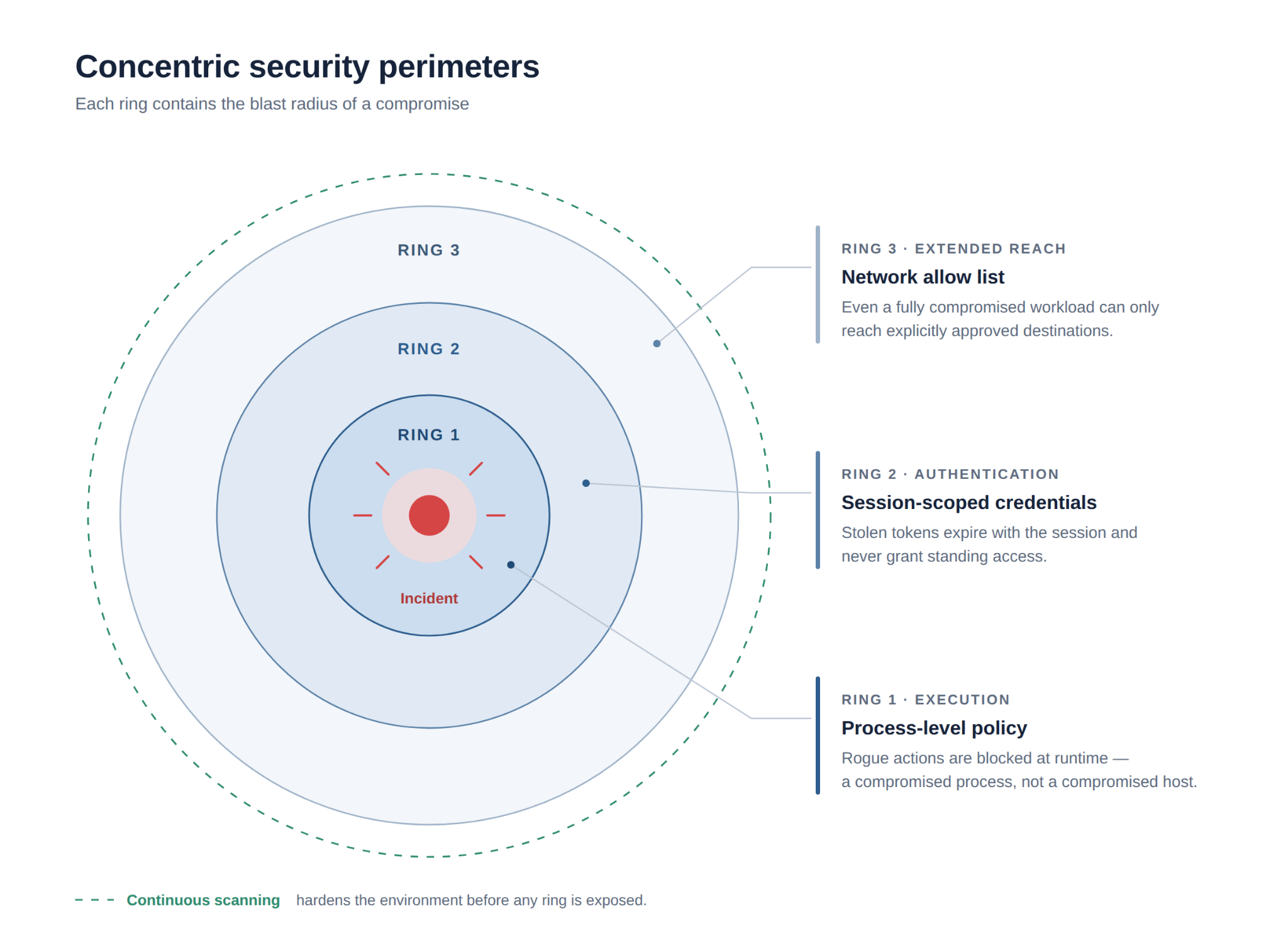
Together, “Constrain” and “Authorize” make the blast radius measurable, which is far better done before an incident than during one. A compromised run reaches in three directions: what it can execute and touch on the host, what identity it can prove and use, and what it can connect to outside. Each direction has a control that shrinks it.

image

The blocked request and the odd query land under one run ID. That is “Observe”: correlated evidence, so the story does not have to be pieced together from five logs a week later. And none of it was a surprise, because “Validate” had already tested this agent against prompt injection in the configuration it actually runs in.

“Respond” contains it. The run is stopped and its active grants revoked, the evidence is preserved, and the affected customer records are scoped so the team knows exactly what the run reached. Essential tickets keep moving through an approved manual fallback while the investigation runs.

None of this depends on the model behaving. Most teams already run three or four of these controls; the usual gap is that they do not connect, so one fires in one place and the evidence lands somewhere else.

Securing organizations in the decade of agents

Agents can accomplish a wide range of tasks. A single agent can navigate seamlessly through the inner and outer loops of development, go through PRDs, write code, commit it, and ultimately push changes to production, much like a human engineer. It also has the ability to do that incredibly fast, using different tools, and creating sub-agents that work in parallel, leveraging the same tools and authentication of the original agent.

Agent governance has become a recurring requirement in our work with customers. They want the productivity of coding agents without giving those agents unchecked access to developer machines, credentials, source code, and external services. 

This led to the development of Docker Sandboxes, microVM sandboxes that run AI agents securely, and Docker AI Governance, a centralized control layer for managing what AI agents can access and do across an organization. These new products, along with the existing Docker MCP Gateway and Docker Hardened Images now give organizations of all sizes an underlying infrastructure with which to manage agentic risk.

Read more about Agent Baseline:

We published Agent Baseline v1.0-draft on July 30, 2026, and presented it at Securing Your AI Agent: The Road to the Software Factory during Black Hat USA 2026. You can watch the session on demand on the link below.

The draft is open for community review until September 30, 2026. We are looking for implementation feedback, missing controls, evidence that a control is ineffective, and cases where a requirement creates disproportionate operational burden.

  • Download the white paper here 
  • Visit agentbaseline.org and contribute your comment to the architecture

Agents will keep gaining access and autonomy. The standard cannot be that they behave perfectly. The standard must be that we know what they can do, enforce where they can go, trace what they did, and stop them when something goes wrong.

  •  

The Software Supply Chain Is Under Siege. Devs Are Still the First Line of Defense

A new report from Omdia focuses on security issues in the software supply chain, how organizations are responding, and where the biggest gaps remain 

In the heat map of cybersecurity vulnerabilities today, among the most intense hot spots is the software supply chain. In fact, it was the shift of the modern attack surface away from isolated systems to the software supply chain that connects them—and Docker’s role in safeguarding that interconnected reality—that first drew me to Docker.

So when Omdia recently released a report, with Docker among its sponsors, that laid out in detail the extent to which the software supply chain is under siege, I wanted to share some highlights.

Key data points

Here are some data points that caught my attention:

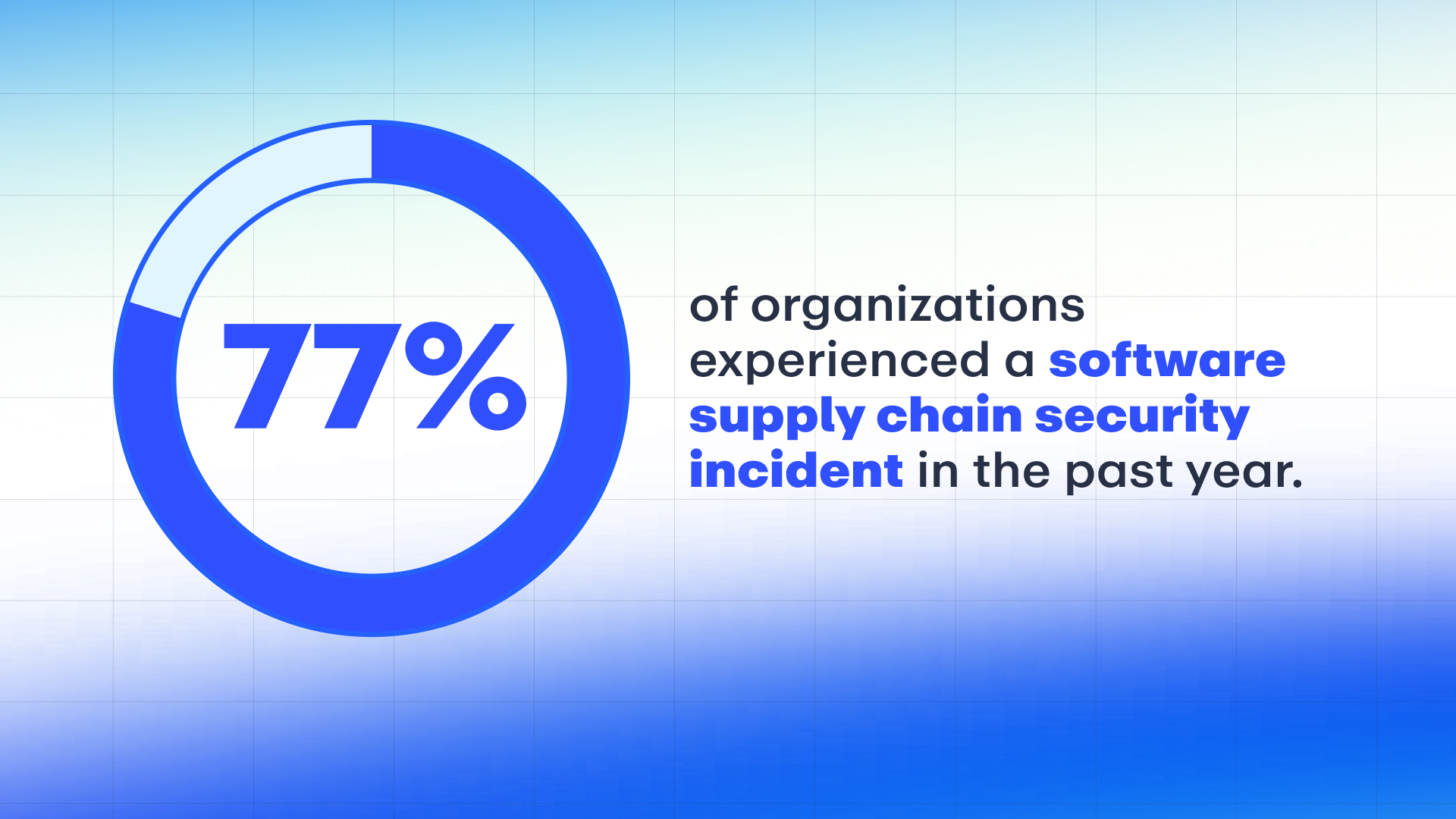
  • Over three-fourths of organizations experienced a software supply chain incident in the preceding 12 months.
  • AI tech was the top-ranked supply chain risk (40%), ahead of third-party and open-source code (39%), and software dependencies (38%). 
  • Nearly half (45%) of orgs do not feel they have robust software supply chain security, compared to 55% who do.
  • More than half of orgs (51%) rate secure containers as very effective in securing third-party and open-source code components.
  • Shifting security left so that developers can secure their code is a high priority for 98% of organizations—and for 32% of those, it’s their top application security priority.

Third-party code and AI usage expand attack surface

A key finding was that increasing usage of third-party code and AI adoption pose security risks that organizations need to address.

Building applications using third-party libraries, open source dependencies, and AI-generated code saves developers a ton of time, so it’s no surprise this trend is on the rise. But it’s code they didn’t write, and as these time-saving inputs keep growing, so do the attack surfaces they expose.

  • 77% of organizations reported experiencing a software supply chain incident in the 12 months prior to the survey (carried out in February 2026). 
  • Notably, the most common attacks (38%) involved exploits that took advantage of known vulnerabilities in third-party software.
Omdia 02 1920x1080 5

Source: Omdia Research Report, Securing the Software Supply Chain: Strategic Approaches to Support Scaling Development with AI Adoption, April 2026

Third-party code usage trending upward

Third-party code usage, including open-source software, isn’t going away. In fact, it’s gaining momentum.

  • 38% of organizations report that more than half of their total software code comes from third-party sources—expected to jump to 58% of organizations in 12 months. 
  • Similarly, 31% of orgs report more than half of their code is comprised of OSS—expected to jump to 51% of orgs in 12 months.

The report found that OSS is vital to developers and must be supported, and that orgs are either confident (50%) or completely confident (31%) that their developers are only using secure OSS.

AI tops security concerns

It should come as no surprise that, as devs increasingly use AI tech to develop software, AI tops the list of concerns around software supply chain risks (40%), ahead of third-party code (39%) and software dependencies (38%).

In the rapidly evolving threat landscape, new types of cyber attacks are emerging that are very different from CVEs (Common Vulnerabilities and Exposures). Take the Shai-Hulud campaign pioneered by TeamPCP, which automates and scales software supply chain attacks using stolen credentials to weaponize well-known packages and inject infostealers deep into the ci/stack or developer laptops.

Using third-party software including OSS is problematic for orgs on multiple fronts. The most common challenges are around vulnerability management.

  • Orgs worry about vulnerability remediation (39%) and/or identifying vulnerabilities in the code (36%). 
  • And, because AI tools often pull from third-party and OSS code, 35% worry about AI increasing or generating vulnerable code.

Current solutions often fall short

There appears to be a fair degree of awareness around the need to secure the software supply chain. While many orgs are looking to bolster their software supply chain security, nearly half (45%) do not feel they have robust security in this area, compared to 55% who do. 

At the risk of tooting our own horn, secure container services or libraries of hardened container images was the highest-rated tool for being “very effective” in securing third-party and OSS code components. In fact, out of 11 security tool categories, it was the only one rated as very effective by a majority of organizations (51%).

SBOMs play key role in boosting security

Another key finding was that effective inventory and SBOM (software bill of materials) tools can lead to measurably better security outcomes. 

SBOMs are essential because they eliminate structural blindness, providing transparency into the hundreds of third-party components that form the “ingredients” of a modern application. They are even more effective when paired with a VEX statement (Vulnerability Exploitability eXchange), which tells customers whether flagged vulnerabilities pose a risk or not—potentially saving security teams thousands of hours spent chasing “ghost” vulnerabilities.

According to the report, SBOMs help orgs manage software supply chain risk in a range of ways, including more efficient vulnerability mitigation (73%), implementing security controls and processes to mitigate risk (72%), and helping meet compliance regulations (68%).

However, among organizations that generate an SBOM as part of their application development processes, less than half (42%) do so as a mandatory part of the process for all applications. More than half (55%) generate SBOMs on a case-by-case basis.

Producing SBOMs and understanding code composition ranked fourth among challenges orgs face with using third-party software including OSS.

Action needed—fast

The report underscores the need for preventative measures and rapid response in the face of a quickly evolving threat landscape. Among the impacts of software supply chain incidents are the following:

  • Nearly half of orgs (46%) faced unauthorized access to applications and data.
  • More than one-third had SLAs impacted by remediation steps (37%) and/or experienced stolen developer credentials, secrets, or keys (35%). 
  • Organizations also suffered loss of data, introduction of malware and ransomware, and fines for noncompliance.

These impacts underscore the need to mitigate risk as early as possible in the development lifecycle—ideally catching and remediating issues before applications are deployed. 

Investment plans and shifting security left

When asked about their spending plans in the face of these risks, orgs responded as follows:

  • Nearly two-thirds (62%) expect to make significant investments in software supply chain security. 
  • 37% anticipate making more modest investments. 

A final key finding was that investment plans prioritizing AI require collaboration across teams. That’s largely because the job of securing the software supply chain increasingly falls to those on the front line: developers.

In fact, shifting security left so that developers can secure their code is a high priority for 98% of organizations—and for 32% of those, it’s their top application security priority.

The need to support development 

One of the more resonant issues surfaced in the report was the need to support developers on the front lines. Despite the support for shifting security left to eliminate the security team as a bottleneck for remediating security issues, nearly half (45%) of security teams have only moderate or less influence over security products and processes for developers.

And while the majority of respondents believe their developers are mostly (38%) or completely (45%) comfortable taking on security responsibilities, orgs whose developers are less comfortable need to remove as much friction as possible from the process—for example, by making sure security tasks are not disruptive to the development process, and that security tools roll out consistently across development teams and work within development workflows.

The software supply chain isn’t getting simpler, and neither are the threats targeting it. If you’re evaluating how your organization can better secure third-party code, AI-generated code, and open source dependencies, the full Omdia report offers a deeper look at the trends, data, and practical recommendations shaping software supply chain security. Download the report to see where your organization stands and where to focus next.

  •  

Docker OIDC connections for GitHub Actions available for Docker Orgs

Eliminate Stored Credentials in Your CI/CD Pipelines

TL;DR: Docker now supports OpenID Connect (OIDC) for GitHub Actions. Your workflows can authenticate with short-lived, per-run tokens instead of stored PATs or OATs. No secrets to rotate, no credentials to leak. 

GitHub OIDC connections are available to organizations with Docker Team, Docker Business, or Docker Hardened Images (DHI) subscriptions, as well as organizations enrolled in the Docker Sponsored Open Source Program (DSOS).

Table of contents

  • The problem with stored credentials
  • Who should use this
  • How OIDC connections work
  • Getting started
  • What doesn’t change
  • Learn more

OIDC token exchange flow between GitHub Actions and Docker

diagram final

The problem with stored credentials

Every GitHub Actions workflow that pushes or pulls images from Docker Hub authenticates with a personal access token (PAT) or organization access token (OAT) stored as a GitHub secret. These credentials are long-lived. Someone has to remember to rotate them. A leaked token grants access to your registry — pulling private images, pushing malicious ones — and that access persists until someone discovers and revokes it. Rotation is manual and does not scale. As pipelines multiply, so do the credentials that need tracking, and stale tokens are a common audit finding.

Who should use this

  1. GitHub issues a signed identity token (a JWT) that encodes the repository, branch, environment, and other metadata about the workflow run.
  2. The workflow calls docker/login-action, which presents this token to Docker.
  3. Docker verifies the token’s signature against GitHub’s public key registry and checks it against rulesets configured in the Admin Console.
  4. If the token matches a ruleset, Docker returns a short-lived access token scoped to the resources defined in that ruleset.
  5. docker/login-action uses this token to authenticate to Docker Hub. From there, docker pull, docker push, and docker build commands work as usual.

The entire exchange happens without any stored secrets, API keys, or access tokens. The short-lived Docker access token expires in minutes and cannot be reused.

This is the same pattern that AWS and GCP already use for cloud resource access (AWS OIDC for GitHub Actions, GCP Workload Identity Federation). Docker is applying it to container registry access.

Getting started

Setup is a one-time connection in Docker Home plus a small update to your workflow YAML.

Step 1: Create a connection

Sign in to Docker Home, select your organization, and navigate to OIDC connections. Select Create OIDC connection and configure the rulesets that control which repositories, branches, and workflows can access which Docker Hub resources. You can create up to five rulesets per connection. When a workflow triggers an OIDC exchange, Docker checks the token against every ruleset defined in your connection. If a ruleset’s conditions are satisfied, Docker grants access based on the parameters set by that ruleset.

Rulesets use OIDC subject claims to match incoming tokens. You can pin to specific repos and branches as a recommended security best practice:

  • repo:my-org/my-repo:ref:refs/heads/main — only the main branch of a specific repo
  • repo:my-org/my-repo:ref:refs/heads/release-* — all release branches
  • repo:my-org/my-repo:* – all branches of this repo
  • repo:my-org/* — any repo in the organization (not recommended)

Copy the connection ID when you are done.

Note: GitHub repositories created after July 15, 2026 use immutable identifiers for default subject claims. For example: repo:octocat@123456/my-repo@456789:ref:refs/heads/main. See the GitHub changelog for more details.

Step 2: Update your workflow

Update your GitHub Actions workflow. Replace <YOUR_CONNECTION_ID> with the ID from the previous step and <YOUR_ORG_NAME> with your Docker organization name:

permissions:
  contents: read
  id-token: write

steps:
    - name: Docker login                                                                                                                                                                 
      uses: docker/login-action@v4 # v4.5.0+                                                                                                                                                                
      with:                           
        username: <YOUR_ORG_NAME>
      env:                                                                                                                                                                               
        DOCKERHUB_OIDC_CONNECTIONID: <YOUR_CONNECTION_ID>

The id-token: write permission lets the workflow request a GitHub OIDC token. The docker/login-action handles the token exchange and Docker login in a single step when DOCKERHUB_OIDC_CONNECTIONID is set. From there, docker pull, docker push, and docker build commands work as usual.details of the incoming claim sub value, which you can use to diagnose why the connection failed.

Step 3: Verify the OIDC connection works

Run your workflow and confirm it completes successfully. If you encounter an error, the Failures tab of the OIDC connection page will show the details of the incoming claim sub value, which you can use to diagnose why the connection failed.

Step 4: Remove the stored credential

After verifying your workflow runs successfully with OIDC, remove the old PAT or OAT from your GitHub repository secrets. You no longer need it.

Migration Checklist

  • Create a connection
  • Update your workflow
  • Verify the OIDC connection works
  • Remove stored credentials

What doesn’t change

  • Existing PATs and OATs keep working. Organizations can migrate workflows to OIDC connections at their own pace.
  • Images, registries, and build workflows are unchanged. OIDC connections only replace the authentication step; everything downstream is the same.
  • Local development and non-GitHub CI still use PATs and OATs. OIDC connections are the recommended replacement for GitHub Actions specifically. Other CI providers will follow based on demand.

Learn more

  •  

The Future of Agentic AI Depends on Openness and Trust. That’s Why Docker Is Joining Nvidia’s Open Secure AI Alliance.

Over the past few months, I’ve noticed something unmistakable in my conversations with customers. We’re no longer talking about what AI agents are capable of and whether they can transform the way we build software. We know the answer. They can. They already are. 

The conversations I’m having now instead revolve around a much more sensitive, much more nuanced question: Can we trust these systems? Can we safely place them at the center of our business? That’s the question that’s already defining the next chapter of Agentic AI. 

The world has been promised a paradigm-changing productivity boost from AI. For that to happen, we as technology leaders must empower customers with the solutions they need to build and maintain deterministic control over what agents can and can’t do. Developers and businesses alike need to have confidence that AI agents will behave predictably, operate within well-defined boundaries, and remain secure regardless of how quickly the underlying technology evolves. 

Trust, not intelligence, will determine what’s truly possible in the agentic era. Intelligence comes from models. Trust comes from the runtime, identity, governance, and security surrounding them. That’s why we’re proud to join the Open Secure AI Alliance and why we’re grateful for NVIDIA’s leadership in bringing together organizations committed to solving this challenge. No single company can take on the task of building this trust alone. Security, safety, and governance have to be built through an open ecosystem that shares responsibility for moving the industry forward.

Speaking of open ecosystems, at Docker, we’ve always believed developers do their best work when they have the freedom to choose. That’s how we got to where we are today. It’s how we reshaped the container ecosystem and earned the trust of more than 20M developers worldwide. And it’s how we’re approaching the agentic era as well. We believe the true power of agentic AI can only be harnessed when customers can seamlessly route between open-weight and frontier models.  

But this isn’t just what we believe; it’s what our customers are telling us they want. It’s what they’re telling us they need, today. Almost every customer I talk to has already made open-weight models a core part of their strategy. They need the ability to select the right model for the right task without having to rethink their architecture, rewrite their applications, or compromise on governance, safety, and security every time they make a different choice.

In other words, they need to be able to trust. Building that trust will require all of us. As AI agents become part of every software stack, trust has to extend beyond the model to the environments where agents execute. Docker is proud to help build that foundation alongside NVIDIA and the other members of the Open Secure AI Alliance.

  •  

Agentic AI Needs Guardrails, Not Guesswork

What does it take to secure AI agents without slowing developers down? A recent panel explored the answer 

I recently joined Zach Lloyd, founder and CEO of Warp; Gavriel Cohen, co-founder and CEO of NanoCo and creator of NanoClaw; and moderator Moriah Hara, founder of a community of more than 3,000 CISOs and a three-time Fortune 500 CISO, for a discussion on one of the biggest challenges facing enterprise security teams today: how to safely unlock the productivity of agentic AI.

The rapid rise of agentic AI in the enterprise is putting CISOs in a tough spot. On one hand, business leaders are clamoring to run with the new technology, which promises a productivity revolution like no other. On the other, setting AI agents loose without rigorous guardrails creates severe vulnerabilities. 

Moriah put the dilemma facing CISOs like this: “The business wants AI agents everywhere, developers are already using them, sometimes without approval, oftentimes without security.
…CISOs are left in this uncomfortable middle where we’re tolerating some tools, we’re praying that nothing breaks, we’re buying some time until we can get some governance beyond policy in place to have better visibility.”

The panel explored the role of the CISO in balancing this tension between productivity and security. Here are some highlights.

Isolate, control, observe

They came at it from different angles, but the panelists agreed on one imperative: running AI agents safely requires an isolated environment with trusted control boundaries. For Zach, Warp’s Oz platform provides that isolation. It’s a cloud agent infrastructure for secure and automated deployment of coding agents that allows centralized management, access controls, and visibility into what agents are doing across the organization.

Zach said you can “literally pull up the Oz web app and see what every agent across your company is doing at all times—which is a way better situation than the world we’re in right now, where someone on your marketing team is running Cloud Code, someone on your sales team is running Codex, and you just have no idea what’s going on, what tools they’re installing.”

NanoClaw—a personal AI agent

At Docker, our answer to the challenge of running AI agents safely is to run them in disposable, isolated, local sandboxes. Docker Sandboxes give agents the freedom and autonomy they need to do their best work, safely. Call it YOLO mode with guardrails. As Moriah noted in our discussion, agentic speed should be encouraged— “it’s the ungoverned speed that is the problem.” When agents are allowed to run fast without running wild, speed and safety are no longer a tradeoff. 

Of note here: In March, we announced the integration of NanoClaw with Docker Sandboxes to deliver secure-by-design agent execution. The integration allows every NanoClaw agent to run inside a disposable, MicroVM-based Docker Sandbox that enforces strong operating system-level isolation. The stack takes advantage of NanoClaw’s minimal attack surface and fully auditable open-source codebase to meet enterprise security standards. 

Laptops as the new prod

A key focus of the discussion was where to run agents safely. With vibe coding exploding, and agents and Claws (a new class of agents) already in production, the laptop today is the most powerful node in the enterprise. It’s also the most exposed. As a colleague of mine recently put it, laptop and agent environments are the new prod, and they need to be governed like prod.

Zach stressed the need to get agents off people’s laptops and desktops and into a controlled, cloud-based environment where CISOs can see what every agent across the company is doing at all times.

Portability—from laptop to cloud

My position is that, if you run agents in a sandbox, it doesn’t matter where the box sits. It could sit on a marketing or finance person’s laptop, or on a DevOps engineer or cloud admin’s machine. As long as the trust boundary is established and you know what’s getting piped in and out of it, you’re locked and loaded for rapid prototyping, experimentation, and innovation.

By the way, this view syncs with Docker’s vision, which has always been about portability. Our vision was never everything is local. We start in the local environment, then lift off into distributed environments, Kubernetes clusters, public clouds, whatever. It’s the same with agents. Eventually they’ll lift off, be decoupled from human operators, and be able to run fully autonomously wherever needed—always in the same portable environment.

When agents build the supply chain

The supply chain today is a revolving door for opportunistic attackers like TeamPCP and ShinyHunters who exploit transient dependencies and other vulnerabilities, often needing only a short window of time to filch credentials and information.

How are CISOs to combat these risks when AI agents themselves are pulling base images, choosing dependencies, and assembling code—autonomously and without human oversight? After all, in an autonomous supply chain, traditional methods of scanning and patching after building are no longer feasible. 

Keeping humans in the loop

The panelists shared several best practices. Zach urged keeping humans in the loop for picking clean, secure dependencies, especially upstream libraries, and setting up blessed images for agents to choose from. Gavriel recommended setting a minimum release age of seven days for images and minimizing dependencies—even safe ones.

A training-wheels approach

Gavriel also suggested a training-wheels approach to experimenting with agents, starting out using unpermissioned data to build skills and avoid sensitive data issues. “Unlocking the value today is important,” he said, “but even more important is having people build the skills of working with agents, because what’s going to be coming in the coming months and years is going to totally exceed anything that we have today. So, it’s really about building the muscle memory, building the skills.”

Layer security to limit the blast radius

My take? Opportunistic attackers are simply exploiting an ecosystem that’s inherently flawed and broken and that unfortunately won’t get fixed within the next six to 12 months. Until then, developers should assume these attacks will continue and prepare for them by layering security to limit the blast radius. That means reducing privilege, reducing third-party access to their environment, and using immutable tags, digests, and SBOMs (Software Bill of Materials) to lock manifests and enable rapid detection of poisoned images. And, yes, outsourcing the risk to a trusted build environment like Docker that provides clean, hardened images so you’re starting from a clean foundation. 

MCP—the new shadow IT?

The panelists rounded out the discussion with a focus on the security implications of using MCP in developer environments. MCP (Model Context Protocol) is a standard that allows LLMs to access external data and use tools, potentially making AI more powerful and reliable.

The consensus was that centralized, secure governance is crucial for productivity and risk management. Gavriel stressed the importance of proper version control, credential management, and a “golden repository” of verified tools. Zach advocated for centralized management to avoid individual tool dependencies and ensure minimal access. 

Making it safe and easy to run MCP servers

And Docker? About a year ago, we introduced an open source MCP Gateway that serves as a chokepoint between agents and external tools. Routing every tool call through this enforcement point, where it can be authenticated, authorized, and logged before it reaches the external system, enables a wide range of agents to access trusted catalogs of MCP servers. While it’s not clear to me how long MCPs will remain useful, given the exponential speed with which AI is evolving, Docker MCP Gateway solves an important challenge today. Like Docker Sandboxes, it makes enforcement strict instead of advisory.

A once-in-a-generation opportunity—and challenge

Enabling dev environments to take advantage of agentic AI is a once-in-a-generation opportunity, and CISOs are accountable for making sure the rush to do so doesn’t devolve into the Wild West.

Moriah closed the panel with a provocative thought: “Six months from now, enterprises are all going to be running agents at scale. The one key success factor will be whether governance was present from day one or got bolted on after the first major incident.”

In the choose-your-own-adventure reality of agentic AI today, what kind of security leader will you be? 

  •  

AI Agents Explained: How to Build with Them Safely

Agents have moved from demos to daily work faster than almost anyone planned for. In our State of Agentic AI report, 60% of organizations already run AI agents in production, and yet 40% name security and compliance as the number-one thing holding them back from scaling further. That gap, between what teams have already shipped and what they can safely operate, is the real story of AI agents right now.

But what is an AI agent, and why does the term suddenly stretch from a coding assistant to an autonomous research system? The short version is that an agent doesn’t just respond, it acts: give it a goal and it’ll plan the steps, call tools, check the results, and adjust, usually without stopping to ask. That’s what separates an agent from the generative AI it’s built on, and it’s why where an agent runs matters as much as which model sits behind it.

Key takeaways

  • An AI agent pursues a goal on its own. It reasons, picks tools, and takes actions in a loop rather than answering one prompt at a time.
  • The model decides, tools act, and the environment is where those actions land.
  • Autonomy is the point and the risk. Once an agent can act on its own, where it runs decides how much a wrong move can cost.
  • Building agents is largely an infrastructure problem: framework choice, tool access, and an isolated place to run them safely.

What is an AI agent?

Strip away the hype and an AI agent is software that takes a goal, decides how to reach it, and acts through tools to get there, then uses what it learns to choose its next move. The model supplies the reasoning, the tools give it hands, and the environment is where its actions actually happen. Put those three together and you get a system that can work through a task instead of just describing one.

Anatomy of an ai agent including

That’s the difference between an agent and the chatbot experience most people started with. A chatbot answers the question in front of it. An agent takes an objective and works the problem: it breaks the goal into steps, decides which tool fits each step, runs it, reads the outcome, and keeps going until the goal is met or it gets stuck. A coding agent asked to fix a failing test might read the codebase, edit a file, install a dependency, run the suite, and open a pull request, all from one instruction. 

Three properties make that possible:

  • Autonomy lets it decide the next action without waiting for approval at each step.
  • Tool use lets it reach beyond text to run code, query APIs, and change files.
  • Memory lets it carry context across steps, so later decisions build on earlier ones.

Remove any one of them and you’re back to a smarter chatbot rather than an agent.

How do AI agents work?

Under the hood, an agent runs a loop. It takes in the current state of its task, reasons about what to do next, acts through a tool, observes what changed, and feeds that back into the next round of reasoning. The loop repeats until the goal is reached or a stopping condition kicks in.

In one pass of the loop, the agent perceives first, gathering context like the goal, relevant memory, and the results of whatever it did last. In the reason step, the model plans the next action and picks a tool. In the act step, it invokes that tool, a shell command, an API call, a database query. In the observe step, it reads the result, including errors. Then it adapts, updating its plan based on what happened, because a failed test isn’t a dead end for an agent, just new input for the next loop.

The parts that make it run

Most agent frameworks assemble the same core pieces, even when they name them differently.

Component

What it does

Model

The reasoning engine. It interprets the goal, plans steps, and decides which tool to call next.

Tools

The connections to the outside world: code execution, file operations, API calls, database queries, web search.

Memory and context

What the agent carries between steps and sessions, so later actions build on earlier results instead of starting fresh.

Orchestration

The control logic that runs the loop, enforces limits, and coordinates multiple agents when a task is split across them.

Environment

Where the agent’s actions actually execute: your laptop, a server, or an isolated sandbox. This is the part most explanations skip, and the part that decides your risk.

What are AI agents used for?

Here are a few common examples of AI agents: 

  • Coding agents read a repository, write and refactor code, run tests, and open pull requests.
  • Support agents triage tickets, pull answers from internal docs, and take action in connected systems.
  • Data agents query multiple sources, reconcile the results, and write a summary.
  • Operations agents watch infrastructure, investigate alerts, and run routine fixes.

What ties these together is the shape of the work. If a task can be described as a goal plus a handful of tools plus a definition of done, an agent can usually attempt it. That’s also why agents are showing up in so many roadmaps at once. 

Agents vs. chatbots, vs. generative AI

Agents, chatbots, and GenAI often get used interchangeably, which muddies the water. Generative AI produces content in response to a prompt. A chatbot wraps that in a conversation. An agent adds autonomy and tools on top, so it can act on the world rather than just describe it. The clearest way to see it is side by side.

Capability

Chatbot

AI agent

Responds to a prompt

Yes

Yes

Uses external tools

Rarely

Yes

Plans and runs multiple steps

No

Yes

Acts without approval at each step

No

Yes

If you want a deeper comparison between generative and agentic systems, we cover it in GenAI vs. agentic AI. But in essence, the moment a system can take actions on its own, you’re no longer just evaluating output quality. You’re also deciding what that system is allowed to touch.

How AI agents are changing software development

An agent is only as safe as the environment it runs in and the access it’s granted. While a chatbot that hallucinates gives you a wrong answer. An agent that goes wrong can delete files, leak secrets, or push a broken change. The autonomy that makes agents productive is the same autonomy that widens the blast radius when something misfires.

Scenario spotlight: Consider what can go wrong when an agent runs directly on a developer’s machine. A vaguely worded cleanup instruction leads a coding agent to run a destructive delete against the wrong directory, which is exactly the kind of failure Docker documented in the rm -rf incident. The agent was trying to help. Nothing contained the mistake, so it reached real files.

This is why experienced teams treat agents as an infrastructure decision, not just a model choice. The interesting engineering questions are about containment: where does the agent execute, which tools can it call for this specific task, whose credentials does it use, and how do you see what it did afterward. Get those right and you can let an agent run without approving each step.

Common misconceptions about AI agents

A few beliefs cause most of the confusion.

  • “More autonomy is always better.” Not quite. Autonomy is a dial, not a switch. More of it means more speed and a larger blast radius at the same time.
  • “Agent security is the model’s job.” The model can’t contain itself. Real safety comes from the infrastructure around it, which is the whole point of securing AI agents at the isolation and access layers.
  • “Governance is only for big enterprises.” Even a solo developer benefits from basic guardrails. As soon as more than one person runs agents, you need shared rules, which is where AI governance starts to earn its keep.

How to start building and running agents safely

You don’t need a platform team to begin, just a few deliberate choices. Pick a harness that matches your task rather than the one with the loudest launch. Connect only the tools the agent needs for the job in front of it, not every tool it might ever want. And decide where it runs before you hand it real access.

That last choice does the most work. Running an agent inside an isolated, disposable environment gives it a real place to work, install packages, edit files, run services, while keeping it away from your host, your credentials, and your other projects. If something goes wrong, you throw the environment away and start a new one. This is the same reasoning behind sandbox security and the microVM architecture that makes strong isolation practical without slowing the agent down. Permission prompts feel like control, but they mostly train you to click allow. A boundary gives you both speed and safety.

Running agents you can actually trust

AI agents are the rare technology where the hard part isn’t getting them to do something, it’s deciding how much they’re allowed to do and where. Once you see an agent as a model plus tools plus an environment, the path forward gets clearer: choose the model, scope the tools, and put real thought into the environment. The first two get most of the attention. The third is where safety actually lives.

That’s the gap Docker Sandboxes is built to close. Each agent runs in its own disposable microVM with control over networking, filesystem access, and resource limits, so it can move fast inside a boundary instead of loose on your machine. And when you’re running agents across a team, AI Governance lets you set the rules once, which actions are allowed, what the network can reach, which credentials and tools are in play, and enforce them everywhere developers work. Define the boundary, then let the agents run.

Frequently Asked Questions

What is an AI agent in simple terms?

An AI agent is software that takes a goal and works toward it on its own, reasoning about what to do, using tools to act, and adjusting based on the results. Unlike a chatbot, which answers a single prompt, an agent runs a loop of decisions and actions until the task is done.

What is the difference between an AI agent and a chatbot?

A chatbot responds to what you type. An agent pursues an objective across multiple steps, calling tools to change files, run code, or query systems along the way. The agent decides its own sequence of actions rather than following a fixed script.

What are AI agents used for?

Common uses include writing and testing code, triaging support tickets, analyzing data across multiple sources, and handling routine operations tasks. The common thread is multi-step work that involves some judgment and a few tools, rather than a single question and answer.

Are AI agents safe to run in production?

They can be, if you contain them. Because agents act autonomously, safety comes from the environment they run in and the access they hold, not from the model alone. Isolation, scoped tool access, dedicated credentials, and monitoring are what make production use responsible.

Do I need special infrastructure to run AI agents?

For experiments, no. For anything that touches real code, data, or credentials, you want an isolated place for the agent to run so a mistake can’t reach your host. That’s why sandboxed, disposable environments have become the default pattern for running capable agents.

  •  

The Developer Has Changed. So Should Developer Conferences

Why Docker is excited to co-host the first WeAreDevelopers World Congress North America

WAD and Docker Logo

When we announced our partnership with WeAreDevelopers, AI agents were still mostly something developers experimented with. Today, they’re becoming part of everyday software development.

That’s why the timing for this year’s WeAreDevelopers World Congress couldn’t be better.

In the months since that announcement, the developer landscape has changed dramatically. If you’re writing software today, your workflow probably looks very different than it did a year ago. You’re prompting AI agents, reviewing AI-generated code, deciding what to accept and what to reject, and thinking about security much earlier in the development process.

Developers are no longer spending all of their time writing code. They’re designing systems that generate code, supervising autonomous agents, deciding what those agents can access, reviewing AI-generated changes, and making sure software is secure before it reaches production. 

That shift feels a lot like the rise of data science a little over a decade ago. We didn’t replace programmers. We created an entirely new discipline that blended software engineering, mathematics, and statistics into something bigger.

I think we’re seeing the beginning of a similar transformation. Whether we continue calling ourselves developers, builders, or something entirely new almost doesn’t matter. The role itself is changing. 

The best engineers of the next decade won’t simply write software. They’ll orchestrate teams of AI agents, establish the guardrails those agents operate within, and ultimately remain accountable for the systems they create.

That’s the conversation our industry needs to have. It’s also why this year’s WeAreDevelopers World Congress feels so important.

A conference built around developers

From September 23 through 25, thousands of developers will gather at the San Jose McEnery Convention Center for the first ever WeAreDevelopers World Congress North America.

Docker is proud to serve as a presenting partner, but our goal isn’t to make this a Docker event.

Our goal is to help create a place where developers can learn from each other.

That’s why we partnered with WeAreDevelopers in the first place. They’ve spent more than a decade building one of the world’s strongest developer communities by focusing on the people building software, not the companies selling it. As AI reshapes how software gets built, North American developers need more than another vendor conference. They need a place to compare notes, share what’s actually working, challenge assumptions, and learn from peers facing many of the same questions.

The best developer conferences have never been about product launches. They’re about conversations. They’re about seeing how other engineers solve problems, discovering tools you didn’t know existed, and leaving with ideas you can actually use on Monday morning.

That’s what has made WeAreDevelopers so successful around the world, and that’s what we’re excited to help bring to the U.S.

The conversation has changed

Over the last year, nearly every conversation I’ve had with engineering leaders has landed in the same place.

Everyone wants the productivity gains that AI agents promise.

If you’ve spent any time with Claude Code, Cursor, Codex, or another coding agent, you’ve probably experienced it yourself. You can move faster than ever before. Then you stop and ask a different set of questions.

What is the agent actually doing?

Can it reach internal systems?

What credentials is it using?

Where is my data going?

How much autonomy am I comfortable giving it?

Those questions aren’t theoretical anymore. They’re becoming everyday engineering problems.

At Docker, they’ve shaped much of what we’ve been building.

We’ve introduced Docker Sandboxes so developers can run AI agents safely without changing how they work. We’ve launched Docker AI Governance to give organizations visibility and control over autonomous agents. We’ve continued investing in Docker Hardened Images because supply chain security only becomes more important as AI generates more code.

They’re all pieces of the same philosophy.

You shouldn’t have to choose between moving fast and staying secure.

The tooling should make both possible.

Meet the Docker team

We’ll have Docker engineers and leaders speaking throughout the event, including:

  • Mark Cavage, President & COO
  • Tushar Jain, EVP of Engineering & Product
  • Mark Lechner, CISO

We’ll also have engineers throughout the conference sharing what we’ve learned building for the next generation of software development, from AI-native workflows and developer productivity to security, containers, and the infrastructure that powers modern applications.

If you’ve been experimenting with agents, thinking about governance, or trying to figure out what secure AI development looks like inside your organization, we’d love to continue the conversation.

See you in San Jose

One thing has remained true throughout every shift in our industry.

Developers learn best from other developers.

That’s what makes communities like WeAreDevelopers special. It’s what has always made the Docker community special too.

AI will continue changing how software gets built. The tools will evolve. Our workflows will evolve right along with them.

What’s next won’t be shaped by any one company. It will be shaped by developers sharing ideas, challenging assumptions, experimenting with new ways of working, and building together.

That’s exactly what we hope to see in San Jose.

Whether you’re exploring AI agents for the first time, figuring out how to govern them at scale, or simply curious about where software engineering is headed next, we’d love to continue the conversation.

Come see what Docker is building for the next generation of software development, and join thousands of developers who are helping define what’s next.

Register today. We’ll see you in San Jose.

  •  

How to Generate an SBOM for Container Workflows

According to Omdia’s 2026 software supply chain security report, 86% of organizations find SBOM generation challenging. A major driver is tool sprawl: teams cobbling together different scanners for different artifact types, getting inconsistent output across pipelines, and spending engineering time reconciling the results rather than acting on them.

SBOMs have become important to how security teams respond to vulnerability disclosures, how compliance teams satisfy auditors, and how procurement decisions get made. That makes the generation step load-bearing. If the SBOM your pipeline produces misses transitive dependencies, records declared versions instead of resolved ones, or is not cryptographically bound to the artifact it describes, every downstream decision built on that data inherits the gap.

This post covers the decisions that determine SBOM quality: when and where to generate, what separates actionable output from data that just checks a box, and how to keep generation reliable as your image portfolio grows.

Key takeaways

  • Build-time SBOM generation produces more complete, accurate output than post-build scanning.
  • Completeness, accuracy, freshness, and verifiability determine whether an SBOM is actionable.
  • Generation tooling runs with elevated build access and may require additional security considerations, for example pinning to immutable references.
  • Images that ship with pre-built SBOMs eliminate the generation burden for your base layer.

When to generate: Build-time vs. post-build

The single decision that most affects SBOM quality is when you generate it. There are two broad approaches, and they produce meaningfully different results.

Comparison of generating an SBOM at built time versus post-build.

Build-time generation

Build-time generation hooks into the build system itself. The generator has access to the resolved dependency tree, the package manager files, and the full build context. It knows exactly what went into the artifact because it was present when the artifact was assembled.

Container build systems with native attestation support can produce an SPDX SBOM during the image build, attach it as an in-toto attestation, and push both the image and the SBOM to the registry in a single operation. Language-specific build plugins take a similar approach for application dependencies, generating SBOMs as part of the standard build lifecycle.

The advantage is structural: build-time generation captures the resolved state of every dependency, including transitive dependencies that post-build scanners may miss.

Post-build scanning

Post-build tools scan a finished artifact and reverse-engineer its contents. They work by identifying package manager metadata, file signatures, and known patterns within the artifact. This approach works on any OCI-compatible image, regardless of how it was built.

The trade-off is coverage. Statically linked binaries, vendored dependencies, and OS packages installed in intermediate build stages may commonly be missed by post-build scanners. The scanner can only report what it can detect, and detection is heuristic-based rather than derived from the actual build graph.

When you have build system access, generate at build time. Post-build scanning is the right choice for third-party images you consume but did not build, or for legacy artifacts without build system integration.

For container images, our documentation covers how to configure build-time SBOM attestation in detail, including the specific flags and generator options for different build workflows.

What makes an SBOM useful

Generating an SBOM is not the same as generating a useful one. The file format is standard, but the quality of the content varies dramatically depending on how and when the SBOM was produced. Five criteria separate actionable SBOMs from checkbox artifacts.

Five criteria that separate actionable SBOMs from checkbox artifacts include completeness, accuracy, freshness, verifiability , and format compliance.

1. Completeness

A complete SBOM accounts for every component in the artifact across all layers and all package types. This includes OS packages from the base image, application dependencies from every package manager in the build, and any tooling or utilities added during the build process. 

This is where multi-stage and minimal base images create real gaps. A Dockerfile with a Node frontend, a C or C++ component compiled into a static binary, and a distroless final stage presents three distinct challenges: the Node layer has deep transitive dependency trees, the statically linked binary often carries no dependency manifest on disk, and the distroless base has no package manager at all. Post-build scanners can miss the statically linked dependencies and may undercount the Node tree. Build-time generation with access to each stage’s resolved dependency graph is the only way to get a complete picture.

2. Accuracy

Accuracy means the SBOM records resolved versions, not declared ranges. A package manifest might declare “^4.17.0” but the resolved version in the lock file is 4.17.21. The SBOM must reflect what was actually installed, not what was requested.

3. Freshness

An SBOM is a point-in-time snapshot tied to a specific build. Every time the artifact is rebuilt, the SBOM should be regenerated. Stale SBOMs create a false sense of visibility.

4. Verifiability

A verifiable SBOM is one that consumers can confirm was produced by the build system and has not been tampered with. Cryptographic signing and attestation frameworks bind the SBOM to a specific artifact digest, along with build provenance that records where and how the artifact was built.

5. Format compliance

Standard formats like SPDX and CycloneDX define required and optional fields. An SBOM that validates against the schema is interoperable across scanning tools, policy engines, and compliance workflows. One that does not may work with your current tools but will break when you change them.

Some base images already ship with SBOMs that meet all five criteria, along with SLSA Build Level 3 provenance and exploitability data. These SBOMs were generated at build time on hardened build platforms with non-falsifiable provenance, cryptographically signed, and attached as in-toto attestations bound to the image digest. They are continuously regenerated with every rebuild, so freshness is maintained without manual intervention. For those images, the generation question is answered for the most critical layer of the stack, and your effort shifts to generating a complete SBOM for the application layer you add on top.

Your generation toolchain is attack surface

The tools you use to generate SBOMs run with elevated access to your build environment. They read your source code, your dependency trees, and your build artifacts. A compromised generator does not just produce bad output; it has the access to exfiltrate or modify what it scans.

This is not a theoretical concern. Version tags on GitHub Actions and container images are mutable. A tool you pinned to v2.1 today can silently become something different tomorrow if a maintainer account is compromised or a tag is force-pushed. The exposure window for incidents like these is typically measured in hours, but automated pipelines can pull compromised versions within minutes.

Treat your generation tooling with the same rigor you apply to any other build dependency:

  • Pin to immutable references (commit SHAs, not version tags).
  • Verify checksums before execution.
  • Run generation in CI, not on developer machines, for reproducible and auditable output.
  • Monitor for upstream security advisories on your generation tools.

This is one dimension of a broader software supply chain security challenge: every tool in your pipeline is a dependency that needs the same scrutiny as your application code. For base images, you can sidestep this risk entirely. Images built on hardened build platforms with non-falsifiable provenance carry their supply chain metadata from the point of origin, cryptographically verified end-to-end.

Integrating SBOM generation into CI/CD

Manual SBOM generation works for one-off audits. For production workflows, generation needs to be automatic, reproducible, and wired into the rest of your delivery pipeline. The pattern is consistent across CI systems.

Generate at build

Add SBOM generation as a build stage step, immediately after the image is produced. For container images, BuildKit attestation flags are the most reliable approach. For application dependencies, language-specific plugins (CycloneDX for Maven/Gradle, npm/yarn for Node) produce the highest-quality output because they access the resolved dependency graph.

For multi-stage builds, generate from the final stage only. Intermediate stages often install build tools and test frameworks that do not ship in the production image. Generating against intermediate stages inflates the SBOM with components that are not deployed, creating noise in vulnerability scans.

Choose an attestation format

SPDX is the native output format for BuildKit attestation and the stronger choice if license compliance is a primary concern. CycloneDX has richer vulnerability correlation support and more granular component classification, making it the better fit for security-focused workflows. If your consumption tools (policy engines, vulnerability scanners, compliance dashboards) have a preference, follow it. If they support both, default to SPDX for container images since it requires no additional tooling beyond BuildKit’s built-in generator.

Attach to the artifact

Store the SBOM alongside the artifact it describes. For container images, this means attaching it as an OCI attestation in the registry rather than saving it as a separate file in an artifact store. Attestation-based storage keeps the SBOM discoverable, versioned, and bound to the specific image digest. When the image is promoted from dev to staging to production, the SBOM travels with it through every registry, rather than requiring a separate copy-and-sync workflow that inevitably drifts.

Validate before publishing

Add a validation step between generation and registry push. Run the SBOM through a format validator (SPDX and CycloneDX both provide official schema validators), check that the component count is reasonable for the artifact, and verify that the SBOM references the correct image digest. A build that produces 12 components for an image you know contains 200+ packages should fail the pipeline, not ship silently.

Scan and enforce continuously

SBOM generation at build time captures what’s shipped. Continuous scanning tells you what’s become vulnerable since. New CVEs drop daily, and an SBOM that was clean at build time can have critical exposures within weeks. Continuous analysis against SBOM data matches new disclosures against your inventory without re-pulling images, and surfaces policy violations as they emerge. With SBOMs attached to every image, you can gate deployment: no image ships without a valid SBOM, no image deploys with a known-vulnerable package above your severity threshold.

Implementation details vary by CI system. Our documentation covers the specific flags and configuration for generating and attaching SBOM attestations across common container build workflows.

Verifying your SBOM output

Before relying on your SBOM output for compliance reporting or vulnerability management, verify that it meets the quality criteria below.

  • Component count sanity check: Compare the number of components in your SBOM against what you expect from the Dockerfile, lock files, and base image. A Node.js app with 200 declared dependencies should produce substantially more entries once transitive dependencies are included.
  • Resolved versions, not ranges: Spot-check entries to confirm the SBOM records specific versions (4.17.21) rather than declared ranges (^4.17.0).
  • Transitive dependency depth: Verify that transitive dependencies appear, not just top-level packages. If your app declares 30 direct dependencies but the SBOM contains 32 entries, transitive coverage is likely incomplete.
  • OS package coverage: Confirm that base image OS packages appear alongside application dependencies.
  • Digest binding: Verify the attestation references the correct image digest. An unbound SBOM cannot be trusted to describe its artifact.
  • Format validation: Run the SBOM through a schema validator (SPDX and CycloneDX both provide official tools).

Start generating, then start verifying

The best time to add SBOM generation to your pipeline is the next time you touch your CI configuration. Start with your highest-traffic production image. Configure build-time generation, attach the SBOM as an attestation, and validate the output against the checklist above. Then expand to the rest of your portfolio.

If you want a head start, Docker Hardened Images ship with complete SBOMs, SLSA Build Level 3 provenance, and OpenVEX data already attached, so you can skip the generation step for your base layers entirely. For everything you build on top, Docker Scout provides continuous vulnerability matching against your SBOM data and enforces policies across your image portfolio.

Frequently asked questions

What is the best format for an SBOM?

For container images, default to SPDX since it is the native BuildKit attestation output and requires no additional tooling. Choose CycloneDX if your primary use case is security scanning and your downstream tools prefer it.

Do I need to generate an SBOM if my images already come with one?

If you are using base images that ship with pre-built SBOMs, provenance, and exploitability data, you do not need to regenerate for that layer. The included SBOM was generated at build time with full access to the build graph and is cryptographically bound to the image.

To verify the pre-built SBOM is trustworthy, check two things: 

  1. Is the SBOM attached as a signed attestation (not a loose file)?
  2. Does the attestation include SLSA provenance?

If the provenance traces back to a hardened build platform with non-falsifiable provenance, you can treat the SBOM as authoritative for that layer. You still need to generate an SBOM for the application dependencies you add on top.

How often should I regenerate my SBOM?

Every time the artifact is rebuilt. If your CI pipeline produces a new image, it should produce a new SBOM to match. Between rebuilds, the existing SBOM is still accurate because the artifact has not changed.

Is SBOM generation required for compliance?

In the United States, Executive Order 14028 helped set SBOM requirements in motion for software sold to federal agencies. The EU Cyber Resilience Act extends SBOM requirements to all products with digital elements sold in the EU.

And as AI workloads come under newer regulations like the EU AI Act with its technical documentation and transparency expectations, component-level inventories are becoming a practical way for teams to show what is inside high-risk systems. Industry frameworks like NIST SSDF and CISA’s SBOM guidance increasingly reference SBOMs as a baseline expectation. Whether legally required today, SBOMs are becoming a procurement prerequisite.

Sources

Omdia, Securing the Software Supply Chain: Strategic Approaches to Support Scaling Development with AI Adoption, May 2026.

  •  

EU Cyber Resilience Act: Overview, Requirements, and Timelines

The EU Cyber Resilience Act (CRA) was officially introduced on December 10th 2024, to protect foundational EU values in the face of rising cyberattack threats. As cyberattacks targeting products with digital elements have grown more frequent and costly, the regulation establishes the first horizontal cybersecurity baseline for all hardware and software products sold in Europe. The urgency is real given that in Omdia’s 2026 software supply chain security report, 77% of organizations reported experiencing a supply chain incident in the last year.

The regulation will take full effect on December 11, 2027, but mandatory vulnerability reporting obligations take effect on September 11, 2026. For teams building and shipping containerized software, the CRA turns practices like SBOM generation, vulnerability disclosure, and image hardening from voluntary best practices into legal requirements.

This guide covers what the EU CRA requires, who it applies to, how its SBOM mandate connects to container build workflows, and what teams need to do before the compliance deadlines arrive.

Key takeaways

  • The CRA requires all products with digital elements sold in the EU to meet cybersecurity standards by December 2027.
  • Manufacturers must include a machine-readable SBOM in technical documentation for every product.
  • Actively exploited vulnerabilities and severe incidents having an impact on the security of a product with digital elements must be reported to authorities within 24 hours starting September 2026.
  • Container runtimes distributed commercially into the EU qualify as products with digital elements under the CRA.

What is the EU Cyber Resilience Act (CRA)?

Before the CRA, the EU had no single, cross-sector regulation setting cybersecurity baselines for  products with digital elements. A smart thermostat, an enterprise database, and a container runtime were all subject to different (or no) cybersecurity obligations. There was no general obligation to patch vulnerabilities, disclose security incidents, or document the software of products with digital elements launched in the EU market. The CRA closes that gap with a horizontal regulation that applies across several industries, placing the primary burden on manufacturers.

The regulation defines a product with digital elements as any software or hardware product, including its remote data processing solutions and any components placed on the market separately. That scope is intentionally broad: it covers everything from consumer IoT devices to enterprise software platforms to container images distributed through registries. Manufacturers must design products securely, handle vulnerabilities throughout the product lifecycle, and provide transparency about software composition.

How the CRA relates to NIS2

The CRA is one part of the broader EU cybersecurity strategy that includes other regulatory frameworks, like NIS2 and DORA. Since the CRA and NIS2 both deal with cybersecurity obligations, they’re easy to conflate, but they target different things. The CRA applies to cybersecurity of products with digital elements, while NIS2 applies to the cybersecurity of essential and important entities.

Recital 12 of CRA even affirms that SaaS, PaaS, or IaaS solutions are subject to NIS2, in principle carving them out of its own scope. However, the line is blurry for products depending on cloud infrastructure.

The European Commission’s March 2026 draft guidance introduced a three-part test for determining when a cloud component falls under CRA scope:

  1. Does the processing happen remotely?
  2. Would the product lose a core function without it?
  3. Did the manufacturer design, develop, or is control of that remote component under its responsibility?

If the answer to all three is yes, the cloud component is part of the product for CRA purposes. Where that test pulls a cloud component into scope and the component processes personal data, the GDPR applies on top of the CRA rather than in place of it, so you still need to assign controller and processor roles and confirm a lawful basis.

Who the CRA applies to

The CRA assigns obligations based on your role in bringing a product to market.

Role

Obligations

Manufacturers

The heaviest set of obligations.

The manufacturer has assessment obligations before placing the product on the market, in order to ensure compliance with the cybersecurity requirements set out in the CRA.

After this process, the manufacturer can affix the CE marking and attach a declaration of conformity to its products. After placement on the market, the manufacturer is required to handle vulnerabilities in the products throughout their lifetime and to report actively exploited vulnerabilities and severe incidents.

Importers and distributors

Fewer obligations.

Both must ensure that the manufacturer complied with a set of obligations, but also retain documentation and act upon becoming aware of non-conformity of the product with the CRA or a vulnerability.

Open-source software stewards

A new CRA category.

Mainly for micro-enterprises and small and medium-sized enterprises, including start-ups, individuals, non-profit organizations and academic research organizations, that systematically support open-source used in commercial activity.

Scaled-down obligations covering, in particular, putting in place a cybersecurity policy and vulnerability handling, but also cooperation with market surveillance authorities and certain reporting obligations.

Key requirements for the EU CRA

The CRA organizes its requirements into two main areas, both defined in Annex I of the regulation: essential cybersecurity requirements for product properties, and vulnerability handling obligations for the product lifecycle.

image

Security by design

Products must be designed, developed, and produced to ensure an appropriate level of cybersecurity based on a risk assessment. In practice, this means shipping with secure default configurations, minimizing the attack surface by removing unnecessary components, protecting the confidentiality and integrity of stored and transmitted data, and providing mechanisms for secure updates.

For container images, the security-by-design requirement maps directly to image hardening:

  • minimal base layers
  • no unnecessary shells or package managers
  • secure defaults out of the box.

The essential requirements also include data minimization: a product should process only personal or other data that is adequate, relevant, and limited to what is necessary for its intended purpose.

Vulnerability handling

Manufacturers must maintain processes for identifying, documenting, and remediating vulnerabilities throughout the support period they define for each product. This includes coordinated vulnerability disclosure policies, timely security updates, and public disclosure of fixed vulnerabilities with enough detail for users to assess impact and apply remediation.

Security updates must be provided free of charge for the duration of the support period. Public disclosures should be limited to the technical detail users need and must not expose personal data, such as the identity of a reporter or of affected users, consistent with the CRA’s expectation that disclosures avoid increasing risk and with GDPR limits on publishing personal data.

Transparency and SBOMs

The CRA also requires manufacturers to include a software bill of materials in the technical documentation for every product with digital elements. The SBOM must be in a commonly used, machine-readable format and must include, at minimum, the top-level dependencies of the product. However, the regulation does not mandate a specific format, but in practice that typically means SPDX or CycloneDX.  Scope the generated SBOM to package and dependency metadata and keep embedded secrets and personal data out of the artifact.

An important nuance: The CRA does not require manufacturers to publish SBOMs publicly. SBOMs must be included in technical documentation and provided to market surveillance authorities on request. Also, the documentation must be retained for ten years after the product is placed on the market, or for the duration of the support period, whichever is longer.

Incident and vulnerability reporting

Manufacturers must report actively exploited vulnerabilities and severe security incidents to the relevant national Computer Security Incident Response Team (CSIRT) and to ENISA through a single reporting platform. The reporting timelines are:

Reporting timelines:
– 24 hours: early warning notification
– 72 hours: full notification with technical details
– 14 days: final report after a corrective measure is available (for actively exploited vulnerabilities)
– 1 month: final report from the 72-hour submission (for severe incidents)

Note for Privacy: These reports can contain personal data, such as a reporter’s identity or affected-user details, so limit each report to the technical information the CSIRT and ENISA actually need and handle any personal data in line with the GDPR.  Notifications should also avoid disclosing information that would increase risk to users.

Conformity assessment

Before placing a product on the EU market, manufacturers must complete a conformity assessment to verify compliance with the essential cybersecurity requirements. The type of assessment depends on how the product is classified under the CRA.

Product categories and conformity assessment

The CRA classifies products into three tiers based on their cybersecurity risk, with each tier subject to increasingly rigorous conformity assessment procedures.

EU CRA Product Categories including general, important class I, important class II, and

If you’re shipping container runtimes, you likely fall into the Important Class II category and will need a third-party assessment. Products that pass their conformity assessment receive the CE marking, which indicates compliance with the CRA and allows them to be sold on the EU market. Products that fail, or that are found to be non-compliant after placement, can be ordered withdrawn or recalled by national market surveillance authorities.

CRA timeline: 3 Deadlines that matter

The CRA entered into force on December 10, 2024, but its obligations phase in over three years. Each milestone introduces a distinct set of requirements.

Date

Milestone

What takes effect

June 11, 2026

Conformity assessment bodies

Member states must designate notifying authorities. Conformity assessment bodies begin formal notification and can start conducting assessments.

September 11, 2026

Reporting obligations

Manufacturers must report actively exploited vulnerabilities and severe security incidents to CSIRTs and ENISA. This retroactively applies to all products already on the EU market, not just new ones.

December 11, 2027

Full enforcement

All essential cybersecurity requirements take effect: security by design, SBOM in technical documentation, vulnerability handling, conformity assessment, CE marking. Non-compliance triggers fines.

The key detail most teams miss: the September 2026 reporting obligation is applicable to products that are already in the market. It retroactively applies to products already on the EU market, not just new releases. If you are selling container images to EU customers today, your 24-hour reporting clock starts in months, not years.

Penalties for non-compliance

Article 64 of the CRA establishes three penalty tiers for non-compliance, with fines set at the member-state level but capped by the regulation:

  • Up to €15 million or 2.5% of global annual turnover (whichever is higher) for failure to comply with essential cybersecurity requirements and other core obligations (Art. 64 (2)) 
  • Up to €10 million or 2% of global annual turnover (whichever is higher) or failure to comply with other CRA obligations (Art. 64 (3))
  • Up to €5 million or 1% of global annual turnover (whichever is higher) for supplying incorrect, incomplete, or misleading information to authorities (Art. 64 (4))

Beyond fines, market surveillance authorities can order product withdrawals, recalls, or outright bans from the EU market. For organizations selling software products into the EU, losing market access is often a more significant consequence than the fine itself.

Microenterprises and small enterprises are generally exempt from fines for missing the 24-hour early warning deadline on vulnerability and incident reporting. Open-source software stewards are not subject to fines for any CRA infringement.

Open-source software and the CRA

The CRA’s treatment of open source was one of the most debated aspects during the legislative process. The final text draws a clear line based on commercial activity.

Free and open-source software that’s not used in the course of a commercial activity, either directly or through support, is outside the CRA’s scope. Individual developers and volunteer maintainers are not classified as manufacturers under the regulation, as long as they operate outside a commercial activity. And the CRA explicitly does not apply to open-source software supplied for distribution outside the scope of a commercial activity.

However, the regulation introduces a new role: the open-source software steward. 

A “steward” is a legal person (a company or foundation, not an individual) that systematically supports the development of open source software intended for commercial activities. The CRA applies a light-touch regime for stewards with limited obligations. They must mainly:

  1. Maintain a cybersecurity policy.
  2. Report actively exploited vulnerabilities.
  3. Cooperate with market surveillance authorities. 

Critically, stewards are not subject to financial penalties for CRA infringements.

Organizations that distribute open-source software under a commercial model, whether through paid support or commercial container image registries, are classified as manufacturers, not stewards. The distinction matters because manufacturers carry the full weight of CRA obligations, including conformity assessment and CE marking.

What the CRA means for container teams

Everything above applies to the full universe of digital products. Here’s where it gets specific. Container images and runtimes distributed commercially into the EU qualify as products with digital elements under the CRA. If your organization publishes container images in a registry that EU customers can pull from, and those images are part of a commercial offering, the CRA applies and you may be considered a manufacturer. This is true regardless of where your organization is headquartered.

The practical implications span the entire container lifecycle:

  • Image composition transparency: Every image needs a machine-readable SBOM that documents at least the top-level dependencies. Image-layer SBOMs generated at build time, which capture OS packages, runtime libraries, and transitive dependencies, go further than the CRA’s minimum.
  • Vulnerability management: Organizations must have processes to track, remediate, and report vulnerabilities in the components their images contain. Starting September 2026, all vulnerability and incident reporting obligations listed in Article 14 come into effect.
  • Security by design: Images should ship with minimal attack surfaces, secure default configurations, and no unnecessary components. Hardened base images with shells, package managers, and debug tools removed satisfy this requirement more directly than standard community images.
  • Provenance and integrity: The CRA’s essential requirements include protecting the integrity of the product and verifying that components have not been tampered with. Cryptographic signatures and provenance attestations address this directly.
  • Support periods: Manufacturers must define and communicate a support period during which they will handle vulnerabilities. For container images, that means committing to a patch and rebuild cadence for the lifecycle of each supported image tag.

Compliance starts at the image layer

The CRA raises the bar for every organization that ships software into the EU. For container teams, the requirements map directly to practices the industry has been moving toward: hardened images, build-time SBOMs, provenance attestations, vulnerability monitoring, and defined support lifecycles. The difference is that these practices are no longer optional.

Thankfully, Docker Hardened Images ship with the artifacts the CRA demands: complete SBOMs, SLSA Build Level 3 provenance with non-falsifiable attestations, OpenVEX exploitability data, and cryptographic signatures. The images are minimal by default, continuously rebuilt against upstream fixes, and backed by defined support periods. Pair that with continuous vulnerability monitoring against SBOM data limited to package and component metadata and excluding personal data and embedded secrets, and the CRA’s 24-hour reporting clock starts with a known blast radius rather than a manual triage.

Frequently asked questions

Does the CRA apply to container images?

Yes, generally. Container images distributed commercially into the EU qualify as products with digital elements under the CRA. This applies whether the images are distributed as part of a software product, sold as managed services, or published in a commercial registry. The regulation applies based on commercial availability in the EU market, not on where the manufacturer is headquartered.

What SBOM format does the CRA require?

The CRA requires a commonly used, machine-readable format but does not name a specific standard. In practice, that usually means SPDX or CycloneDX. For container workflows, SPDX is the format BuildKit generates natively as an image attestation. Whichever format you use, scope the SBOM to package and dependency metadata and exclude embedded secrets and personal data from the generated artifact.

Do I have to publish my SBOM publicly?

No. The CRA requires SBOMs to be included in technical documentation and provided to market surveillance authorities upon request. There is no obligation to make them publicly available. However, organizations that do publish SBOMs as attestations attached to their images make it easier for downstream consumers to verify compliance and assess risk. If you do publish, scrub the SBOM and attestations of secrets, internal hostnames, and any personal data first, because a published artifact is difficult to retract.

Are open-source projects exempt?

Open-source software is outside the CRA’s scope as far as they are not made available on the market, and therefore supplied for distribution or use in the course of a commercial activity. Individual volunteer maintainers are not classified as manufacturers as far as they operate outside a commercial activity. However, organizations that distribute open-source software commercially (through paid support, managed services, or commercial registries) may be classified as manufacturers and subject to the full set of CRA obligations.

When do the CRA’s SBOM requirements take effect?

The SBOM requirement is part of the essential cybersecurity requirements in Annex I, which take full effect on December 11, 2027. However, the vulnerability reporting obligations that begin on September 11, 2026 are operationally much harder to meet without SBOM data, so the practical imperative to have SBOMs in place arrives well before the formal deadline.

Source

Omdia, Securing the Software Supply Chain: Strategic Approaches to Support Scaling Development with AI Adoption, May 2026.

  •  

What is an SBOM (and Why Can’t You Ship Without One)?

In Omdia’s 2026 software supply chain security report, 73% of organizations that generate SBOMs say they enable more efficient vulnerability mitigation, yet 86% still find the generation process challenging. That gap between recognized value and operational difficulty is where most teams are stuck. For teams building and securing containerized applications, understanding what an SBOM is, and how to make it useful, is no longer optional.

This guide covers what SBOMs contain, why they matter for software supply chain security, how standard formats and tooling work, and where the industry is headed with regulations and enforcement.

Key takeaways

  • An SBOM is a machine-readable inventory of every component inside a software artifact.
  • SBOMs gain real value when paired with provenance attestations and cryptographic signatures.
  • Generating SBOMs at image build time captures the full dependency tree, including OS packages.
  • Regulatory mandates (EO 14028, CISA guidance, EU CRA) are making SBOMs a procurement baseline.

What is an SBOM?

Every software artifact ships with dependencies. A container image based on Alpine Linux might include dozens of system packages, each with its own version, license, and upstream maintainer. An application layer on top adds frameworks, libraries, and transitive dependencies that the developer may never have explicitly chosen. The deeper the stack, the harder it becomes to answer a basic question: what is actually running in production?

A software bill of materials answers that question. It’s a structured, machine-readable inventory of every component, library, and module inside a software artifact. Where a package manifest like package.json or requirements.txt lists declared dependencies, an SBOM captures the resolved dependency tree after the build, including transitive dependencies, system-level packages, and metadata about each component’s origin, version, and license. Think of it as a nutrition label for software.

docker anatomy of an sbom

What an SBOM contains

A well-formed SBOM includes several categories of metadata for each component:

  • Component identity: Package name, version, and supplier (e.g., openssl 3.1.4, maintained by the OpenSSL Project)
  • Licensing: The license type governing redistribution and use (MIT, Apache 2.0, GPL)
  • Dependency relationships: How components depend on each other, including direct and transitive dependencies
  • Unique identifiers: Package URLs (purl) or SWID tags that enable cross-referencing against vulnerability databases
  • Checksums and digests: Cryptographic hashes that let consumers verify the component has not been tampered with
    This data is structured using open standards, primarily SPDX or CycloneDX, to keep it machine-readable and interoperable across tools, registries, and compliance workflows. In practice, an SPDX SBOM entry for a single package looks like this:
{
  "name": "openssl",
  "SPDXID": "SPDXRef-Package-openssl",
  "versionInfo": "3.1.4",
  "supplier": "Organization: OpenSSL Project",
  "licenseDeclared": "Apache-2.0",
  "checksums": [{ "algorithm": "SHA256", "value": "a1b2c3..." }]
}

A real SBOM contains one entry like this for every component in the artifact, from the base image’s OS packages up through the application’s runtime dependencies.

Why SBOMs matter for software supply chain security

The value of an SBOM becomes clear the moment something goes wrong. When the Log4Shell vulnerability was disclosed in December 2021, organizations with current SBOMs could query their inventories and identify every affected image within minutes. Teams without them spent days manually tracing dependencies across registries and deployment manifests.

Sonatype’s research found that nearly 65% of open source CVEs lack an NVD-assigned CVSS score, and when scored independently, 46% turned out to be high or critical. Without an SBOM, those unscored vulnerabilities are invisible.

Faster incident response

When a new CVE drops, the first question is always where are we exposed? An SBOM makes that question answerable in seconds rather than days. Cross-reference the affected package and version against your SBOM library, and you have an immediate blast radius. Pair the SBOM with continuous vulnerability scanning and the process becomes automated: new CVEs are matched against existing SBOMs, and affected images are flagged without manual intervention.

Customer spotlight: JWP, a video streaming platform serving more than 1 billion users, enabled vulnerability scanning across 400+ repositories in under an hour. With SBOMs feeding their scanning pipeline, the team fixed thousands of vulnerabilities while filtering out tens of thousands of non-critical issues, reducing noise and accelerating remediation.

Regulatory compliance

SBOMs are moving from best practice to legal requirements. In the United States, Executive Order 14028 helped set SBOM requirements in motion for software sold to federal agencies. CISA’s 2025 Minimum Elements guidance aims to clarify what a useful SBOM should include. The EU Cyber Resilience Act (EU CRA) extends similar requirements to products sold in the European market. For organizations operating in regulated industries, finance, healthcare, defense, and critical infrastructure, SBOM delivery is becoming a procurement gate.

Proactive verification, not reactive trust

SBOMs shift the security model from assuming software is safe to verifying that it is. Rather than trusting that a base image is clean because the registry says so, teams can inspect the SBOM to confirm which packages are present, which versions are running, and whether any known vulnerabilities apply.

In practice, that means writing policies against SBOM data: no image ships if it contains a package from an unapproved supplier, no end-of-life component persists past a defined grace period, no image deploys without a matching SBOM attestation. These checks can run automatically in CI, turning the SBOM from a passive document into an active gate.

When combined with provenance attestations and cryptographic signatures, the SBOM becomes one layer in a verifiable chain of custody from source to deployment. You’re no longer taking the registry’s word for it. You’re cryptographically verifying it.

SBOM formats and standards

For an SBOM to be useful across teams, tools, and organizations, it needs a shared language. Two open standards dominate the landscape, each designed for a different primary use case.

SPDX (Software Package Data Exchange)

Developed by the Linux Foundation (ISO/IEC 5962:2021), SPDX is the most widely adopted format for license compliance and open source auditing. It is also the format used by BuildKit’s built-in SBOM generator, which attaches an SPDX document as an attestation to the container image during the build.

CycloneDX

Developed by the OWASP Foundation, CycloneDX is optimized for security workflows and DevSecOps pipelines. It includes fields for vulnerability metadata and dependency graphs, and integrates well with tools like OWASP Dependency-Track.

SBOM Formats at a Glance

SPDX

CycloneDX

Primary focus

License compliance, open source auditing

Security, vulnerability management

Governed by

Linux Foundation (ISO/IEC 5962:2021)

OWASP Foundation

Format types

JSON, YAML, tag-value, RDF/XML

JSON, XML, Protocol Buffers

Best for

Compliance, due diligence, audits

DevSecOps pipelines, CI/CD integration

Container ecosystem support

Native in BuildKit attestations

Also produced by tools like Syft and Trivy

If you’re building container images, start with SPDX. It’s the format BuildKit generates natively, so you get an SBOM as a build output with zero additional tooling. Your downstream scanning tools may prefer CycloneDX, and that’s fine. The two formats are interoperable, and converters exist for moving between them. Let the build produce SPDX; let consumption tools handle conversion if they need it.

SWID (Software Identification Tags), a third format governed by ISO/IEC 19770-2, is primarily used for IT asset management in enterprise and government procurement. But it has largely lost traction in cloud-native and container workflows.

How SBOMs fit into container workflows

In traditional software development, SBOMs are often generated after the fact, bolted on as a compliance artifact during release. Container workflows offer a better approach: generating the SBOM at build time, as a native output of the image build process.

SBOMs are generated at runtime and consumed continuously through deployment and monitoring.

Build-time generation

When you build a container image with BuildKit, the builder scans the final image filesystem and produces an SBOM that reflects what actually shipped, not just what was declared in the Dockerfile. Because it captures the resolved state after all build stages complete, it includes OS-level packages, application-level dependencies, and any files copied from external sources.

Source-level SBOMs, generated from manifest files before the build, frequently miss transitive dependencies and system packages. An image-layer SBOM reflects reality.

Attestation and provenance

An SBOM tells you what’s in an image. Provenance attestations tell you how it was built: which builder, which source commit, which build platform. Together, they form a verifiable chain of evidence that auditors and policy engines can evaluate programmatically. This is the model described by SLSA (Supply-chain Levels for Software Artifacts), where Build Level 3 requires hardened build platforms with non-falsifiable provenance. SLSA is the specification; in-toto is the attestation format it uses.

The SBOM itself is attached to the image as an in-toto attestation using the SPDX predicate format. Provenance is attached the same way, so both travel with the image as verifiable, machine-readable metadata.

Registry storage

Once the image and its attestations are built, they need to live somewhere consumers can access them. Pushing the image to an OCI-compliant registry keeps the SBOM co-located with the artifact it describes. This matters because an SBOM that lives in a separate system, a shared drive, a compliance portal, or a CI artifact bucket, will eventually drift out of sync with the image it was generated from. Co-location eliminates that gap: pull the image, and you pull its SBOM and provenance with it.

Continuous scanning

With SBOMs attached to images and stored in a registry, they become inputs for continuous vulnerability monitoring. New CVEs are matched against the components listed in the SBOM without re-analyzing the image itself. Instead of re-scanning every image when a new vulnerability is disclosed, the scanner cross-references the SBOM inventory and flags affected images immediately.

Policy enforcement

Scanning identifies risk. Enforcement acts on it. Policy engines can consume SBOM data to gate deployments based on rules the team defines: no image ships if it contains a package from an unapproved supplier, no end-of-life component persists past a defined grace period, no image deploys without a matching SBOM attestation.

These checks run automatically in CI, turning the SBOM from a passive document into an active gate. You’re no longer relying on manual review to catch a problematic dependency. The pipeline catches it before the image reaches production.

SBOM maturity: Where does your organization stand?

SBOM adoption isn’t binary. Most organizations fall somewhere on a spectrum from ad hoc to fully scaled. The following maturity model helps teams assess where they are and what to prioritize next.

Level

Generation

Storage

Scanning

Governance

Ad hoc

Manual, on request

Local files or shared drives

Occasional, tool-dependent

No formal policy

Pilot

Automated for 1–2 apps or services

Alongside build artifacts

Integrated into CI for pilot apps

Basic policy drafted

Production

Automated for all new images

Attached to images in OCI registries

Continuous, with alerting

Policies enforced in pipelines

Scaled

All images, including third-party ingestion

Centralized SBOM management platform

Continuous with policy gating

Cross-org governance, audit trails, supplier requirements

Omdia’s 2026 software supply chain security survey surfaced that more than half of the organizations generating SBOMs are only generating them on a case-by-case basis. 

Common misconceptions about SBOMs

SBOMs are just a compliance checkbox

Teams that generate SBOMs solely to satisfy a procurement requirement are missing the operational value. SBOMs are most useful as a live data source for vulnerability management, incident response, and dependency tracking. A one-time SBOM generated for an audit and then filed away provides a false sense of coverage.

They’re the same as SCA

Software composition analysis (SCA) tools scan code or images for known vulnerabilities. An SBOM is the inventory that makes that scanning possible. SCA and SBOMs generally work together. The SBOM is the inventory, and SCA tools use that inventory, often generating their own, to check for known vulnerabilities. The distinction matters because scanning tends to be only as good as the inventory behind it.

SBOMs are a one-time artifact

An SBOM is tied to a specific image digest. Every time you rebuild an image, the SBOM should be regenerated to reflect any dependency changes. Stale SBOMs create a gap between what you think is running and what’s actually deployed. Automated build-time generation eliminates this drift.

SBOMs substitute runtime security

SBOMs tell you what shipped. They do not tell you what’s happening at runtime. An SBOM will not catch a zero-day that hasn’t been disclosed yet, detect anomalous process behavior inside a running container, or verify that the application logic is correct. SBOMs are one layer in a defense-in-depth model: they handle inventory and composition. Runtime monitoring, network policies, and access controls handle the rest.

What can go wrong without SBOMs

Let’s say a zero-day vulnerability is disclosed in a widely used library. Without SBOMs, the security team starts a manual triage: checking Dockerfiles, querying registries, asking developers which versions they use. Hours pass. Some images are missed because the affected package is a transitive dependency three levels deep. By the time the blast radius is mapped, the vulnerability has been public for two days.

With SBOMs attached to every image, the same triage takes minutes. Query the SBOM database for the affected package and version, get a list of every image that includes it, and prioritize remediation based on deployment context.

Getting started with SBOMs

The most common mistake teams make is treating SBOM adoption as a large-scale transformation project that’ll derail workflows. It doesn’t need to be.

  • Start with one image. Pick a production image and enable SBOM generation on the next build. With BuildKit, that is a single flag:

docker buildx build –attest type=sbom –tag myapp:latest .

Review the output. This single step often reveals transitive dependencies and OS packages you did not know were in the image.

  • Automate generation in CI. Extend the flag to your CI pipeline so every image build produces an SBOM automatically.
  • Store SBOMs alongside images. Attach SBOMs as attestations in your OCI registry so the SBOM stays co-located with the artifact it describes.
  • Connect to monitoring. Feed SBOMs into a vulnerability monitoring tool that can continuously match components against new CVEs. This closes the loop between inventory and action.
  • Set policies. Define what is acceptable: maximum CVE age, required minimum SBOM completeness, blocked licenses. Enforce these policies in the pipeline so non-compliant images are flagged before deployment.

Build with visibility, ship with confidence

SBOMs are the foundation of software supply chain security. They turn opaque software artifacts into transparent, auditable inventories that security teams, compliance officers, and developers can all use. But an SBOM alone is not enough. The real value comes when SBOMs are generated at build time, paired with provenance attestations, and continuously monitored against emerging threats.

Docker makes this workflow native. Docker Hardened Images ship with complete SBOMs, SLSA Build Level 3 provenance, OpenVEX exploitability data, and cryptographic signatures on every image. Meanwhile, Docker Scout provides continuous vulnerability monitoring powered by the SBOM data attached to your images, surfacing actionable insights across your entire image portfolio. Together, they give teams a verifiable chain of custody from source to production, with no manual assembly required.

Frequently asked questions

What does SBOM stand for?

SBOM stands for software bill of materials. It’s a structured inventory of every component, dependency, and metadata element inside a software artifact, formatted in a machine-readable standard like SPDX or CycloneDX.

Are SBOMs required by law?

In the United States, Executive Order 14028 requires SBOMs for software sold to federal agencies. CISA’s 2025 draft guidance proposes an updated set of minimum elements. The EU Cyber Resilience Act extends similar requirements to products sold in the European market. For organizations in regulated industries, SBOMs are increasingly a procurement prerequisite rather than a voluntary practice.

What is the difference between an SBOM and a package manifest?

A package manifest (package.json, requirements.txt, go.mod) lists the dependencies a developer declared. An SBOM captures the fully resolved dependency tree after the build, including transitive dependencies, system-level packages, and metadata like licenses and checksums. The manifest is an input to the build; the SBOM is an output that reflects what was actually shipped.

How often should an SBOM be updated?

An SBOM should be regenerated every time the associated artifact is rebuilt. For container images, this means generating a new SBOM with each image build. Between rebuilds, the existing SBOM remains valid for the specific image digest it describes, but new CVEs may be discovered against the components it lists. Continuous monitoring against the stored SBOM catches these without requiring a rebuild.

Source

Omdia, Securing the Software Supply Chain: Strategic Approaches to Support Scaling Development with AI Adoption, May 2026.

  •  

Docker Hardened Images enhanced vulnerability scanning with Docker and Aikido

Aikido now scans Docker Hardened Images (DHI) with built-in VEX support. Vulnerabilities that Docker has verified as non-exploitable drop out of the queue automatically, so developers spend their time on findings that actually matter. This post walks through what changed, why it matters, and how users can benefit from the new integration.

Why teams are drowning in CVEs

Modern application teams drown in CVEs. And the volume is climbing fast. AI coding agents now generate and assemble software far faster than any team can review it, pulling in dependencies by the hundreds and spinning up new services on demand. Every base image they reach for is another stack of CVEs landing in someone’s queue. The faster code ships, the more it matters that it starts from a foundation that’s already minimal, already patched, and already vetted — which is exactly why hardened images matter more now than they ever have.

Docker Hardened Images addresses this problem at the source. DHI images are purpose-built, often distroless, and ship with only the software the workload needs. The attack surface is smaller by construction. Patches land faster than upstream in many cases.

A smaller attack surface only helps if your scanner can see it. Distroless images break tools that expect a package manager or a shell. Naive scanning produces false positives against components that are not actually present, or flags CVEs in code paths that cannot be reached. Teams end up triaging noise that the image author already knew was not a problem.

The new integration closes this gap. DHI publishes signed VEX attestations alongside each image. Aikido reads those attestations and applies them during triage. The CVEs Docker has already cleared get filtered out, with a clear reason attached.

Before you begin

You need three things to scan DHI with Aikido:

Connect Docker Hub to Aikido

In Aikido, go to Settings > Containers and click Connect Registry.
Select Docker Hub.
Enter your organization namespace, username, and Personal Access Token.
Aikido discovers your repositories and lists them for scanning.

Scan a Docker Hardened Image

Once the registry is connected, open the registry action menu and click Scan repos in registry. There is no extra configuration for DHI. Aikido detects hardened images automatically and applies the right data sources in the background.

Under the hood, the workflow follows the DHI technical spec:

  1. Detection. Aikido identifies the DHI base image from the image reference and registry metadata.
  2. Cataloging. The scanner pulls the signed SPDX 2.3 SBOM published with the image. SBOMs are retrieved through OCI 1.1 referrer lookup against the registry, or from /opt/docker/sbom/ when present. Reading the vetted SBOM produces complete, accurate component data, where indexing a distroless filesystem would not.
  3. Matching. Components are matched by PURL against the Docker OSV feed and upstream advisory feeds.
  4. Applying VEX. Aikido overlays the OpenVEX statements Docker publishes for the image, and suppresses any finding marked as resolved by the attestation.

How VEX status shows up

VEX status

What it means

Fixed

The vulnerability is patched in this image.

Not Affected

Docker has verified the CVE is a false positive or non-exploitable in context. Aikido suppresses these by default.

Under Investigation

Impact is still being assessed by Docker.

Affected

The vulnerability applies, and a fix is not yet available.

What you see in Aikido

Aikido keeps the UI focused on a single question: is this image vulnerable or not. When Docker’s VEX attestation indicates a CVE doesn’t require triage (for example, it’s been fixed or marked not affected), Aikido filters it out of the active queue automatically. You don’t have to triage it, tag it, or click through anything. Findings that remain in the queue are the ones that genuinely apply to the image, so your team spends time only on what matters.

Behind the scenes, Aikido still consumes the full OpenVEX statement (status, justification, image digest) for audit and compliance purposes. It just isn’t surfaced as a status drill-down in the UI, because in practice nobody triaging vulnerabilities wants to dig through VEX metadata.

What the result looks like

On a typical DHI workload, the active queue shrinks dramatically once VEX is applied. A scan that returns several hundred CVEs against a generic base image collapses to the handful of findings the image actually carries.

A concrete example: a CVE in a parser library shows up across most base images. Docker marks it not_affected in the DHI build because the vulnerable code path cannot be reached by an adversary. Aikido reads that statement, files the CVE under “VEX indicates not affected,” and your team never sees it in triage. The justification stays attached if an auditor asks.

For teams pursuing FedRAMP, SOC 2, or other compliance regimes, this matters twice. The findings list is honest. The exceptions are signed, attributable to the image publisher, and traceable back to a public attestation. You are not handing auditors a wall of red.

Recap

The integration is based on the following information provided by Docker Hardened Images:

  • Signed SBOMs give Aikido complete component data without trying to index a distroless filesystem.
  • OpenVEX attestations carry Docker’s exploitability verdict, with justification, directly into the scanner.

The outcome is a triage queue that reflects real exploitability in your image, not a flat dump of every CVE that ever touched an upstream package.If you have not started with hardened images yet, the Docker Hardened Images documentation is the place to begin.

Learn more about the integration:

On June 25th, Aikido is hosting a webinar for those interested in learning more about the integration. 

Register for Aikido x Docker: Less Noise, More Signal in Container Security

Resources

  •  

5 Software Supply Chain Security Best Practices for Development Teams

Understanding software supply chain security is one thing. Putting it into practice across a real pipeline, with real deadlines and real constraints, is another. Most organizations recognize that their software supply chain is a growing attack surface, but translating that awareness into concrete, repeatable practices is where the work gets difficult.

But why should your team tackle this now? According to Sonatype, over 99% of open source malware identified in 2025 occurred on npm. And the first self-replicating npm worm emerged, spreading autonomously across developer environments and compromising hundreds of packages within days. Meanwhile, Verizon’s 2025 Data Breach Investigations Report found that the share of breaches involving third parties doubled year-over-year to 30%.

This guide focuses on those practices that matter most for teams building and shipping container-based workloads. It’s organized around five categories that follow the natural flow of software delivery: trusted content, build security, pre-deployment verification, access and policy controls, and continuous monitoring. This way, your team can be better equipped to protect your software supply chain in the wake of increasingly automated and sophisticated attacks.

Key takeaways

  • Start from trusted, minimal base images and pin all dependencies by digest to eliminate upstream drift.
  • Verify build provenance with cryptographic attestations and generate SBOMs at every build.
  • Integrate vulnerability analysis into developer workflows and enforce policy-driven access controls across registries and pipelines.
  • The most effective programs treat supply chain security as an engineering discipline, not a compliance checkbox.
docker SSC Security Best Practices

1. Start with trusted content

Choose verified, minimal base images

Every container image inherits the security posture of its base image. If that foundation contains unpatched vulnerabilities, outdated libraries, or components you do not need, those risks propagate into every image built on top of it. The first and highest-leverage supply chain practice is selecting base images that are minimal, continuously maintained, and verifiably built. 

Look for base images that ship with complete SBOMs, provenance attestations at SLSA Build Level 3, and cryptographic signatures you can verify before deployment. Minimal images reduce attack surface by removing shells, package managers, and utilities that production workloads rarely need but attackers frequently exploit.This is where hardened, provenance-verified base images become a foundational practice. Rather than maintaining custom hardening scripts for each base image, teams can start from images that are rebuilt from source with full transparency into how they were produced.

Pin dependencies and verify integrity

Dependency pinning is a deceptively simple practice that prevents a category of supply chain attacks. When a Dockerfile references a tag like python:3.12, that tag can point to a different image digest tomorrow than it does today. A compromised or accidental change upstream flows silently into your builds.

Pin container images by SHA256 digest, not by tag. Pin language-level dependencies (npm, pip, Maven) to exact versions with lock files, and verify the integrity of those lock files in CI. If your build system pulls a dependency and the hash does not match what was committed, the build should fail.

  • Scenario spotlight: Consider a team that builds nightly from a :latest-tagged base image. One morning, a routine build deploys to staging and integration tests start failing. The root cause: an upstream package update in the base image introduced a breaking change. With digest pinning and explicit upgrade workflows, this class of problem disappears entirely, and so does the more dangerous variant where a malicious change slips in unnoticed.

2. Secure the build pipeline

Enforce build provenance and attestation

Build provenance answers a question that SBOMs alone cannot: where was this artifact built, by what system, and from what source? Without provenance, you can verify what’s in an image but not whether the build environment itself was trustworthy.

The SLSA framework defines progressive levels of build integrity, from basic provenance documentation at Level 1 through hardened, tamper-resistant build platforms producing non-falsifiable provenance at Level 3. At minimum, builds should generate signed provenance attestations that link every artifact back to its source commit, build configuration, and builder identity.

In practice, this means configuring your CI/CD system to produce SLSA provenance attestations (typically expressed using the in-toto attestation format) alongside every image build. These attestations become the cryptographic evidence that your deployment policies can verify before allowing an image into production.

Harden CI/CD infrastructure

The build pipeline itself is a high-value target. If an attacker compromises your CI/CD system, they can inject malicious code into every artifact you produce, and your existing checks may not catch it because the malicious modification happens after the source code review.

Key hardening practices include:

  • Isolate build environments so each job runs in a fresh, ephemeral context with no residual state from previous builds.
  • Limit the secrets available to build jobs to the minimum required.
  • Pin GitHub Actions and other CI plugins to full commit SHAs rather than mutable tags.
  • Enforce branch protection rules that require code review and passing status checks before any merge to a release branch.

CISA emphasizes build system integrity as a foundational element of supply chain assurance. If you cannot trust the system that produced an artifact, no amount of post-build scanning will compensate.

3. Verify before you deploy

Generate and consume SBOMs continuously

A software bill of materials is only useful if it’s accurate, current, and integrated into your decision-making. Generating an SBOM once at release time and filing it away satisfies a compliance requirement but provides minimal security value.

The more effective practice is generating SBOMs at every build, attaching them to the image as attestations, and consuming them downstream in admission controllers, vulnerability scanners, and license compliance checks. When a new CVE drops, teams with current SBOMs can determine in minutes which running workloads are affected. Teams without them start a multi-day forensic exercise.

Pairing SBOMs with exploitability data (VEX) adds another layer of actionability. VEX documents indicate whether a vulnerability in your SBOM is actually exploitable in the context of your specific image, reducing the noise that causes alert fatigue and helps teams focus remediation on the vulnerabilities that actually matter.

Integrate vulnerability analysis into developer workflows

Vulnerability scanning is most effective when it surfaces results where developers are already working, not in a security dashboard that gets checked once a sprint. Shifting analysis into the inner development loop means flagging issues at build time, in pull requests, and during local development, well before an image reaches a registry.

This is where continuous vulnerability analysis integrated into the developer workflow becomes essential. Rather than batching scan results into weekly reports, effective programs surface findings alongside the code change that introduced them, with actionable remediation guidance.

The NIST Secure Software Development Framework (SSDF) reinforces this pattern. Practice PW.7 recommends that organizations review and analyze human-readable code to identify vulnerabilities and verify compliance with security requirements. Automated analysis integrated into CI/CD is the scalable implementation of that guidance.

4. Control access and enforce policy

Manage registry access and image policies

Your container registry is the distribution point for every image your organization runs. If developers can pull any image from any public registry without restriction, the supply chain extends to every maintainer of every image they choose to use.

Implement registry access controls that restrict which images are approved for use, enforce that all images come from verified publishers or internal builds, and require signature verification before any image enters production. Image access management policies ensure that teams can experiment freely in development while production environments consume only vetted, policy-compliant images.

  • Scenario spotlight: Medplum, a healthcare developer platform helping customers meet HIPAA and HITRUST requirements, migrated their container foundation to Docker Hardened Images with just 54 lines added and 52 removed across their codebase. The result was a dramatically reduced CVE count, non-root execution by default, and no shell access in production. They also got a cleaner story to tell their auditors. Instead of explaining custom hardening scripts and per-CVE exception documentation, the team can point to documented hardening methodology and SLSA Build Level 3 provenance.

Apply least privilege across the pipeline

Supply chain attacks frequently exploit over-permissioned service accounts, CI tokens with broad scope, or shared credentials that provide more access than any single job requires. Applying least privilege to your delivery pipeline means scoping every credential, token, and API key to the minimum permissions needed for its specific task.

CISA specifically recommends phishing-resistant multi-factor authentication on all developer and CI/CD accounts. Beyond authentication, ensure that build service accounts cannot push to production registries, that deployment tokens cannot modify build configurations, and that no single credential grants access to both source code and production infrastructure.

5. Monitor, respond, and improve

Implement runtime monitoring

Static analysis and build-time scanning catch the threats you anticipate. Runtime monitoring catches the ones you did not. When a supply chain compromise makes it past your pre-deployment controls, runtime anomaly detection is the layer that identifies unexpected behavior: new network connections from a container that should not make outbound calls, file system modifications in an immutable image, or process execution patterns that diverge from the image’s normal profile.

Effective runtime monitoring for supply chain security goes beyond traditional application performance monitoring. It requires baseline behavioral profiles for your container workloads and alerting that triggers on deviation, not just on known-bad signatures. This is particularly important for detecting compromised dependencies that behave normally during testing but activate malicious behavior under specific runtime conditions.

Build incident response into your supply chain program

When a supply chain incident occurs, response speed depends on preparation. Teams that have practiced their response to a compromised dependency, a malicious base image update, or a build system breach respond in hours. Teams that have not practiced these scenarios scramble for days.

Your incident response plan should include procedures for:

  • Identifying which artifacts were produced from compromised components (this is where provenance and SBOMs pay for themselves)
  • Revoking and rotating credentials that may have been exposed
  • Rebuilding affected images from verified sources
  • Communicating with downstream consumers of your software

Best practices at a glance

Software supply chain practice

What it looks like in production

Trusted base images

All production images built from minimal, signed, provenance-verified base images with near-zero CVEs

Dependency pinning

Container images pinned by digest; language dependencies locked to exact versions with hash verification

Build provenance

Every artifact ships with signed SLSA attestations linking it to its source, builder, and build configuration

CI/CD hardening

Ephemeral build environments, pinned CI plugins, scoped secrets, branch protection enforced

Continuous SBOMs

SBOMs generated at every build, attached as attestations, consumed by admission and scanning tools

Developer-integrated scanning

Vulnerability analysis in PRs, local builds, and CI with actionable remediation guidance

Registry access management

Image pull policies restrict production to approved, signature-verified images from vetted sources

Least privilege

Pipeline credentials scoped per job; phishing-resistant MFA on all developer and CI/CD accounts

Runtime monitoring

Behavioral baselines for containers with alerts on anomalous network, filesystem, and process activity

Incident response

Documented, practiced playbooks for supply chain scenarios with provenance-backed blast radius analysis

Getting started

Building a software supply chain security program is iterative work. The practices in this guide represent the larger picture, but the path there is incremental. Start with the foundation: trusted base images and dependency integrity. Layer in build provenance and SBOMs. Then expand into policy enforcement, developer-integrated scanning, and runtime monitoring as your program matures.

Docker Hardened Images provide a ready-made foundation for teams implementing these practices. Thousands of minimal, continuously rebuilt images ship with SLSA Build Level 3 provenance, signed SBOMs, and OpenVEX exploitability data, giving you a trusted starting point without the overhead of maintaining custom hardening pipelines. An independent assessment by SRLabs validated DHI’s provenance chain, signing model, and vulnerability management workflow, and continuous hardening practices. 

Pair that with Docker Scout for continuous vulnerability analysis integrated directly into your development workflow, and you have the core tooling to support a supply chain security program that scales with your engineering organization.

Frequently asked questions

What’s the most important software supply chain security best practice?

Starting from trusted, minimal base images has the highest leverage because it reduces the attack surface for everything built on top. A single vulnerable component in a base image can propagate across hundreds of downstream images and workloads.

How do SBOMs and build provenance work together?

An SBOM tells you what’s inside an artifact. Build provenance tells you where and how it was built. Together, they provide the transparency needed to assess whether an artifact is trustworthy and to quickly identify affected workloads when a vulnerability or compromise is discovered.

How does the SLSA framework relate to supply chain best practices?

SLSA (Supply Chain Levels for Software Artifacts) provides a progressive maturity model for build integrity. It gives teams a clear path from basic provenance documentation toward hardened, isolated build platforms with non-falsifiable provenance. Future iterations of the spec are expected to extend coverage into areas like hermeticity, reproducibility, and source integrity.

What is the difference between vulnerability scanning and runtime monitoring

Vulnerability scanning identifies known weaknesses in code and dependencies before deployment. Runtime monitoring detects unexpected behavior in running workloads, catching compromises that scanning missed or that activate only under specific conditions.

Where should teams start if they have no supply chain security program today?

Start with base image selection and dependency pinning. These two practices are relatively low-effort to implement and immediately reduce your exposure to the most common supply chain attack vectors. From there, add SBOM generation and build provenance to build the visibility needed for everything else.

  •  

What is AI Governance? Frameworks, Principles, and Best Practices

AI agents are moving fast. According to our State of Agentic AI report, 60% of organizations already have AI agents in production, yet 40% cite security and compliance as the number-one barrier to scaling them further. And that gap between adoption and oversight is exactly where AI governance lives.

As AI takes on higher-stakes decisions and agents begin operating with greater autonomy, the organizations that lack clear guardrails face mounting exposure to regulatory penalties, security vulnerabilities, and reputational damage. AI governance closes that gap by establishing the rules, roles, and review processes that keep AI systems aligned with business goals, legal requirements, and ethical standards. This guide covers what AI governance is, why it matters, the key principles and frameworks shaping it, and how to start building a governance practice that scales with your AI ambitions.

Key takeaways

  • AI governance is the set of frameworks, policies, and controls that guide how organizations build, deploy, and oversee AI systems responsibly.
  • It spans ethics, compliance, risk management, and technical safeguards, covering the full AI lifecycle from development through monitoring.
  • With AI agents now operating autonomously in production, governance also needs to address runtime security, access control, and agent-specific oversight.
  • Organizations that embed governance into their development workflows early are better positioned to scale AI safely and meet evolving regulations.

What is AI governance?

AI governance is the system of frameworks, policies, and controls that direct how an organization builds, deploys, and oversees artificial intelligence. It defines who is accountable for AI decisions, what standards those systems need to meet, and how performance and compliance are monitored over time.

Think of it as the operating model for responsible AI. Just as software engineering teams rely on CI/CD pipelines, code reviews, and access controls to ship reliable software, AI governance provides the equivalent structure for AI systems. It brings together technical safeguards (like model monitoring and access policies), organizational processes (like review boards and risk assessments), and regulatory alignment (like compliance with the EU AI Act or NIST AI Risk Management Framework) into a unified approach.

AI governance is not just a policy document. It’s a living practice that spans the full AI lifecycle, from data collection and model training to deployment, monitoring, and retirement. And as AI systems grow more capable, governance needs to evolve with them.

Why is AI governance important?

AI is no longer experimental. Organizations are embedding it into hiring workflows, financial modeling, customer support, infrastructure management, and software development. When AI operates at that scale, the consequences of getting it wrong are significant.

And a lot could go wrong without the right guardrails. An automated hiring tool could filter out qualified candidates based on biased training data. A model running on sensitive customer data with no access controls, could create an exposure that only surfaces during a compliance audit. These scenarios are not far-fetched. They represent the kinds of governance gaps that organizations encounter when AI adoption outpaces oversight.

Five benefits of AI governance displayed as cards: reduce risk and prevent harm, build trust with stakeholders, meet regulatory compliance, protect data privacy and security, and scale AI with confidence.

AI governance matters because it helps organizations:

  • Reduce risk and prevent harm. AI models can reflect biases in their training data, produce unreliable outputs, or behave unpredictably in production. Governance establishes testing, monitoring, and review processes that catch these problems early.
  • Meet regulatory and compliance requirements. Legislation like the EU AI Act, the NIST AI RMF, and ISO/IEC 42001 are creating enforceable standards for AI. Organizations operating across jurisdictions need governance to stay compliant and avoid penalties.
  • Build trust with users and stakeholders. Transparent AI practices, from explainable models to clear data-handling policies, give customers, partners, and employees confidence that AI is being used ethically.
  • Protect data privacy and security. AI systems often process sensitive data. Governance defines how data is collected, stored, accessed, and used, reducing the risk of breaches or misuse.
  • Scale AI with confidence. Without governance, every new AI initiative introduces uncoordinated risk. A well-designed governance framework turns AI adoption into a repeatable, auditable process rather than a series of one-off experiments.

For enterprises where senior leadership actively shapes AI governance, the payoff is measurable. Research from Deloitte’s 2026 State of AI Report found that organizations with strong senior leadership involvement in AI strategy achieve significantly greater business value from their AI investments than those that delegate governance to technical teams alone.

Key principles of AI governance

While every organization will tailor governance to its specific context, most effective programs share a core set of key principles. These principles serve as the foundation for policies, processes, and technical controls.

Principle

What it means in practice

Transparency

AI systems should be understandable. Teams need to document how models are trained, what data they use, and how they arrive at decisions. Transparency builds trust and makes it possible to audit and troubleshoot AI behavior.

Accountability

Every AI system should have a clear owner. Governance assigns responsibility for decisions at each stage of the AI lifecycle, from data selection through deployment and monitoring. When something goes wrong, there should be no ambiguity about who is responsible.

Fairness and bias control

AI models can inherit and amplify biases present in training data. Governance programs include processes for evaluating datasets, testing for disparate outcomes, and correcting bias before models reach production.

Privacy and data protection

AI governance defines rules for how personal and sensitive data is collected, stored, processed, and shared. This includes compliance with data protection regulations like the General Data Protection Regulation (GDPR) and alignment with organizational data policies.

Safety and reliability

AI systems need to perform consistently and predictably across the environments where they are deployed. Governance establishes testing standards, performance benchmarks, and fallback mechanisms to keep systems reliable.

Human oversight

For high-stakes use cases, governance frameworks define where human review is required. This includes setting thresholds for automated decisions, designing escalation paths, and ensuring humans can intervene when AI behavior deviates from expectations.

Core components of an AI governance framework

Principles are the starting point, but turning them into a working program takes concrete building blocks. An effective AI governance framework typically includes the following components:

Five building blocks of an AI governance framework listed vertically: policy and standards, risk and management, monitoring and observability, compliance and audit, and lifecycle management, each with a one-line description.
  • Policy and standards. The rules that govern AI development and use: acceptable use policies, data handling standards, model documentation requirements, and approval workflows. For governance to work, these need to be embedded in the workflows teams already use, not filed away in a wiki nobody checks.
  • Risk assessment and management. A classification system that matches oversight to impact. Not every AI application warrants the same scrutiny, and a risk-tiered approach applies proportional controls. For teams building AI agents, this extends to security and access controls like runtime isolation and scoped permissions.
  • Monitoring and observability. AI systems behave differently over time as data distributions shift and environments evolve. Governance defines what’s monitored, what triggers alerts, and what requires human intervention.
  • Compliance and audit. How you verify that policies are actually being followed. Every significant action in the AI lifecycle should produce a record, from training data to production behavior, so compliance becomes a byproduct of good engineering rather than a separate manual process.
  • Lifecycle management. Models need to be retrained, updated, versioned, and eventually retired. This component defines who owns each stage, what checks apply at each transition, and when to roll back or decommission.

And before any of these components can function, organizations need clear ownership, whether that’s a dedicated AI ethics board, a cross-functional governance committee, or designated AI owners within each business unit. Without that, these components exist on paper only.

The regulatory landscape for AI governance

AI regulation is evolving quickly, and organizations operating across multiple jurisdictions need to track a growing patchwork of requirements. Here are the most significant frameworks shaping AI governance today:

The EU AI Act

The European Union’s AI Act, which entered into force in 2024, is the world’s first comprehensive AI regulation. It takes a risk-based approach, classifying AI systems into four tiers: 

  1. Unacceptable risk (such as social scoring)
  2. High-risk (applications in employment, education, and law enforcement)
  3. Limited-risk (with specific transparency obligations)
  4. Minimal-risk (with few regulatory requirements) 

Organizations deploying high-risk AI systems in the EU face strict compliance obligations, including conformity assessments, transparency requirements, and human oversight mandates. Penalties for noncompliance can reach up to 7% of global annual turnover, depending on the risk tier.

The NIST AI Risk Management Framework (AI RMF)

In the United States, the National Institute of Standards and Technology (NIST) AI RMF offers a voluntary but widely adopted approach to AI risk management. It’s organized around four core functions: 

  1. Govern: Establish organizational accountability.
  2. Map: Identify and categorize AI systems and their impacts.
  3. Measure: Assess risks using quantitative and qualitative methods.
  4. Manage: Prioritize and act on risks through continuous monitoring. 

While not legally binding, the AI RMF is increasingly referenced by US federal agencies and is a practical starting point for organizations building governance programs.

ISO/IEC 42001

ISO/IEC 42001 is the first international management system standard for AI. It provides a certifiable framework for governing AI across its lifecycle, covering risk management, data quality, transparency, and continuous improvement. For organizations that already hold ISO certifications (like ISO 27001 for information security), ISO/IEC 42001 integrates naturally into existing compliance programs.

Other notable frameworks

  • United Kingdom: The UK favors a pro-innovation, sector-based approach. Rather than a single AI law, UK regulators issue industry-specific guidance focused on safety, transparency, and accountability.
  • United States (state level): Federal AI legislation remains limited, but states like California, Colorado, Illinois, and Utah are advancing their own AI and automated-decision laws.
  • OECD AI Principles: Adopted by over 40 countries, the OECD Principles on AI emphasize transparency, fairness, accountability, and human-centered design.

Common AI governance challenges

Implementing AI governance is rarely straightforward. Even organizations that recognize the importance of governance face a set of recurring AI governance challenges:

  • Keeping pace with AI adoption. AI capabilities are advancing faster than most governance programs can adapt. New model architectures, agentic AI workflows, and third-party AI integrations can introduce risks that existing policies were not designed to address.
  • Fragmented ownership. In many organizations, AI projects are distributed across teams with no centralized oversight. This makes it difficult to maintain consistent standards, track all active AI systems, or enforce policies uniformly.
  • Balancing innovation with control. Overly restrictive governance can slow down development and frustrate engineering teams. The goal is to design guardrails that protect the organization without creating bottlenecks that discourage experimentation.
  • Measuring effectiveness. Unlike security or performance, governance outcomes are harder to quantify. Organizations often struggle to define meaningful metrics that demonstrate whether their governance program is actually reducing risk.
  • Navigating regulatory uncertainty. With regulations varying by jurisdiction and evolving rapidly, organizations face the challenge of building governance programs that are flexible enough to accommodate future requirements without constant rework.

Top 6 AI governance best practices

Building an effective AI governance program takes more than writing a policy document. It requires a sustained, cross-functional effort. These AI governance best practices can help teams move from intention to implementation:

  1. Start with a clear AI inventory. You cannot govern what you cannot see. Begin by cataloging all AI systems in use across the organization, including third-party tools and embedded AI features. Document their purpose, data sources, risk level, and current oversight status.
  2. Assign ownership early. Designate governance owners at both the organizational level (such as an AI governance lead or committee) and the project level (such as an AI owner for each deployment). Make accountability explicit.
  3. Classify by risk, then apply proportional controls. Not every AI system warrants the same level of scrutiny. Use a risk-based classification system to focus governance resources where they matter most, reserving the heaviest controls for high-risk, high-impact applications.
  4. Embed governance into development workflows. Governance should be part of the AI development lifecycle, not a checkpoint that happens after the fact. Integrate policy reviews, bias testing, and documentation requirements into your CI/CD pipelines so they run automatically alongside your existing build and test steps. AI governance tools can help automate parts of this process.
  5. Monitor continuously, not just at launch. AI systems can drift over time as data distributions change or new edge cases emerge. Implement ongoing monitoring for model performance, fairness, and compliance rather than relying solely on pre-deployment reviews.
  6. Build for adaptability. Regulatory requirements and AI capabilities will continue to evolve. Design your governance framework to be modular, so you can update policies, add new controls, and respond to emerging regulations without overhauling the entire program.

What AI governance looks like for developers

Much of the conversation around AI governance focuses on policy, committees, and compliance frameworks. But for the engineers and platform teams actually building and shipping AI systems, governance shows up in much more practical ways. 

Here’s what it looks like at the development level:

Five governance checkpoints mapped to CI/CD stages in a left-to-right pipeline: PR review for model cards, build for bias and fairness checks, deploy for sandbox enforcement, runtime for access controls, and monitor for audit trails.

Model cards and documentation as part of the PR process

Just as code changes go through review, AI model updates should include structured documentation covering training data, known limitations, performance benchmarks, and intended use cases. This makes governance a natural part of the development workflow rather than a separate bureaucratic step.

Automated bias and fairness checks as part of testing in CI/CD

Rather than relying on manual reviews before launch, teams can integrate bias detection and fairness testing directly into their continuous integration pipelines. When a model update introduces a regression in fairness metrics, the pipeline catches it before it reaches production.

Sandbox-by-default for AI agents

When developing and testing AI agents, running them inside sandboxed containers ensures they cannot access resources or perform actions beyond their intended scope. This is especially critical for agents that execute code, make API calls, or interact with live infrastructure.

AI governance and access controls

Governance at the platform layer means enforcing least-privilege access policies for AI workloads through the same container orchestration and networking tools teams already use. This includes controlling which models, APIs, tools (MCP servers) and data stores an AI system can reach at runtime.

Audit trails and observability built in

Logging every decision an AI system makes, every data source it touches, and every action it takes provides the foundation for both compliance and debugging. Treat AI observability with the same rigor you would apply to any production service.

For teams already working with containers and cloud-native development practices, many of these controls map directly onto familiar patterns. The goal is to extend your existing engineering discipline to cover AI-specific risks, not to build a parallel governance bureaucracy.

Where does your organization stand?

Not every organization is starting from scratch, and not every organization needs the same level of governance rigor on day one. A useful way to think about your current state is through a simple maturity spectrum:

Maturity stage

What it looks like

Ad hoc

No formal AI governance policies exist. Individual teams make their own decisions about AI use, with no centralized oversight, documentation, or review process. Risk management is reactive, addressed only after incidents occur.

Informal

Some governance practices are in place, but they are inconsistent across teams. There may be general guidelines or an AI ethics statement, but no structured enforcement, regular audits, or clear ownership.

Structured

The organization has defined governance policies, assigned ownership, and implemented review processes for AI systems. Risk classification is in use, and governance is integrated into at least some development workflows. Compliance with relevant regulations is actively tracked.

Integrated

Governance is embedded across the AI lifecycle, from development through deployment and monitoring. Automated controls enforce policies at the infrastructure level. Governance practices adapt as new AI capabilities, regulations, and use cases emerge. The organization treats governance as a competitive advantage, not a compliance burden.

Most organizations today fall somewhere between ad hoc and informal. If that sounds familiar, that’s completely normal and a perfectly fine place to start. The goal is not to leap to full integration overnight. It’s to identify where you are, pick the highest-impact gaps, and close them incrementally.

AI governance for AI agents

The rise of AI agents introduces a new dimension to AI governance. Unlike traditional AI models that respond to a single prompt, AI agents operate with greater autonomy. They can make decisions, call external tools, execute multi-step workflows, and interact with live systems, often with minimal human intervention.

This autonomy creates new governance requirements. Organizations need to define what actions agents are allowed to take, what data they can access, how their behavior is logged and audited, and under what conditions they should escalate to a human. Traditional governance models built around static model evaluations are not sufficient for systems that act independently in production environments.

Tackling agent governance also raises questions about runtime security. When an AI agent can execute code, make API calls, or modify infrastructure, the blast radius of a governance failure is significantly larger than a chatbot returning a biased response. Controls like sandboxing, least-privilege access, and real-time monitoring become essential.

Effective AI agent governance means defining clear boundaries for agent behavior, enforcing them at the infrastructure level, and maintaining audit trails that satisfy both internal stakeholders and external regulators. And as agentic AI becomes more widespread, organizations that build agent-specific governance practices early will be better positioned to scale AI adoption safely.

Common misconceptions about AI governance

  • “AI governance is just compliance.” Compliance is one component, but governance also covers ethics, risk management, operational controls, and organizational accountability. Treating governance as a checkbox exercise leaves significant gaps.
  • “Governance slows everything down.” Well-designed governance enables speed by reducing rework, preventing costly incidents, and creating clear approval pathways. The goal is not to add friction, but to build confidence that AI systems are safe to scale.
  • “Only regulated industries need AI governance.” Every organization using AI faces risks related to bias, security, and reliability, regardless of industry. Governance is not just about avoiding penalties. It’s about building systems that stakeholders trust.
  • “Governance is a one-time project.” AI governance is an ongoing practice. As models evolve, regulations change, and new use cases emerge, governance frameworks need continuous refinement and adaptation.
  • “Small teams can skip governance.” Even small-scale AI deployments benefit from basic governance practices like documentation, access controls, and monitoring. Starting small makes it easier to scale governance as AI adoption grows.

Getting started with AI governance

AI governance is no longer optional for organizations that want to use AI responsibly and at scale. The gap between AI adoption and governance maturity is real, but it’s also closable. By establishing clear principles, assigning ownership, building governance principles into development workflows, and investing in the right tools and controls, teams can move from reactive risk management to proactive, scalable governance.

The organizations that get this right will not only avoid regulatory pitfalls and security incidents. They’ll build the kind of trust and operational confidence that makes it possible to innovate faster. Whether you’re governing traditional machine learning models or a fleet of autonomous AI agents, the fundamentals are the same: define the rules, enforce them consistently, and keep evolving as the technology does.

That’s where Docker AI Governance comes into play. It brings network, sandbox, and MCP tool controls into a single console — so your team can define the rules once and enforce them everywhere developers work.

Stop reacting to AI risk. Start governing it. See how Docker AI Governance works →

Frequently asked questions

What is the primary focus of AI governance?

The primary focus of AI governance is ensuring that AI systems are developed and used in ways that are safe, ethical, compliant with regulations, and aligned with an organization’s values and strategic goals. It brings together policy, process, and technology to manage AI risk across the entire lifecycle.

What’s the difference between AI governance and AI ethics?

AI ethics defines the moral principles that should guide AI development, such as fairness, transparency, and respect for privacy. AI governance is the operational framework that puts those principles into practice through policies, roles, controls, and accountability structures. Ethics informs governance. Governance enforces ethics.

Who’s responsible for AI governance in an organization?

AI governance is a shared responsibility. Senior leadership (CEO, CTO, CISO) sets the strategic direction and accountability structures. Cross-functional governance committees or AI ethics boards define policies. Individual project teams are responsible for implementing and adhering to governance standards in their day-to-day work.

How do you measure the effectiveness of AI governance?

Common metrics include the percentage of AI systems covered by governance policies, incident rates related to AI bias or failures, compliance audit results, time to resolve governance issues, and stakeholder satisfaction with AI transparency and fairness practices.

How does AI governance apply to AI agents?

AI agents operate with greater autonomy than traditional models, making governance more critical. Agent-specific governance covers what actions agents can take, what data they can access, how their behavior is logged, and when they should escalate to a human. Runtime controls like sandboxing and least-privilege access are especially important.

  •