❌

Vue lecture

How Airtel delivered its flawless Indian Premiere League 2026 cricket broadcasts

For the millions of fervent fans of the Indian Premiere League (IPL), being able to count on a flawless live streaming cricket experience is never up for debate. For Airtel, producing league TV broadcasts with some of the world's most massive concurrent viewership, dropped packets and buffering are simply not options.

During the IPL 2026 season, Airtel partnered with Google Cloud to manage this digital delivery. Across 74 matches, the streaming infrastructure delivered several hundred petabytes of egress data. The final match alone processed tens of billions of requests, hitting a peak egress of several Tbps.

Delivering video under these concurrency spikes requires an edge architecture designed strictly around localization, paired with proactive operational monitoring. 

Our goal for IPL 2026 was to deliver an uninterrupted, stadium-grade viewing experience to cricket fans across India, regardless of concurrency surges or network conditions. Partnering with Google Cloud and using Media CDN gave us deep local edge proximity and excellent cache efficiency. Combined with proactive match-day real-time monitoring, we delivered a reliable broadcast experience from start to finish.

Architecting for concurrency and edge efficiency

IPL-BLog-Architecture

One of the primary challenges in live sports broadcasting is seamlessly handling large traffic spikes and never degrading stream performance or overwhelming backend origins. That’s especially important when millions of viewers simultaneously tune in during a final over because every millisecond counts.

To accelerate content delivery across India’s diverse ISP landscape, Airtel leveraged Google Cloud’s Media CDN. By utilizing Google’s extensive global edge network, Airtel was able to serve viewer requests from edge locations that were physically close to end users. This deep localization was a cornerstone of the broadcast's success, with 99.9% of all tournament traffic being served locally from within India.

This efficient architecture minimized network hops and reduced transit congestion, translating into remarkable infrastructure and viewer experience metrics throughout the 74 matches:

  • Superior caching efficiency: Airtel saw an overall cache hit ratio exceeding 98%. By effectively absorbing massive viewer traffic load at the edge, origin server/video platform demands remained minimal even during peak playoff viewership.

  • Consistent ultra-low latency: Airtel maintained a p99 latency of < 300 ms during the tournament, which supported fast stream start times and minimized buffering risk during critical game moments.

Proactive strategies for operational readiness

While maintaining an intelligent backend architecture was vital to Airtel’s IPL streaming strategy, it was  only half the equation. Executing high-stakes live broadcasts across 74 consecutive matches also demanded meticulous operational preparation and proactive match-day execution.

Because Airtel and Google Cloud recognized that potential bottlenecks had to be identified long before the first ball, they established a deeply integrated operational support model:

  1. Pre-tournament support readiness reviews: Well ahead of the opening match, joint engineering teams conducted comprehensive support readiness reviews. By auditing traffic projections, reviewing manifest configurations, and validating failover mechanisms early, the teams supported robust client readiness, resulting in low operational friction during the tournament.

  2. Monitoring as a service (MaaS): The teams maintained continuous, proactive telemetry monitoring through MaaS on Media CDN, and real-time observability enabled early detection and mitigation of network shifts before anomalies could impact viewer playback.

  3. Dedicated match-day and weekend support: Live sports don't play by the rules of  standard business hours, so Airtel established comprehensive monitoring protocols for every match. During critical weekend fixtures and the high-stakes playoff stage, Google Cloud’s Technical Account Management and MaaS teams worked hand-in-hand with Airtel engineering to provide dedicated, real-time event support.

A blueprint for live broadcast excellence

Airtel’s successful streaming of IPL 2026 demonstrates that handling extreme concurrency is only possible with an integrated strategy across architecture, edge localization, and operational governance. By combining a 98%+ cache hit ratio with 99.9% local delivery and proactive match-day monitoring, Airtel hit a benchmark for live sports broadcasting at scale.

This deployment provides an overview of the technical architecture and operational strategies involved in scaling live media delivery for high-concurrency events. To learn more about optimizing live broadcasts and edge delivery, review the Media CDN developer documentation.

  •  

How WPP operationalizes platform and data engineering for AI marketing

Between chaotic levels of market fragmentation and economic volatility, marketing and communications agencies can no longer rely on the human intuition they’ve traditionally used to win clients and optimize their ad spend. WPP is replacing that guesswork with an AI-powered view of shifting market dynamics, giving brands predictive certainty that lets them invest with confidence while moving at the speed of the market. That’s the value of WPP Open, its agentic marketing system.

But before it could begin applying sophisticated AI models to power those insights, WPP had to overcome a critical engineering challenge: the marketing data that made up the models was fragmented across hundreds of global agencies. While this dynamic made it nearly impossible to deploy AI tools efficiently and securely, access to models was only part of the equation. And  until it built a reliable way to ingest, clean, and serve data to those models, WPP couldn’t unlock the true potential of generative AI.

To solve this, WPP partnered with Google Cloud to construct a unified data backbone and  custom platform engineering path. Now, by standardizing its serverless compute patterns and data processing workflows, WPP is able to  securely deploy targeted marketing campaigns in days instead of months.

Architecting a centralized, service-based data foundation 

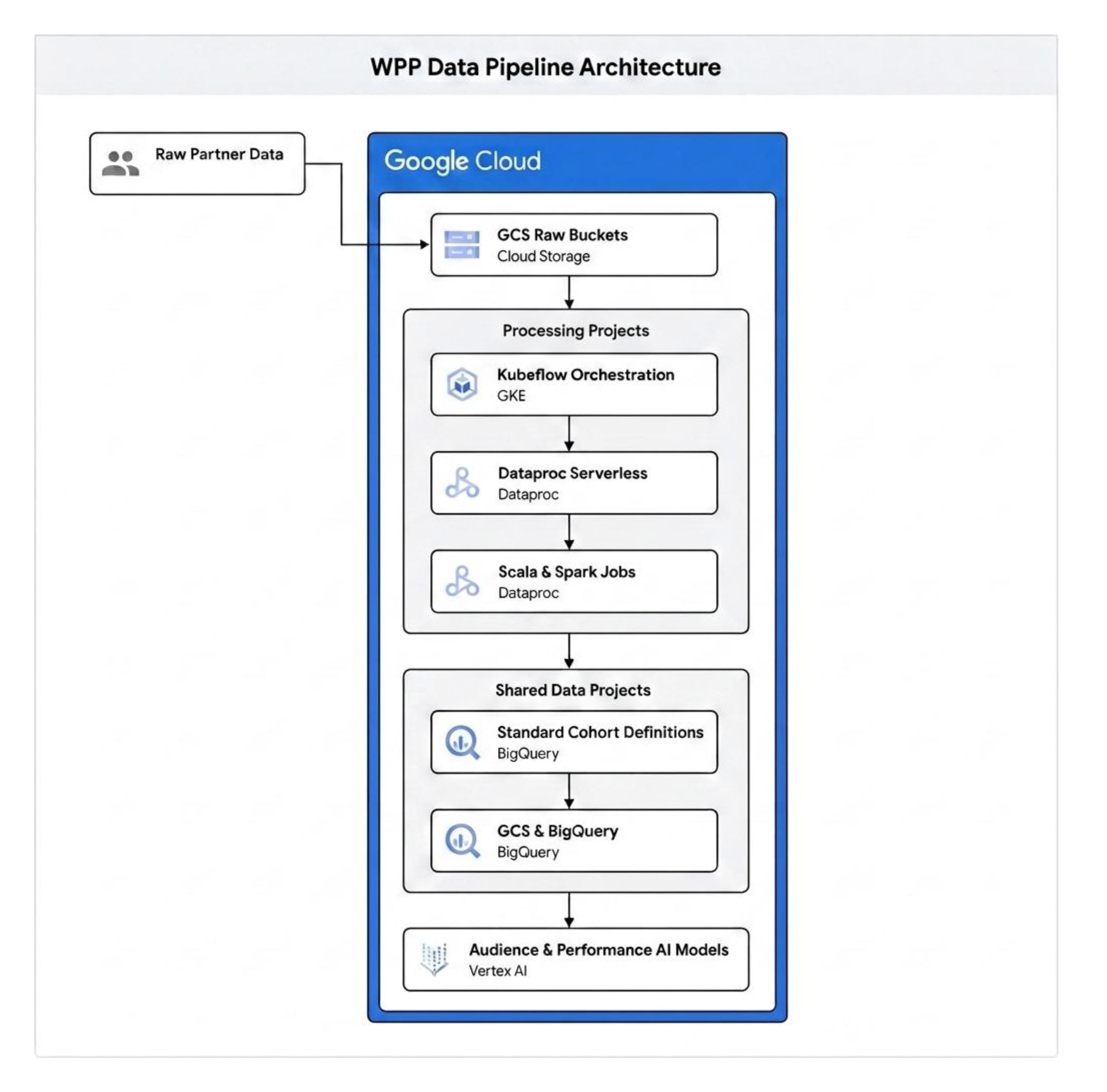
An important part of this effort was accelerating data availability and centralizing management. To do this, WPP adopted a service-based project structure for its current production environment. Rather than isolating every workload into separate silos, its engineering team centralized Google Cloud Storage (GCS) and BigQuery into dedicated, shared data projects, while also segregating the compute and processing workloads into distinct processing projects.

This structure simplified the core team’s user experience and ensured that all data consumers interacted with a unified source of truth. Because data from WPP’s various product lines lives in shared infrastructure, it was essential that security be strictly enforced at a granular level. By directly applying identity and access management (IAM) controls at the individual GCS bucket and BigQuery dataset levels, the company’s teams only see the data they’re  authorized to access.

At the same time, raw data from various partners lands in dedicated GCS buckets in order to keep the raw inputs organized and isolated. From there, Managed Service for Apache Spark executes custom Apache Spark jobs to cleanse, normalize, and canonicalize information into standardized cohort definitions (SCDs). By utilizing a serverless architecture combined with Kubeflow for pipeline orchestration, WPP’s data engineering team avoided the overhead that often results from managing cluster infrastructure. This allowed them to focus entirely on the data transformation logic fueling the downstream GCS and BigQuery layers  that ultimately feed the company’s audience & performance AI models.

1 WPP Data Pipeline Architecture

What made our collaboration with Google Cloud successful was the balance they struck between uncompromising professionalism when it comes to best practices and timely delivery of incredibly pragmatic, real-world solutions.
- Jonas Dahlbaek
Senior Data Engineering Lead, WPP

Standardizing data into unified cohorts

 When raw data enters WPP’s processing zone, its platform converts it into SCDs that become core concepts used throughout the framework for keying purposes. These are based on five keys: age, gender, geo, product, and interest. But these underlying data definitions are fluid and continuously canonicalized to reflect evolving marketing concepts. As a result, this uniform structure allows WPP to join and aggregate data on a global scale without exposing sensitive underlying particulars or relying on shared identifiers.

The platform's core processing engine was built in type-safe Scala to ensure comprehensive visibility and compliance This custom framework tightly controls how data is transformed, and it inherently supports full source traceability while guaranteeing that every data point within the curated datasets can be traced back to its origin. This is a crucial level of traceability when building enterprise AI applications, as data scientists and auditors must understand exactly what information feeds into the models, even as WPP concurrently prepares to transition to Google Cloud Knowledge Catalog for automated, enterprise-wide data governance in the future.

Working with Google Cloud has been instrumental in accelerating and standardizing our engineering efforts. In a world where massive volumes of fragmented data present a daily challenge, having the right infrastructure is paramount to thriving in the AI age and helps our developers and AI marketers alike.
-Suleman Khan
Product Manager for OI & Google Partnerships, WPP

Standardizing the enterprise software lifecycle

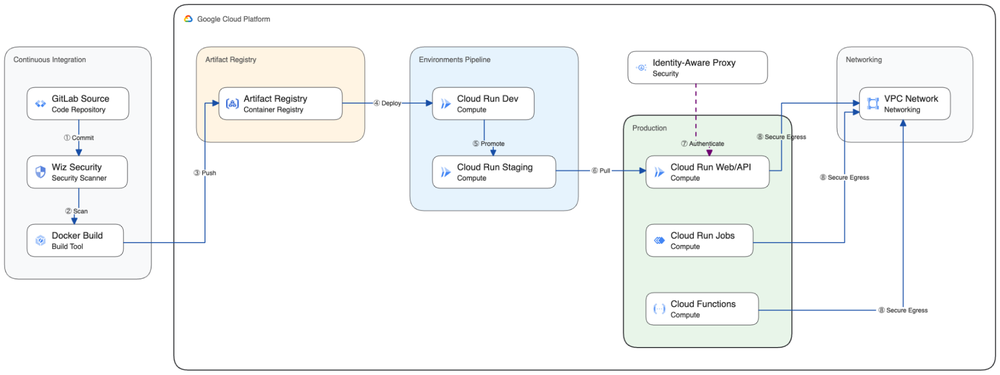
For WPP, even with all these steps in place, processing data is only half the battle. To serve applications and manage the underlying infrastructure, the company’s platform engineering team developed a suite of reusable and centralized GitLab continuous integration and continuous deployment (CI/CD) templates. With this, WPP reduced the cognitive load on individual development teams and ensured that all deployments met strict corporate security standards.

These templates manage various enterprise workloads autonomously. The suite includes universal Cloud Run templates for full-stack web applications and  batch data processing and scheduled pipelines. It also includes a deploy-only template for multi-stage workflows and a Cloud Run functions deployment template for event-driven microservices.

2 WPP Cloud Platform Engineering

Implementing zero-rebuild promotion

Rebuilding container images in a production environment can introduce unnecessary risk and the potential for configuration drift. In order to maintain environmental consistency, WPP embraced a "build once, deploy many" methodology that applied cross-project IAM logic and Google Cloud Artifact Registry configurations.

As part of this process, developers build and test container images in the development environment. Once those exact, immutable container images are validated, they’re promote  directly to production. This zero-rebuild promotion ensures total parity across deployment stages and eliminates unexpected production behaviors. The CI/CD templates also facilitate progressive traffic migration, which allowed teams to route a small percentage of traffic to new revisions before initiating a full rollout.

Immutable deployments. Traceable data. Unshakable trust. When you know exactly what goes into your AI, you can ship at the speed of light.
- Ranjith K Poldas
Associate Director , Devops (I&P), WPP Media

Automating security and intelligent networking

With this modern architecture, enterprise security acts as a foundational enabler for WPP, so it integrated Wiz security scanning directly into the pre-push phase of the CI/CD pipeline to catch vulnerabilities before code merges. The company also utilized Google Cloud Identity-Aware Proxy to enforce zero-trust access across its  internal applications.

To further simplify operations, WPP adopted templates with intelligent virtual private cloud (VPC) logic. This configuration automatically identifies and resolves networking conflicts between legacy VPC connectors and modern Direct VPC access. This automated networking prevents deployment failures and accelerates the release cycle.

Monitoring operational health and driving ROI

Because a resilient platform foundation requires deep observability, WPP’s engineering team now monitors strict operational metrics instead of relying solely on deployment frequency. The team tracks request latency across p50, p95, and p99 percentiles, alongside 4xx and 5xx error rates. It  also monitors container startup times to mitigate cold starts, while tracking overall CPU and memory utilization. This granularity ensures that both data pipelines and serverless infrastructure always remain highly available.

"Navigating a transformation of this scale across multiple complex workstreams—spanning data engineering, platform infrastructure, and AI integration—required more than just alignment; it demanded deep, mutual trust. Working as true partners, Google Cloud and WPP moved in lockstep to deliver production-ready platform capabilities on time."
Yang Yue , Program Manager , Google Cloud

For WPP, operationalizing its data and AI stacks at this velocity provided the necessary infrastructure for its advanced workloads, and the business impact was clear and quantifiable. By building this dual foundation, the company reduced creative and strategy time from four weeks to just three hours. It also saw a 70% gain in production efficiency, a 33x increase in content volume, and  a 2.8x increase in campaign return on investment. In short, by partnering with Google Cloud and implementing a broad suite of products and tools, WPP was able to quickly realize a significant ROI and boost productivity, efficiency, reliability, and security across the company.

  •  

GOL! How TelevisaUnivision streamed the FIFA World Cup to millions with Google Cloud

Live sports broadcasting represents the ultimate stress test for digital media infrastructure, where operational success or failure is measured in milliseconds and observed live by millions of viewers simultaneously. During the 2026 FIFA World Cup, the stakes reached a high for TelevisaUnivision, the leading Spanish-language media conglomerate. With Mexico serving as both a primary host nation and a core contender on home soil, fan engagement created unprecedented demand across Latin America and TelevisaUnivision's ViX streaming platform.

For a marquee broadcaster like TelevisaUnivision, high-stakes events carry direct, long-term brand and reputational implications. Audiences demand uninterrupted, pristine access to every critical moment of play. Playback interruptions during a key goal, login latency at kickoff, or degraded stream resolutions immediately impact customer satisfaction, risking subscriber churn and brand dilution. When streaming tier-1 global sports events, technical execution directly impacts consumer trust, requiring an absolute commitment to zero-downtime availability and flawless performance on the part of the provider.

Why TelevisaUnivision selected Google Cloud  

Navigating Latin America's complex networking ecosystem, which is marked by heavy ISP fragmentation and cross-border transit bottlenecks, required more than a standard vendor relationship. TelevisaUnivision needed a strategic partner willing to make joint investments in network capacity, infrastructure resiliency, and custom feature development. TelevisaUnivision selected Google Cloud's Media CDN based on two foundational differentiators: its architecture, and Google Cloud’s customer focus.

Platform architecture 

Media CDN provided a resilient, globally distributed infrastructure built specifically to absorb massive live-stream traffic spikes while protecting origin infrastructure. Core architectural advantages included:

  • In-ISP deep edge caching: Media CDN embedded cache nodes deep within local ISP networks across Mexico and Central and South America, placing video segments within a single network hop of viewers.

  • Direct ISP peering: By establishing direct peering connections with major regional telecommunications operators such as América Móvil and Telefônica, the architecture completely bypassed congested international transit routes.

  • Dedicated capacity reservations: TelevisaUnivision reserved live event capacity with dedicated allocated headroom in-region. This isolated livestream traffic from "noisy neighbor" risks and comfortably absorbed peak traffic surges.

  • Sub-millisecond sessions with Valkey 9.0: To handle massive traffic spikes during the World Cup, TelevisaUnivision migrated its session store to Memorystore for Valkey 9.0, operating as serverless microservices on edge compute. This architecture delivered sub-millisecond response times for critical authentication and entitlement checks, while providing automatic scaling to process peak API traffic without the need for manual capacity reservations.

Worldcup diagram

Obsession for customer success

Beyond technical capabilities, TelevisaUnivision chose Google Cloud for its joint co-engineering model and deep operational alignment.

  • Joint 24/7 war rooms: For all 104 matches, TelevisaUnivision engineers and Google Cloud specialists operated side-by-side in unified command centers.

  • Proactive monitoring as a service: Google Cloud’s Customer Reliability Engineering teams provided round-the-clock proactive monitoring and automated alerting.

  • Joint operational authority: Combined teams performed extensive pre-tournament stress tests and simulated failovers. During live matches, unified telemetry empowered joint leads to dynamically route traffic and adjust CDN configurations instantly as regional ISP congestion emerged.

Summary

The strategic partnership between TelevisaUnivision and Google Cloud during the 2026 FIFA World Cup established a new benchmark for global sports broadcasting. Across 39 consecutive days of tournament execution, TelevisaUnivision reported that the joint infrastructure delivered:

Total matches broadcast

104 live matches

Platform availability

100% platform availability (0 downtime)

Cumulative viewership

675 million views across TelevisaUnivision & ViX

By uniting localized edge delivery, sub-millisecond serverless compute, and dedicated operational co-engineering, TelevisaUnivision and Google Cloud solidified a battle-tested blueprint for executing marquee live streaming events at record global scale.

  •