Vue lecture
Retirement: Support for PowerShell 7.4 ends on November 10, 2026
Retirement: Support for .NET 8 and .NET 9 ends on November 10, 2026—upgrade your apps to .NET 10
Retirement: Support for Node.js 22 ends on April 30, 2027
[In preview] Public Preview: Flex Nodes for AKS
[Launched] Generally Available: Azure Functions support for PowerShell 7.6
[In preview] Public Preview: Mdsv4 and Msv4 Series Virtual Machines for SAP
New low-cost burstable Amazon EC2 T8i instances are generally available
Today, we’re announcing the general availability of new low-cost burstable Amazon EC2 T8i instances powered by custom sixth generation Intel Xeon Scalable Processors (Granite Rapids), available only on AWS. T8i instances are among the lowest-cost EC2 instances and deliver up to 30% better price performance over previous generation T3 instances. These instances are designed to run a variety of low-to-moderate CPU utilization workloads such as freemium services, training and demo environments, staging and development, data processing, microservices, low-traffic websites, and login gateways.
T8i instances
Thousands and thousands of customers run various lightweight workloads on T3 instances that require small, cost-effective compute configurations. These include microservices architectures, low-traffic websites, development and testing environments, small databases, data processing jobs, and short-duration compute tasks. Many of these customers like T family’s burstable performance model, which provides a baseline level of CPU performance with the ability to burst above the baseline when needed using CPU credits.
As customers modernize their infrastructure, migrate from on-premises environments, adopt event-driven and microservices architectures, and experiment with AI inference workloads, they have asked for newer generation cost-optimized small instances, better price performance to reduce their total cost of ownership, and a seamless migration path that leverages their existing knowledge and tooling.
T8i instances address each of these requests:
- Up to 30% better price performance. Powered by the AWS Nitro System and custom sixth generation Intel Xeon Scalable Processors (Granite Rapids), T8i instances enable customers to lower their total cost of ownership with up to 30% better price performance.
- Up to 70% higher compute performance. T8i instances deliver up to 70% higher compute performance, up to 1.25x higher network bandwidth, and up to 2.4x higher EBS bandwidth compared to T3 instances.
- Seamless upgrade from T3. For existing T3 customers, upgrading to T8i is straightforward. The instances offer the same CPU credit system and the same familiar lightweight compute options customers already know. Customers simply select T8i instead of T3 and immediately benefit from improved price performance.
- Cost-effective entry point for new customers. For customers new to AWS or migrating from on-premises, T8i instances provide one of the most cost-effective entry points to run workloads that need low-to-moderate CPU utilization or for running short-duration compute tasks such as batch processing, event-driven functions, or CI/CD pipelines.
Instance specifications
T8i instances offer four sizes, each with two vCPU offered as a single core. The following table summarizes the specifications.
| Instance size | vCPUs | Memory (GiB) | Baseline Performance /vCPU (%) | CPU credits earned / hour | Network burst bandwidth (Gbps) |
| t8i.nano | 2 | 0.5 | 5 | 3 | Up to 6.25 |
| t8i.micro | 2 | 1 | 10 | 6 | Up to 6.25 |
| t8i.small | 2 | 2 | 20 | 12 | Up to 6.25 |
| t8i.medium | 2 | 4 | 20 | 12 | Up to 6.25 |
Like T3, T8i instances offer unique vCPU-to-memory ratios such as 1:0.25, 1:0.5, and 1:1 that are not offered by other EC2 instances. Like T3, T8i instances utilize the CPU credit system along with the Standard and Unlimited credit configuration modes. Unlimited mode is the default on T8i.
For workloads that need larger instance sizes above T8i offerings (nano, micro, small, and medium), I recommend M8i Flex instances that offer up to 30% better price performance than equivalent previous generation T3 instances along with the flexibility to scale up to 16xlarge.
Now available
Amazon EC2 T8i instances are available today in the following AWS Regions: US East (N. Virginia, Ohio), US West (Oregon, N. California), Asia Pacific (Hyderabad, Malaysia, Mumbai, Seoul, Singapore, Sydney, Tokyo), Canada (Central), and Europe (Frankfurt, Ireland, London, Paris). For Regional availability and upcoming Region expansion, search the instance type in the CloudFormation resources tab of AWS Capabilities by Region.
You can purchase T8i instances via On-Demand instances, and Spot instances with Savings Plan option coming soon. T8i instances support shared tenancy only and do not support Dedicated tenancy or Dedicated Hosts. t8i.micro and t8i.small instances are also available under the AWS Free Tier. To learn more, visit the Amazon EC2 Pricing page.
Try T8i instances in the Amazon EC2 console and send feedback to AWS re:Post for EC2 or through your usual AWS Support contacts.
— Channy
Updated on September 18 — Corrected the memory size for each instance type.
AWS Elastic Beanstalk introduces Cluster Mode
Since the first launch of AWS Elastic Beanstalk in 2011, customers have deployed full-stack applications in Java, .NET, Python, Node.js, PHP, Ruby, and Go, trusting Elastic Beanstalk to manage deployment and infrastructure operations so they could focus on business logic. Fifteen years later, that trust has only deepened, and the service has been rebuilt to match it. Now, AWS Elastic Beanstalk is the application management service on AWS that takes full operational responsibility for your production environments. Bring applications however they exist today: source code, Dockerfiles, or container images. Elastic Beanstalk creates and manages the production environment underneath. You manage your application. AWS manages everything else, deploying, scaling, patching, monitoring, and maintaining it continuously. That operational responsibility stays with AWS, for the life of the application.
We have been rebuilding the operational engine underneath and delivering a series of capabilities that make it more powerful than ever. Elastic Beanstalk now uses AI-powered environment analysis to diagnose health issues and recommend fixes automatically. A new official GitHub Action lets teams deploy directly from their existing CI/CD workflows with a single YAML configuration. And we rebuilt the infrastructure foundation to deliver OpenTelemetry-based observability, traffic-splitting deployments with automatic rollback, event-driven autoscaling, secrets management through AWS Secrets Manager, and HTTPS by default via AWS Certificate Manager.
Today, we’re announcing the next chapter of AWS Elastic Beanstalk: a new fully-managed Cluster Mode that deploys, scales, patches, monitors, and upgrades your applications continuously for the life of the workload. You bring your application. AWS runs it.
A new Cluster Mode is built for teams running a portfolio of applications. Instead of operating each application in isolation, you run multiple applications that share infrastructure powered by Amazon Elastic Kubernetes Service (Amazon EKS), fully managed with a single operational baseline. Multiple applications share resources, so per-application cost decreases as your portfolio grows without adding operational complexity. Whether you run ten applications or a hundred, you manage them through one experience, with the same operational guarantees across every stack.
Elastic Beanstalk Cluster Mode benefits for your workloads:
- Source code to production, any runtime. Upload source code in Java, .NET, Python, Node.js, PHP, Ruby, or Go. Elastic Beanstalk handles containerization automatically through Cloud Native Buildpacks when needed. No Dockerfile and no rearchitecting required. You can bring legacy applications from on-premises or deploy new services in any supported language.
- Enterprise compliance built in. Elastic Beanstalk is HIPAA eligible, PCI DSS compliant, and aligned to SOC 1/2/3 with no additional configuration, so teams in regulated industries can deploy production workloads with the compliance posture they already require.
- Production-grade deployment strategies. All-at-once, rolling, immutable, and traffic-splitting deployments with automatic rollback on failure. Event-driven autoscaling. AWS Secrets Manager integration. All native OpenTelemetry enabling easy integration with most observability backends, including Amazon CloudWatch.
- AI-powered troubleshooting. When something goes wrong, Elastic Beanstalk collects service-side logs and provides AI-generated recommendations to help you resolve issues faster without digging through infrastructure.
A first look of Elastic Beanstalk Cluster Mode
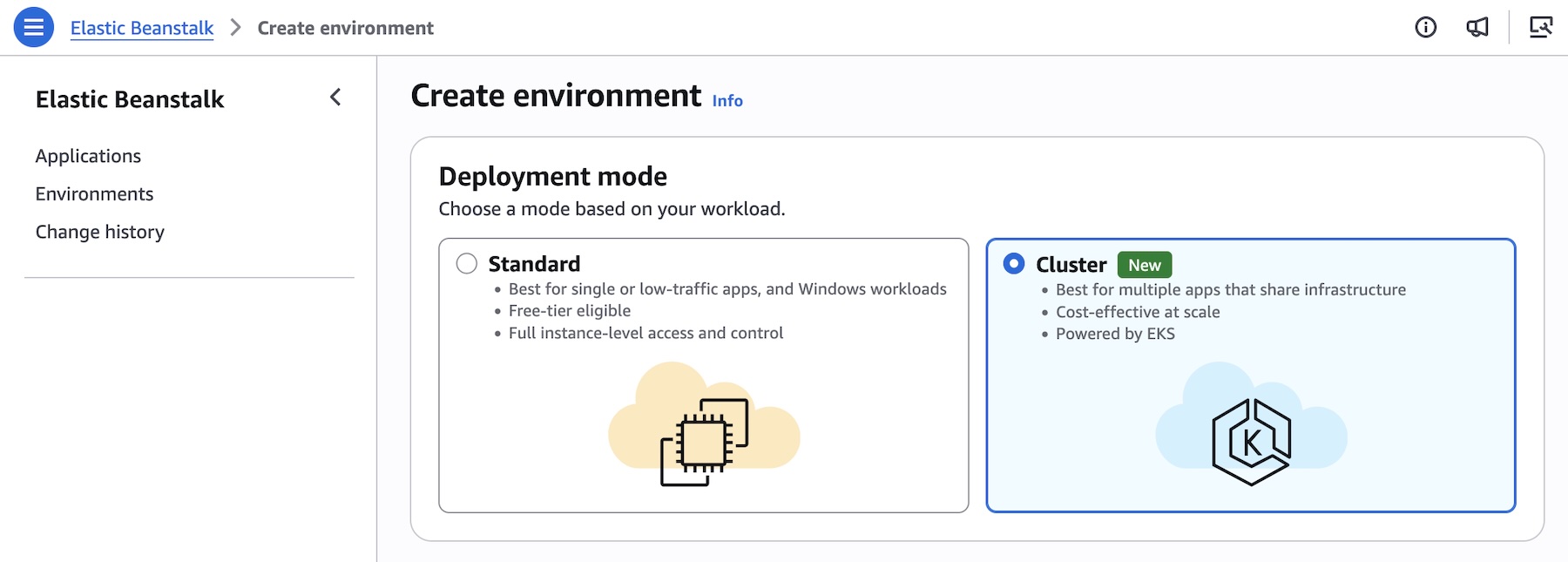
To get started, go to the Elastic Beanstalk console, create a new environment, and choose the Cluster in the Deployment type.
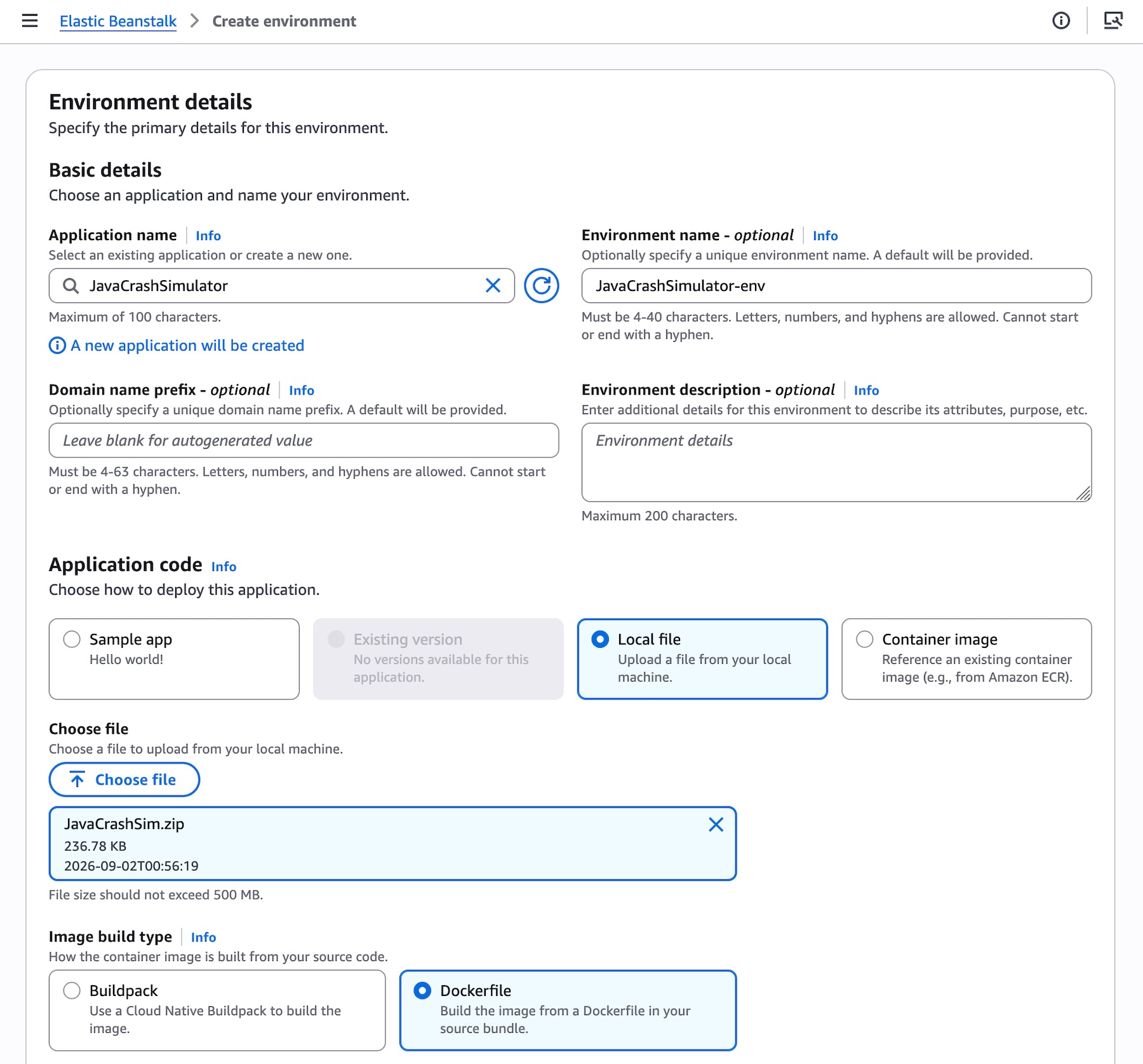
Elastic Beanstalk accepts source code, docker file, or container image to deploy your application. For example, you can provide the application code for your environment by selecting Local file and specifying container image build options. For the rest of the sections, the default values should be good for most scenarios.
Choose Create button and the deployment will begin! Note that the first deployment for a given set of subnets triggers EKS cluster creation, which takes about ten-ish minutes. Subsequent deployments are faster because they reuse an existing EKS cluster.
Here’s what it looks like when deployment is successful:
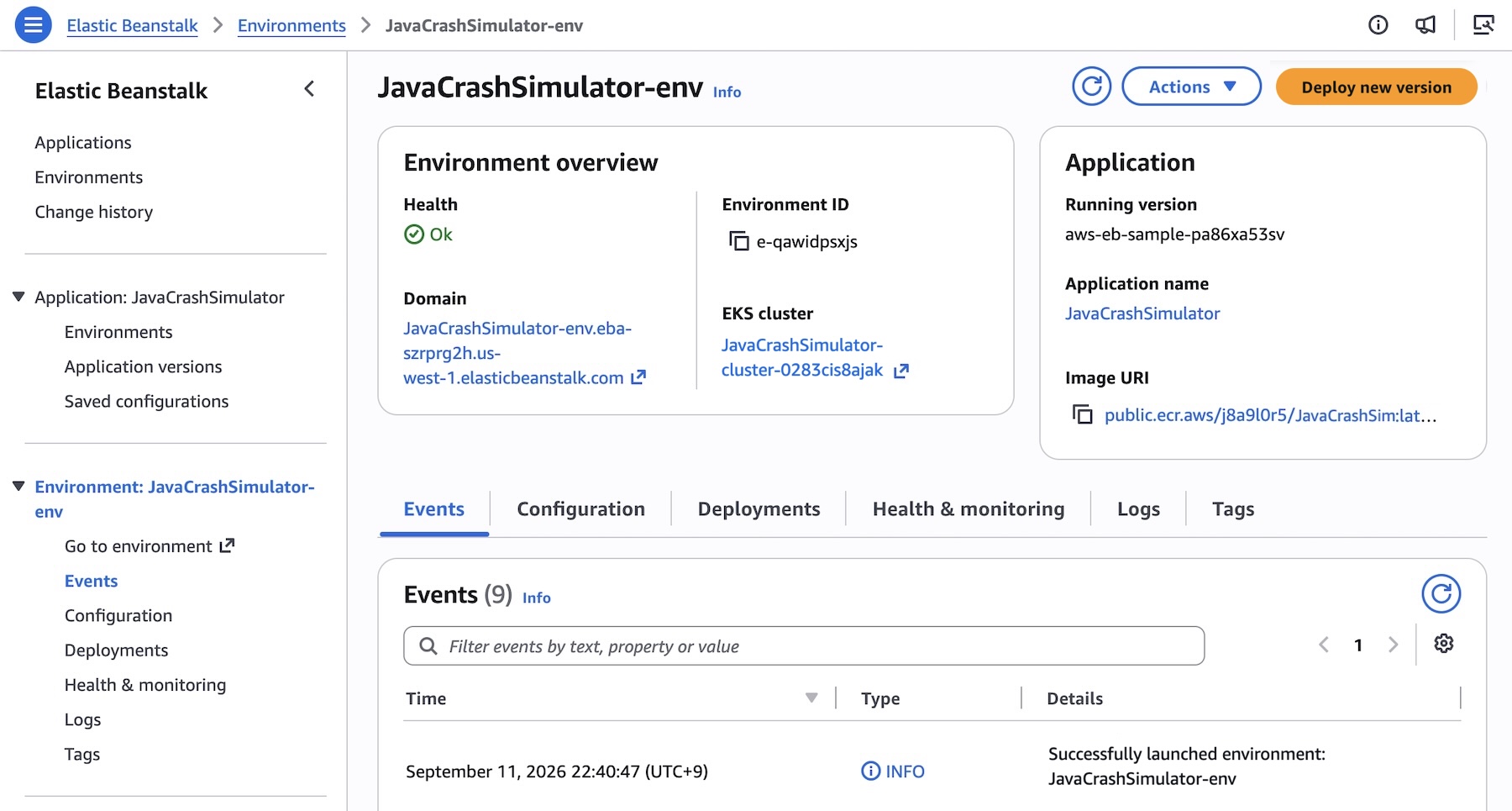
You can also use AWS Command Line Interface (AWS CLI), the EB CLI, or AWS SDKs. For example, consider deploying an application made up of several microservices to Kubernetes. Create an application first.
aws elasticbeanstalk create-application \
--application-name "my-microservice" \
--description "Multi-services demo" \
Each microservice may have pre-built images in Amazon Elastic Container Registry (Amazon ECR). Register them as application versions:
IMAGES=(
"frontend-v1|public.ecr.aws/my-microservices/frontend:v1"
"cartservice-v1|public.ecr.aws/my-microservices/cart:v1"
"paymentservice-v1|public.ecr.aws/my-microservices/payment:v1"
"shippingservice-v1|public.ecr.aws/my-microservices/shipping:v1"
)
for entry in "${IMAGES[@]}"; do
IFS='|' read -r label uri <<< "$entry"
aws elasticbeanstalk create-application-version \
--application-name $APP_NAME \
--version-label "$label" \
--image-configuration Source="{Uri=$uri}" \
--region "us-west-2
echo "Registered: $label"
done
You can set and deploy the corresponding service options for each service. For example, the frontend service is the only service that needs a public internet interface such as Application Load Balancer and also sets a health check path since it’s an HTTP service:
[
{"Namespace": "aws:elasticbeanstalk:eks", "OptionName": "cluster-role", "Value": "arn:aws:iam::0123456789012:rol<...>"},
{"Namespace": "aws:elasticbeanstalk:eks", "OptionName": "node-role", "Value": "arn:aws:iam::0123456789012:role/E<...>"},
{"Namespace": "aws:elasticbeanstalk:eks:environment", "OptionName": "observability-role", "Value": "arn:aws:iam::0123456<...>"},
{"Namespace": "aws:elasticbeanstalk:eks:environment", "OptionName": "subnets", "Value": "subnet-1,subnet-2,subnet-3,<...>"},
{"Namespace": "aws:elasticbeanstalk:eks:environment:autoscaling", "OptionName": "min-replica", "Value": "1"},
{"Namespace": "aws:elasticbeanstalk:eks:environment:autoscaling", "OptionName": "max-replica", "Value": "2"},
{"Namespace": "aws:elasticbeanstalk:eks:environment", "OptionName": "cpu", "Value": "0.5"},
{"Namespace": "aws:elasticbeanstalk:eks:environment", "OptionName": "memory", "Value": "256Mi"},
{"Namespace": "aws:elasticbeanstalk:eks:environment", "OptionName": "memory-limit", "Value": "512Mi"},
{"Namespace": "aws:elasticbeanstalk:eks:environment", "OptionName": "service-port", "Value": "8080"},
{"Namespace": "aws:elasticbeanstalk:eks:alb", "OptionName": "scheme", "Value": "internet-facing"},
{"Namespace": "aws:elasticbeanstalk:eks:alb", "OptionName": "healthcheck-path", "Value": "/_healthz"}
] #frontend-options.json namespaces
Now, create the frontend service environment with these options. You can continue to deploy each service environment in a similar manner.
aws elasticbeanstalk create-environment \
--application-name my-microservice \
--environment-name frontend \
--version-label frontend-v1 \
--tier Name=Cluster,Type=EKS \
--option-settings file:///tmp/frontend-options.json \
Here’s a look at the console once all services are deployed:
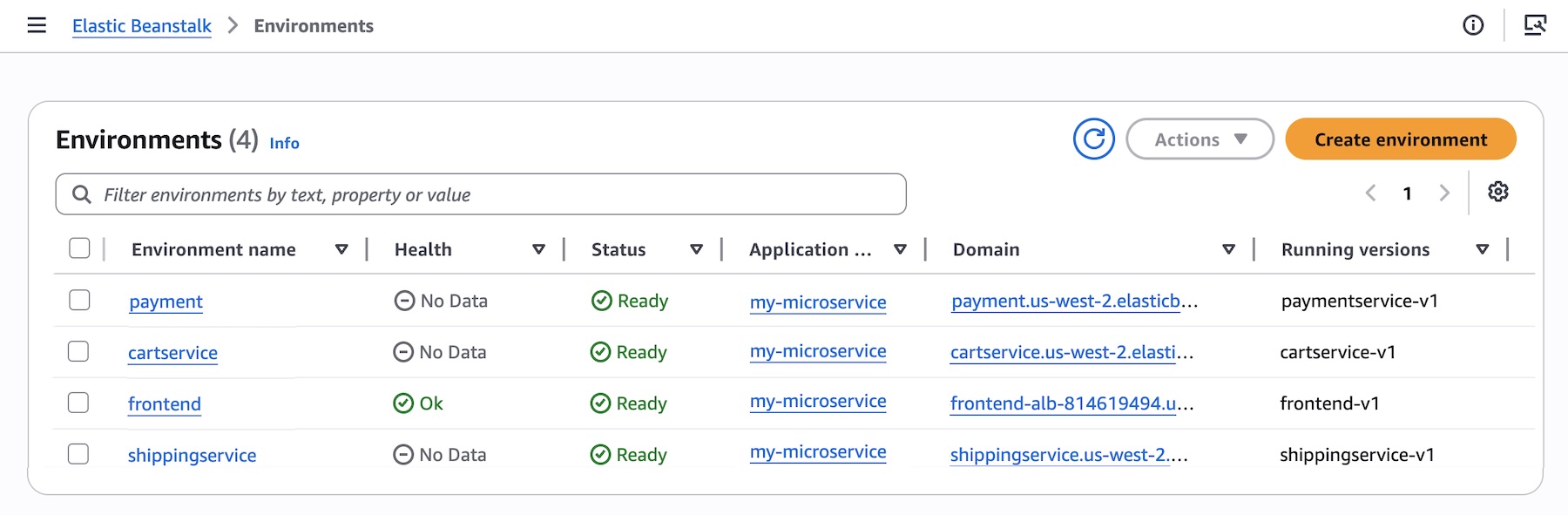
Elastic Beanstalk Standard powered by Amazon Elastic Compute Cloud (EC2) continues to be fully supported. Standard and Cluster Mode environments run side by side within the same Elastic Beanstalk application, enabling teams to migrate one environment at a time at their own pace. Validation checks confirm compatibility before any changes are made, so no environment is forced to move.
Elastic Beanstalk Standard Mode remains the best fit for:
- Single applications or single-environment use cases
- Windows/.NET Framework workloads on IIS
- Applications that cannot be containerized
- Workloads spending under $500/month where the EKS control plane fee and EKS Auto Mode premium add overhead that a single application cannot offset through bin-packing
To learn more about how to deploy and manage your applications in the Cluster Mode, visit the Elastic Beanstalk Cluster Mode documentation.
Now available
AWS Elastic Beanstalk Cluster Mode is generally available today in all AWS Regions that Elastic Beanstalk is available. For Regional availability and a future roadmap, visit the AWS Capabilities by Region. If you want to call APIs, search documentation, find regional availability, and troubleshooting about this new feature, try using the AWS MCP Server and plugins with your preferred AI tool.
There is no additional charge for Elastic Beanstalk Cluster Mode. You pay only for the underlying AWS resources your applications consume, including the EKS control plane fee, EKS Auto Mode compute, Amazon ECR, and Amazon CloudWatch. Note Elastic Beanstalk Cluster Mode is not AWS Free Tier eligible. To learn more, visit the AWS Elastic Beanstalk Pricing page.
Give it a try in the Elastic Beanstalk console and send feedback to AWS re:Post for AWS Elastic Beanstalk or through your usual AWS Support contacts.
— Channy

M4N VM family, now GA: Highest per-core IOPS and throughput for I/O and memory-bound workloads
As enterprise organizations scale mission-critical applications, storage I/O and memory access can become severe operational bottlenecks. Whether its Oracle databases, in-memory databases like SAP HANA, or high-throughput SQL Server clusters, EHR systems, and real-time big data analytics, memory-bound databases often force enterprises to over-provision compute cores (vCPUs) to get the RAM capacity and storage bandwidth they need, driving up costly third-party software licensing fees.
Today, we are thrilled to announce the general availability of the M4N machine series in Google Compute Engine, purpose-built for I/O intensive, high-memory workloads, the second offering in our network- and block-storage optimized VM family. Compared to similar offerings from other hyperscalers M4N provides the highest per-core IOPS and throughput for high-memory instances, and over 20% TCO reduction for Oracle databases.
M4N is also the industry’s first instance of network and block storage optimized with higher memory ratios (up to 26:1) and size (6TB). Powered by 5th Gen Intel® Xeon® Scalable processors and built on Google Cloud's custom Titanium offload architecture, M4N instances deliver up to 25,000 MiB/s (25 GiB/s) of aggregate host storage performance and up to 1 million IOPS when paired with Hyperdisk Extreme — doubling the block storage performance of current M4 instances.
M4N targets workloads that demand both extreme high-density RAM and uncompromising I/O performance, complementing our existing memory-optimized families (such as M1, M2, M3, M4, and X4) by solving specific storage and network bottlenecks for high-throughput enterprise applications.
Built for demanding workloads
|
Workload Category |
Typical Applications |
Why M4N Wins |
|---|---|---|
|
Mission-critical enterprise DBs |
Oracle, SAP HANA, SQL Server, IBM DB2, MySQL, PostgreSQL |
Memory-to-core ratios (up to 26.57 GB/vCPU) paired with 25 GiB/s storage for rapid data ingestion, transaction logging, and zero-stall backup cycles. |
|
Generative AI and RAG data layers |
Milvus, Pinecone, Qdrant, Vespa, Redis, In-Memory Context Caching |
Sub-millisecond similarity search across massive vector indexes in RAM, combined with 400 Gbps network bandwidth for distributed model retrieval. |
|
Enterprise healthcare and ERP |
Epic Systems (Operational Database), SAP ECC, SAP S/4HANA |
Sustained I/O headroom that prevents query latency spikes during peak clinical/transactional hours. |
|
Real-time analytics and EDA |
Electronic Design Automation, Genomic Modeling, In-Memory OLAP |
High memory capacity to load massive datasets entirely in RAM with maximum storage bandwidth for checkpoint dumps. |
Optimizing Oracle licensing costs
Enterprise IT departments struggle with the rising cost of core-based software licensing. For workloads like Oracle database, licensing fees are typically calculated based on the number of vCPUs or physical cores assigned to the instance. Historically, this has forced a difficult trade-off: paying for more compute cores than necessary just to obtain the required amount of RAM and storage performance.
M4N changes this paradigm with its industry-leading high memory-to-vCPU ratio. By providing the highest per-core IOPS and throughput for high-memory instances of all the leading hyperscalers, M4N allows database administrators to:
-
Reduce TCO and licensing overhead: Stop over-provisioning of cores while meeting Oracle database performance density requirements, resulting in over 20% TCO reduction compared to similar offerings from leading hyperscalers.
-
Right-size infrastructure: Allocate the exact amount of compute power needed for the workload while still accessing massive memory pools.
-
Improve cache-hit ratios: With more memory available per core, larger portions of the database can reside in the system global area (SGA), reducing expensive I/O operations and further boosting efficiency.
What customers are saying
Early experiences with M4N show that workload-optimized infrastructure is the engine for transformation.
“Before M4N, meeting our demanding I/O requirements on Google Cloud often required over-provisioning our compute to achieve the necessary performance density. The new M4N instances solve this by delivering high throughput across the smaller to larger shapes.” - Sherri Trojan, Sr Principal Solution Architect, Sabre
"We are delighted to see Google Cloud introduce this next-generation high-performance infrastructure for mission-critical database workloads. The new compute platform demonstrates tremendous potential for enterprise Oracle deployments requiring scalability, resiliency, and performance. We are excited about what this innovation means for customers running Oracle workloads on Google Cloud.” - Bala Kuchibhotla, Co-Founder and CEO, Tessell
"With M4N, Google Cloud continues to push the boundaries of platform co-design. By combining 5th Gen Intel Xeon Scalable processors with Google's custom Titanium offload architecture, M4N delivers the extreme memory capacity, high memory bandwidth, and uncompromising I/O throughput required for the world’s most demanding mission-critical data environments." - Intel
What’s new: Scaling extreme data layers with M4N
M4N bridges two previously separate paradigms in cloud infrastructure: large memory footprints and extreme I/O performance. Engineered with custom Titanium offloads, M4N minimizes I/O bottlenecks without requiring infrastructure add-ons or compromises on memory density. Let’s take a look at how M4N fits into these environments.
1. Enabling high bandwidth data transfer
For workloads with large memory footprints, M4N provides:
-
Superior VM-to-VM bandwidth: Delivers up to 400 Gbps aggregate VM-to-VM network bandwidth and up to 50 Gbps single-flow bandwidth within the same VPC, unlocking non-blocking data exchange for distributed database clusters and real-time streaming data layers.
-
Enhanced internet and egress throughput: Enjoy up to 200 Gbps internet egress bandwidth and up to 48 MPPS packet processing performance.
-
High bandwidth out-of-the-box: Achieve full performance without needing to purchase or configure premium Tier_1 networking add-ons.
2. Dynamic storage performance with Hyperdisk
Paired with Google Cloud's next-generation storage portfolio, M4N with Hyperdisk lets you independently tune IOPS, throughput, and capacity:
-
Hyperdisk Extreme (HdX): Delivers up to 25 GiB/s aggregate block storage throughput and 1,000,000 IOPS—double the storage performance of standard M4. This is great for rapid database recovery, transactional checkpointing, and instant in-memory index reloads.
-
Hyperdisk Balanced (HdB): Scales up to 20 GiB/s throughput and 640,000 IOPS for cost-effective enterprise storage at scale.
M4N machine types and specifications
M4N instances are offered across three distinct memory-to-vCPU ratio tiers, scaling from 16 to 224 vCPUs and up to 5,952 GB of DDR5 RAM. M4N also offers predefined VM shapes across three distinct memory-to-vCPU ratios to match specific workload requirements, with support for Resource-based Committed Use Discounts (CUDs). Details here.
Get started today
The M4N instances are now available in select regions around the globe. To learn more about how the M4N family can enhance your memory- and I/O-bound applications and reduce your licensing costs, contact your account representative or explore the documentation.

Announcing: New Windows App client-side endpoints for Azure Virtual Desktop
Google is a leader in The Forrester Wave™: Public Cloud Platforms, Q3 2026
We are excited to share that Google Cloud was named a Leader and received the highest score in the ‘current offering’ category in the Forrester Wave™: Public Cloud Platforms, Q3 2026 report, which examines the 10 most significant public cloud providers across 30 comprehensive criteria, Google also received the highest possible score in 23 out of 30 evaluation criteria, including, but not limited to vision, innovation, AI development services, database services, analytics services, containers and kubernetes services, modernization services, and security services. We believe Forrester’s recognition confirms our belief that to lead in the agentic era, you need a complete, integrated platform that’s engineered from the ground up, from silicon to systems to models.
Access the complimentary report: The Forrester Wave™: Public Cloud Platforms, Q3 2026.
Build on co-designed infrastructure proven in global enterprises
For over a decade, our infrastructure engineers, application developers, and AI researchers worked side by side to co-design infrastructure to power Gemini, Search, YouTube, Maps, and Gmail. We couldn't simply buy the platform and infrastructure we needed; we had to invent it. This led to the creation of everything from TPUs, the Transformer architecture, Kubernetes, Axion, and now Gemini.
In the agentic era, you need an integrated AI stack, where compute, orchestration software, modernization tools, and global networks operate together to give you more value from your investments — even if you’re not working at the frontiers of AI research. At Google Cloud, we’ve worked tirelessly to bring these breakthrough innovations to leading enterprises, startups, and frontier labs to help them achieve new levels of scale and efficiency, and we believe Forrester’s evaluation validates that strategy:
“Google Cloud’s vision is to enable the ‘agentic enterprise,’ and AI already permeates its platform, positioning the company to push further up the tech stack toward business users who increasingly shape AI adoption in the enterprise. Google Cloud is a good fit for enterprises seeking rapid technology innovation and a broad AI-enabled cloud platform.” - The Forrester Wave™: Public Cloud Platforms, Q3 2026 report
Run agents quickly on a secure, flexible platform
Most traditional infrastructure can’t keep pace with agents, and enterprises need a scalable alternative. But you don’t want a new, greenfield platform just for AI agents. Kubernetes is the proven industry standard for modern enterprise applications — from microservices and transactional databases to real-time LLM inference. We are evolving Google Kubernetes Engine (GKE) and our operations tooling so organizations can scale autonomous agents alongside traditional workloads on a single, proven platform.
Forrester gave Google Cloud the highest scores possible in Container and Kubernetes services, Serverless/FaaS services, and Operations management services, noting:
“Operators will find strong offerings in operations management as well as containers and Kubernetes services. Our evaluation did not identify significant capability gaps.”
Over the past three months, we’ve enhanced our infrastructure portfolio to help teams scale agentic workloads with enterprise predictability. Recent updates let you:
-
Safely execute untrusted agent code alongside traditional workloads with default-deny security using GKE Agent Sandbox (GA) and Cloud Run Sandboxes (preview), which provision lightweight, gVisor-isolated boundaries for your agent in under a second (and up to 300 sandboxes/sec per cluster).
-
Eliminate up to 90% of idle compute costs by serializing your container RAM state directly to Google Cloud Storage with GKE Pod Snapshots, allowing you to suspend idle agent sessions in ~100ms and resume them in ~280ms.
-
Cut time-to-first-token (TTFT) up to 70% and double cache-hit rates with predictive routing in GKE Inference Gateway, which uses a continuously trained ML model to make routing decisions based on real-time traffic data.
Ground your agents with real-time enterprise data
Agents are only as effective as the context that grounds them. Traditional distributed data topologies separate operational databases from analytical systems through fragmented, multi-hop pipelines. In the agentic era, this divide introduces multi-hop latency, stale context, and governance friction.
Our Agentic Data Cloud evolves the enterprise data platform from a static repository into a dynamic reasoning engine. It unifies transaction processing and analytical intelligence into an active system of action, providing the real-time context and deterministic responsiveness that autonomous workflows require. Google received 5/5 scores across the Database services, Analytics services, Data integration services, and Data Governance services criteria:
“Google Cloud’s traditional strength in database services and analytics drives strong performance, including multicloud and hybrid capabilities, along with an Agentic Data Cloud that bridges analytics and transactional systems.”
Over the past three months, we’ve introduced key capabilities to the Agentic Data Cloud to help customers unify their data estates:
-
Enable agents to query live financial and supply chain records without costly data movement using SAP BDC Connect for BigQuery (GA), which provides bi-directional, zero-copy data sharing between your SAP systems and BigQuery.
-
Map and infer business meaning across your entire data estate with Knowledge Catalog. You can now aggregate native context across your Google and partner data platforms, semantic models, and third-party catalogs, unifying them into a single, governed source of truth.
-
Access live data from Iceberg and BigQuery from the PostgreSQL data plane with Lakehouse federation. Perform live joins between AlloyDB's transactional data and historical insights in BigQuery or Iceberg without any data movement. You can also replicate data continuously to BigQuery and, importantly, to Iceberg tables directly from AlloyDB with Datastream.
The benchmark is set: Build what’s next on Google Cloud
We are honored that Forrester has named Google Cloud a Leader in The Forrester Wave™: Public Cloud Platforms, Q3 2026. We believe this recognition validates decades of foundational research, disciplined full-stack co-design, and our commitment to building an open, reliable cloud.
The era of fragmented infrastructure has come to an end. Whether your organization is an AI research lab scaling models across one million accelerator chips, a global financial exchange settling trillions in clearing systems, or an enterprise empowering millions of users with autonomous workflows, Google Cloud delivers the performance, scale, security, and data foundation to build what’s next.
Take the next step in your cloud journey:
-
Download the full report: Read the complete analysis in The Forrester Wave™: Public Cloud Platforms, Q3 2026.
Google Cloud partners with CIQ to provide an enterprise-grade experience for Rocky Linux
At Google Cloud, we strive to offer a great customer experience for enterprises by building a robust and supported platform for running all Linux-based workloads.
This mission is why we were one of the first cloud providers to offer purpose-built Rocky Linux images when Rocky Linux debuted last year as a replacement option for CentOS. We were also one of the first hyperscalers to sponsor the Rocky Enterprise Software Foundation (RESF) to support the open source community behind this Linux distribution. With these efforts, we’re pleased that many customers are already running Rocky Linux in Google Cloud today.
Today, we’re excited to announce that we’re taking another step in furthering the support we provide for Rocky Linux. We’re partnering with CIQ—the company started by CentOS co-founder and Rocky Linux founder Gregory Kurtzer featuring core expertise across Linux, cloud, HPC, containers and security— so we can provide customers a new and improved experience for Rocky Linux on Google Cloud.
Starting today, customers can leverage Google’s support offerings to file support cases for Rocky Linux. Google support teams and the Rocky Linux experts at CIQ are working together to address customer issues to help ensure they get enterprise-grade support. If you already have a paid support plan with Google, you will be able to open a case for an issue related to Rocky Linux. Google teams can expediently help resolve the issues, backed by CIQ expertise, giving you an integrated experience of using Rocky Linux on Google Cloud.
"We asked ourselves, how do we bring the best value to everyone? Through this partnership, anytime you use our Rocky Linux on Google Cloud, both Google and CIQ jointly have your back! From the cloud platform itself, all the way through the enterprise operating system, every aspect of using Google Cloud is supported by a single call to Google, and together, we are your escalation team.”—Gregory Kurtzer, CEO of CIQ and Founder/Director of Rocky Linux and the RESF
In addition to CIQ-backed support for Rocky Linux, Google is also working with CIQ to provide a streamlined product experience - with plans to include performance-tuned Rocky Linux images, out-of-the-box support for specialized Google infrastructure, tools to help support easy migration, and more. We’re doing these updates in a community-friendly way. Together with CIQ, Google is helping to create a Rocky Linux Cloud SIG that aims to provide optimized, standardized, and simplified Rocky Linux experience.
If you’re currently looking for alternatives to CentOS as it reaches end of life, Rocky Linux on Google Cloud can have you covered both from a product and support perspective. So, take Rocky for a spin if you haven’t already, and if you have questions or suggestions on how we can help you, please don’t hesitate to reach out to us. To learn more, please also join us for a webinar discussion on April 6th 2022 at 11.00am PT.
[Launched] Generally Available: TLS/SSL certificate and end-to-end TLS encryption support for Azure Functions Flex Consumption
[Launched] Generally Available: Azure Ephemeral OS Disk with full caching for VM/VMSS
[Launched] Generally Available: Azure Developer CLI (azd) Extension Framework
Google named a Leader in 2026 Gartner® Magic Quadrant™ for Strategic Cloud Platform Services
For the ninth consecutive year, Gartner® has named Google a Leader in the Gartner Magic Quadrant™ for Strategic Cloud Platform Services, positioned furthest for Completeness of Vision.
We believe this recognition reflects our longstanding dedication to helping customers build and scale their most demanding workloads reliably and securely on Google Cloud. As we enter the agentic era, we're accelerating their journeys with a dynamic infrastructure, and connecting enterprise apps, data and agents on a single, flexible platform for predictable cost and performance.
What’s driving this momentum? There are three major advantages that we feel set Google Cloud apart:
-
A co-designed, unified technology stack across custom silicon and hardware systems, open software and orchestration, frontier models and agentic applications.
-
A dynamic infrastructure that helps you securely connect and scale your users, data, apps, and agents everywhere.
-
Digital sovereignty with genuine choice, giving organizations total control over their data without sacrificing essential cloud functionality.
We are committed to helping our customers innovate and deliver at scale while giving them the flexibility, performance, and control they need. Let’s dive into three design principles that Google Cloud lives by as we continue to build and enhance our infrastructure:
1. Accelerate AI with a co-designed stack without lock-in
Google Cloud is the only provider to deliver a complete, first-party AI stack that is deeply co-designed from silicon to agentic applications. Our infrastructure team works with Google DeepMind researchers to co-design and optimize every layer of our technology stack. From custom silicon, like Google TPUs and Arm-based Google Axion processors, to Google Kubernetes Engine (GKE) and Gemini models, our system delivers exceptional performance and predictable costs.
Co-designing hardware and software creates massive operational efficiency, but it doesn't mean creating a closed ecosystem. We remain deeply committed to open source and open standards across every layer of the stack including frameworks like llm-d for distributed inference, benchmarking for open models with GKE Prism, and eliminating hardware lock-in with TorchTPU for PyTorch compatibility across TPUs and GPUs. You get the full power of a vertically co-designed stack while maintaining complete freedom across models, frameworks, and silicon. Combining all of these deeply integrated components means building an AI Hypercomputer, capable of exceptional scale, performance, and efficiency. This is the same infrastructure foundation chosen by nine of the top ten AI labs globally.
2. Scale quickly and economically with a dynamic infrastructure
Today, demand for AI resources is skyrocketing. Internally at Google, our data centers now process 3.2 quadrillion tokens monthly, roughly 7x more than last year1. For enterprise leaders navigating this shift, scaling AI systems are notoriously difficult to architect, resource-intensive, and bursty, which can lead to scaling bottlenecks and large pools of underutilized compute.
Organizations need a dynamic infrastructure to automate capacity management, modernize business applications at their own pace, and securely connect data, apps, and agents to drive optimized global experiences.
To thrive at an agentic scale, you need infrastructure capable of operating as a single system. With Google Cloud, you can:
-
Kick-start your AI transformation using Gemini-powered tools to intelligently map and modernize core apps, turning static legacy systems into dynamic foundations for AI and agents.
-
Choose from a wide range of workload-optimized compute types and configurations. You can combine predefined and custom CPU shapes, NVIDIA GPUs, and Google custom silicon (TPUs and Axion CPUs), which are designed to deliver exceptional performance-per-dollar for AI and Enterprise workloads.
-
Connect your enterprise and AI infrastructure on a single, flexible control plane with Google Kubernetes Engine. This includes capacity management capabilities like Dynamic Workload Scheduler to preschedule capacity for planned events and dynamic resource allocation to define advanced rules that dictate how resources are consumed, helping to maximize utilization and reduce costs.
-
Simplify day two operations using Gemini Cloud Assist to proactively identify, troubleshoot, and resolve operational issues for your new agent-based workflows.
-
And finally, run your workloads across hybrid and multicloud environments with Cross-Cloud Interconnect, leveraging Google’s 10+ million kilometer private fiber backbone to deliver up to 40% higher performance than public internet routing and automated delivery in minutes2.
By adopting a unified foundation of dynamic infrastructure, adaptive applications, and responsive systems, organizations can establish the resilient, high-performance infrastructure necessary to lead in this new technological frontier.
3. Embrace digital sovereignty with more choice and security
You shouldn’t have to compromise between modernization, frontier AI capabilities, and regulatory control. Sovereign Cloud from Google gives you access to Gemini and open-weight models across sovereign platforms with three flexible deployment options:
-
Data sovereignty and control: Retain complete control over your data’s location and cryptographic authority with Google Cloud Data Boundary. Manage your encryption keys outside Google infrastructure using External Key Management (EKM) with Key Access Justifications (KAJ), while enforcing precise geographic processing and storage boundaries across both Google Cloud and Google Workspace.
-
Local compliance and regional operations: Run your applications on physically and logically separated regional clouds operated exclusively by local partners, built on Google Cloud dedicated for European customers. In France, S3NS delivers PREMI3NS, providing a standalone sovereign cloud that has achieved the SecNumCloud 3.2 qualification from the French National Agency for the Security of Information Systems (ANSSI). Dedicated sovereign cloud operations operated by Thales are also coming soon to Germany.
-
On-premises and air-gapped flexibility: Bring Google Cloud capabilities directly to your on-premises environment via Google Distributed Cloud (GDC). GDC offers two distinct deployment modes: air-gapped, a fully-managed, self-contained environment operating with zero connectivity to the public internet for public sector, defense, and regulated enterprise workloads; and connected, allowing you to run workloads on your hardware locally while leveraging Google Cloud’s centralized control plane for unified management.
Accelerate your Cloud journey
Whether you're modernizing core enterprise systems, managing complex compliance requirements, or deploying autonomous AI agents, Google Cloud gives you the performance, scale, and freedom of choice to succeed.
Read the full 2026 Gartner Magic Quadrant for Strategic Cloud Platform Services or explore our AI Hypercomputer page to learn more.
1. Pichai, Sundar. "I/O 2026: Welcome to the Agentic Gemini Era." The Keyword, Google, 19 May 2026
2. During testing, network latency was more than 40% lower when traffic to a target traveled over the Cross-Cloud Network compared to when traffic to the same target traveled across the public internet.