Instant Access for application-consistent restore points on virtual machines (that have Premium v2 or Ultra disks as data disks) is now generally available. With Instant Access, you can begin restoring a disk from a restore point as soon as the snapshot i
As organizations invest in AI, many are discovering a new bottleneck: obtaining data that is both protected and useful. Engineering teams need realistic, production-like data to validate AI-generated changes, train models, test applications, and generate business insights. Yet, privacy initiatives can sometimes make that data harder to access, less representative of real-world conditions, or unable to preserve critical relationships between records.
The Perforce Delphix“2026 State of AI and Data Privacy Report” highlights this challenge. Among surveyed organizations, 26% say privacy controls make production-quality data harder to obtain, 25% struggle to preserve relationships across data entities, and 51% cite data quality challenges.
“Protecting data isn’t enough if it can no longer support the systems that depend on it.”
Protecting data isn’t enough if it can no longer support the systems that depend on it. For engineering teams, the question is whether their data protection strategies can preserve the qualities that make data valuable in the first place. You need a well-rounded data strategy with tools that maintain referential integrity and relationships across your environments.
What these statistics mean for practitioners
At first glance, statistics from the report, like “51% of enterprises cite data quality challenges,” may sound like a purely governance issue.
In practice, they represent engineering problems. Low-quality datasets can produce:
“When an AI model is trained on incomplete or distorted data, its outputs become less reliable.”
When an AI model is trained on incomplete or distorted data, its outputs become less reliable. When test environments contain unrealistic data, defects can escape into production. When analytics datasets lack consistency, teams spend more time validating results than acting on them.
Data protection and utility are not opposing goals
A common misconception is that organizations must choose between privacy and innovation, but the most successful organizations know that compliance, quality, and speed can and need to work together.
Connected enough to preserve referential integrity.
There’s a two-fold goal in the AI era: reduce sensitive data exposure while also creating trusted data that remains valuable after protection. All too often, enterprises sacrifice compliance for innovation or speed. That’s a big reason 84% of respondents in our report have a data privacy exception in their non-production environments.
“There’s a two-fold goal in the AI era: reduce sensitive data exposure while also creating trusted data that remains valuable after protection.”
Organizations can only move at AI speed when they have access to trustworthy data that accurately represents production conditions. When privacy controls degrade quality, limit realism, or restrict access to representative datasets, the data layer becomes the new bottleneck.
Why referential integrity matters more than ever
Many discussions about data privacy focus on masking sensitive fields. However, masked data that loses referential integrity between entities can create a different kind of risk.
A customer, order, or payment record may still exist, but if the relationships connecting those records break during protection processes, the data no longer resembles reality. Take billing validation, for example. It needs referential integrity when a customer has multiple products, charges, and invoices across several database tables to produce the correct products or make accurate charges.
Broken relationships are especially problematic for modern AI and analytics systems. Analytics pipelines depend on consistent identifiers to join information across sources. AI and machine learning workflows depend on complete business context to identify patterns and make predictions. Software testing depends on realistic relationships between records to validate application behavior accurately.
Testing environments can fail to expose production issues.
Teams lose trust in protected datasets.
Importantly, these failures are often difficult to detect. Pipelines may continue running successfully while quietly producing degraded outcomes, which can be a very costly mistake.
This helps explain why 25% of surveyed organizations cited preserving relationships across data entities as a significant challenge. For practitioners, that statistic is a warning that privacy controls can unintentionally undermine the quality of AI and analytics initiatives if they fail to preserve business context.
Keep in mind that not all data protection solutions are created equal — enterprise-grade masking algorithms are key to preserving relationships. When applied consistently and at scale, these algorithms ensure the same input produces the same masked output across your systems and environments. Other masking approaches might be done piecemeal, resulting in broken relationships.
What engineering teams should measure
Many organizations measure privacy success through compliance metrics alone. However, AI-driven environments require a broader definition of success. Engineering leaders should evaluate privacy initiatives against several dimensions:
Data quality: Does the protected dataset accurately reflect production conditions?
Realism: Can developers, data scientists, and analysts use the data confidently for their intended purpose?
Referential integrity: Do relationships remain consistent across applications, tables, environments, and data sources?
Accessibility: Can teams obtain compliant data without introducing delays?
Provisioning speed: How quickly can trusted datasets be delivered when needed?
These measurements help organizations determine whether privacy efforts enable AI outcomes or create new obstacles.
Designing for governance by default
As AI adoption grows, privacy cannot remain a separate process that occurs after development begins. Organizations should instead map the entire data lifecycle, from data request and discovery to reuse and retirement.
This approach helps ensure governance is built into workflows rather than applied as a late-stage checkpoint. It also provides stronger auditability, reduces compliance exceptions, and gives teams greater confidence that protected datasets remain fit for purpose.
Most importantly, it aligns privacy objectives with business outcomes instead of treating them as competing priorities.
Trusted data will become a competitive differentiator
The need for test data — in volume, coverage, and scale — is booming as agentic development continues to rise. AI has also increased the volume of change enterprises can generate, but the challenge of validating that change remains unsolved.
That responsibility still belongs to data. The organizations that gain the most value from AI will not necessarily be the ones with the most advanced models. They will be the ones with the most trustworthy data foundations — using a portfolio approach that combines data virtualization for speed, masking for security, and synthetic data for coverage as needed.
“In the AI era, trusted data, not fast model output, may be the ultimate competitive advantage.”
The research points to a clear lesson: If privacy controls uphold realism, quality, relationships between records, or access to representative datasets, they can enable AI success.
As enterprises continue investing in AI and data privacy, the real objective should be ensuring protection and utility coexist. Because in the AI era, trusted data, not fast model output, may be the ultimate competitive advantage.
Support for PowerShell 7.4 will
end on November 10, 2026, please transition to PowerShell 7.6. Your Azure Function apps will continue to run, but security patches and updates will no
longer be provided and customer support for
PowerShell 7.4 will be disco
Support for .NET
8 and .NET 9 will end on November
10, 2026. Please transition to .NET
10 by that date. Your
Azure Function Apps will continue to operate,
but security updates will no longer be provided, and support for .NET 8 and
.NET 9 on Azure Function
Support for Node.js 22 will end on April 30, 2027, please transition to Node.js 24 by that date. Your Azure Function apps will continue to run, but security patches and updates will no longer be provided and customer support for Node.js 22 will be discont
Last week, Claude Fable 5.1 became available on AWS. According to Anthropic, Claude Fable 5.1 delivers frontier intelligence for ambitious tasks across coding, scientific research, and enterprise workflows. Claude Fable 5.1 is built for long-running, high-stakes work that runs for hours and spans many applications. It can own more of a software project on its own, handling features across an entire codebase, code review, and performance work over extended sessions.
Anthropic has designated Fable 5.1 a Covered Model, a category of Claude models that carry additional data retention, safety review, and access policies wherever they’re offered. Claude Fable 5.1 is subject to data retention for up to 30 days and human review by Amazon personnel, with a new aws_reviewdata retention mode. In this mode, AWS retains your prompts and outputs for human safety review within the AWS boundary. The provider_data_share mode is legacy, and Amazon Bedrock does not share your data with the model provider. In addition, Enterprise Frontier Safeguards (EFS), built in partnership between AWS and Anthropic, will let eligible customers use Covered Models while keeping their data in a cloud environment they control.
Last week’s launches
Here are some launches that got my attention:
Amazon Linux 2027 (AL2027) in public preview: AL2027 is the next version of the Amazon Linux operating system. It runs on kernel 7.1+, purpose-built for cloud-native workloads on AWS with performance, scale, and security in mind. Built on AL2023’s baseline, AL2027 is designed for customers who need a secure, stable, and AWS-native operating system running web applications, databases, containerized microservices, AI/ML workloads, and large-scale infrastructure.
Amazon EC2 R9g and R9gd memory-optimized instances: These instances are powered by AWS Graviton5 processors, delivering the best price performance for memory-intensive workloads running on Amazon EC2. R9g and R9gd instances deliver up to 25% better compute performance compared to AWS Graviton4-based R8g and R8gd instances. They are up to 30% faster for databases, up to 35% faster for web applications, and up to 35% faster for machine learning. To learn more, read Daniel’s blog post.
AWS Lambda SnapStart for container image functions: Lambda SnapStart is an opt-in capability that makes it easier for you to build highly responsive and scalable applications without provisioning resources or implementing complex performance optimizations. Previously, SnapStart was only supported for managed runtimes (Python, .NET, and Java). You can now use SnapStart for container images to reduce startup times from several seconds to as low as sub-second for latency-sensitive workloads such as ML inference and interactive APIs.
AWS Agent Registry now generally available: AWS Agent Registry provides a private, governed catalog and discovery layer for agents, tools, skills, MCP servers, and custom resources within your organization. In addition to the capabilities launched in preview (manual and URL-based record creation, approval workflows, semantic and keyword search, and AWS CloudTrail audit trails), Registry now adds new enterprise features. To learn more, visit the AI Blog post.
Amazon Redshift now supports Apache Iceberg v3 tables: You can read from and write to Apache Iceberg v3 tables in your data lake of Amazon Redshift. With this launch, Amazon Redshift introduces support for default column values, row lineage, and deletion vectors. Amazon Redshift’s Graviton based provisioned and serverless clusters support the new v3 format. To learn more, visit Apache Iceberg v3 features in Redshift.
For a full list of AWS announcements, be sure to keep an eye on the What’s New with AWS page.
Other AWS news
Here are some additional projects and news items you may find interesting:
AWS named a Leader in the 2026 Gartner Magic Quadrant for Strategic Cloud Platform Services: For the 16th consecutive year, Gartner has recognized AWS as a Leader in the 2026 Gartner Magic Quadrant for Strategic Cloud Platform Services, and once again placed AWS highest on the Ability to Execute axis. We believe this recognition reflects our commitment to delivering the broadest and deepest set of cloud capabilities from infrastructure and AI to security and operations, so you can build, innovate, and scale with confidence.
AWS Certified AI Business Strategist: This new certification targets professionals who evaluate, champion, and scale AI initiatives in their organizations: line-of-business leaders driving adoption across their teams, sales professionals articulating AI value to customers, consultants guiding client strategy from experimentation through production, program managers aligning AI investments to business outcomes. Beta exam registration opened September 1, 2026, with exam delivery beginning September 29.
Agentic Security: Detection and Response at Machine Speed: We believe security should evolve ahead of AI adoption, not behind it. That belief drove our team to collaborate with the SANS Institute on a new chapter in the 2026 Cloud Security Exchange eBook, where we lay out a practical framework for securing agentic workloads at enterprise scale. Our chapter goes deeper on securing agentic workloads, with specific architectural patterns, implementation guidance, and frameworks for security teams at every stage of agentic AI maturity, whether you’re evaluating, piloting, or operating at scale.
For a full list of AWS blog posts, be sure to keep an eye on the AWS Blogs page.
Everybody wants to know who built Ox Alpha. But developers using the anonymous coding model with their own private code will have a more pressing question: What happens to that code after they hit send?
Let’s start with the model’s unusual arrival. An anonymous provider listed Ox Alpha on OpenRouter on August 20, and no company has claimed it yet. OpenCode, the open-source terminal agent, debuted it the same day and announced a capacity of 100 trillion tokens a day.
OpenRouter describes a reasoning model built for long-horizon software engineering. The listing sets the context window to 1,048,576 tokens and prices both input and output at 0 for the preview.
Which checkpoint is behind the endpoint matters least for this launch. Which legal entity receives the request, and under which route’s terms, has drawn almost no scrutiny at all.
The reaction has been a detective story of tokenizer probes, benchmark screenshots, and a rotating shortlist of suspects.
Which checkpoint is behind the endpoint matters least for this launch. Which legal entity receives the request, and under which route’s terms, has drawn almost no scrutiny at all.
The identity hunt has been more rigorous than the benchmarking
A developer known as unclecode, who wrote the Crawl4AI crawler, built modelprint to fingerprint anonymous API endpoints. The launch version sent nine infrastructure probes and matched the responses against known models. Ox Alpha lined up with GLM-5.3 on six of the nine.
He is careful about what that proves. Matching fingerprints establish shared infrastructure rather than model identity, he wrote in the project documentation. One lab can serve two different checkpoints from the same stack.
The circumstantial case around Z.ai is strong. The company reportedly previewed GLM-5 on OpenRouter as Pony Alpha, and it announced GLM-5.3 six days before Ox Alpha turned up. Xiaomi’s MiMo team keeps coming up as an alternative, and one reading of the tokenizer behavior points instead at cl100k_base, an OpenAI encoding that sits oddly on a Chinese model.
The benchmark story has held up worse. Ben Davis on X reported a score of 80% across 10 DeepSWE tasks, and he himself flagged the small sample size. A later 113-task run published on GitHub resolved 66 of them (58.4%) over 20 hours of agentic work.
That run is reproducible, whereas the viral screenshot was not. It remains a community benchmark, and the official DeepSWE leaderboard does not list Ox Alpha at all.
One model, different routes, different privacy expectations
The Ox Alpha model page says the provider retains prompts and completions and does not use them for training. OpenRouter’s broader Stealth Program terms, which govern all other use, grant a license described in the document as irrevocable and perpetual. OpenCode says its Zen providers follow zero-retention and no-training policies. Its published list of exceptions does not include Ox Alpha.
OpenRouter currently publishes conflicting disclosures: Ox Alpha’s page says retained data is not used for training, while the incorporated Stealth EULA licenses state that submitted content is used for training and improvement. They produce materially different privacy expectations depending on how a team reaches the model. A developer cannot infer any of it from the model name.
Scale makes that gap operational rather than academic, because coding agents have pushed billions of tokens through Ox Alpha since Thursday. That traffic can include repository contents, test logs, environment output, and screenshots from private production codebases.
If the Z.ai attribution holds, a second diligence question comes up. The Commerce Department added Zhipu AI, the company’s former name, to its Entity List in January 2025. The rule said that the listed entities advance China’s military modernization by developing and integrating advanced AI research. Export controls govern items subject to the EAR, not ordinary API traffic, so nothing here makes the call unlawful. It does put the vendor in a category most enterprise procurement teams screen for.
The reveals that settled anything came through first-party channels
OpenRouter named Quasar Alpha and Optimus Alpha as early GPT-4.1 tests on its own blog. Xiaomi confirmed Hunter Alpha as an early MiMo build itself. Community fingerprinting has pointed to the right lab before, but it has never been enough to close the question.
The fair counterargument is that anonymous previews gather unbiased evaluations ahead of a launch, which is a legitimate reason to run one.
A name will appear on someone’s blog within weeks, long after every team that shipped a private repository through the free preview made that decision without one.
Ox Alpha also carries more restrictive data terms than OpenRouter’s generic Stealth Program terms, which contemplate training on submitted user content.
A name will appear on someone’s blog within weeks, long after every team that shipped a private repository through the free preview made that decision without one.
Starting October 1, 2026, the specified runtime versions Python 2.7, Python 3.8, and PowerShell 7.1 & 7.2. will
no longer be supported by Automation. Runbooks
using these versions may continue to run but will not receive security updates,
bug fixes, or o
Azure Event Hubs Dedicated now supports Confidential Computing, enabling organizations to protect streaming data while it is being processed in memory. By leveraging hardware-based trusted execution environments (TEEs), customers can help safeguard sensit
Azure Site Recovery now supports up to 5x churn (500 MB/s per VM). This major enhancement empowers customers to confidently run high IOPS workloads with Azure Site Recovery, ensuring robust disaster recovery for even the most demanding applications like d
If you manage TLS certificates for your applications, you know the challenge: certificates expire, and when they do, your customers see errors or your service goes down. As certificate validity periods get shorter (the Certification Authority (CA)/Browser Forum mandates reduced maximum validity to 100 days starting March 2027, and to 47 days by 2029), manual renewal processes become untenable. You need automation.
Automatic Certificate Management Environment (ACME) is an open protocol for requesting, renewing, and revoking TLS certificates without human intervention. It’s the same protocol behind Let’s Encrypt, and it’s supported by dozens of clients across every platform.
Today we’re announcing ACME support for public certificates in AWS Certificate Manager (ACM). ACM now provides a fully managed ACME server endpoint that works with any ACMEv2-compatible client, such as Certbot, cert-manager for Kubernetes, acme.sh, or any other client you already use. You can issue public TLS certificates from Amazon Trust Services through the standard ACME protocol.
Before today, if you wanted automated certificate management using the ACME protocol, you relied on external certificate authorities alongside ACM, leading to a fragmented visibility experience. Some certificates lived in ACM, others were managed externally with no central dashboard. PKI administrators had limited ability to control who could request certificates or which domains were allowed.
With ACME support in ACM, you can now set up one or more managed ACME endpoint that allows you to centrally manage and monitor ACME certificate usage across your organization.
As a PKI administrator, you get centralized controls that go beyond basic certificate issuance. You can bind IAM roles to ACME accounts for fine-grained access control over which domains each client can request. You can define domain scopes at the endpoint level to enforce organization-wide policies. And you get centralized monitoring and visibility in the same place: AWS CloudTrail logs every certificate request for auditability, Amazon CloudWatch tracks operational metrics, and ACM sends expiry notifications when certificates are approaching renewal. Using ACM, your PKI team can search all certificates, whether issued through the ACM console, an API call, or ACME.
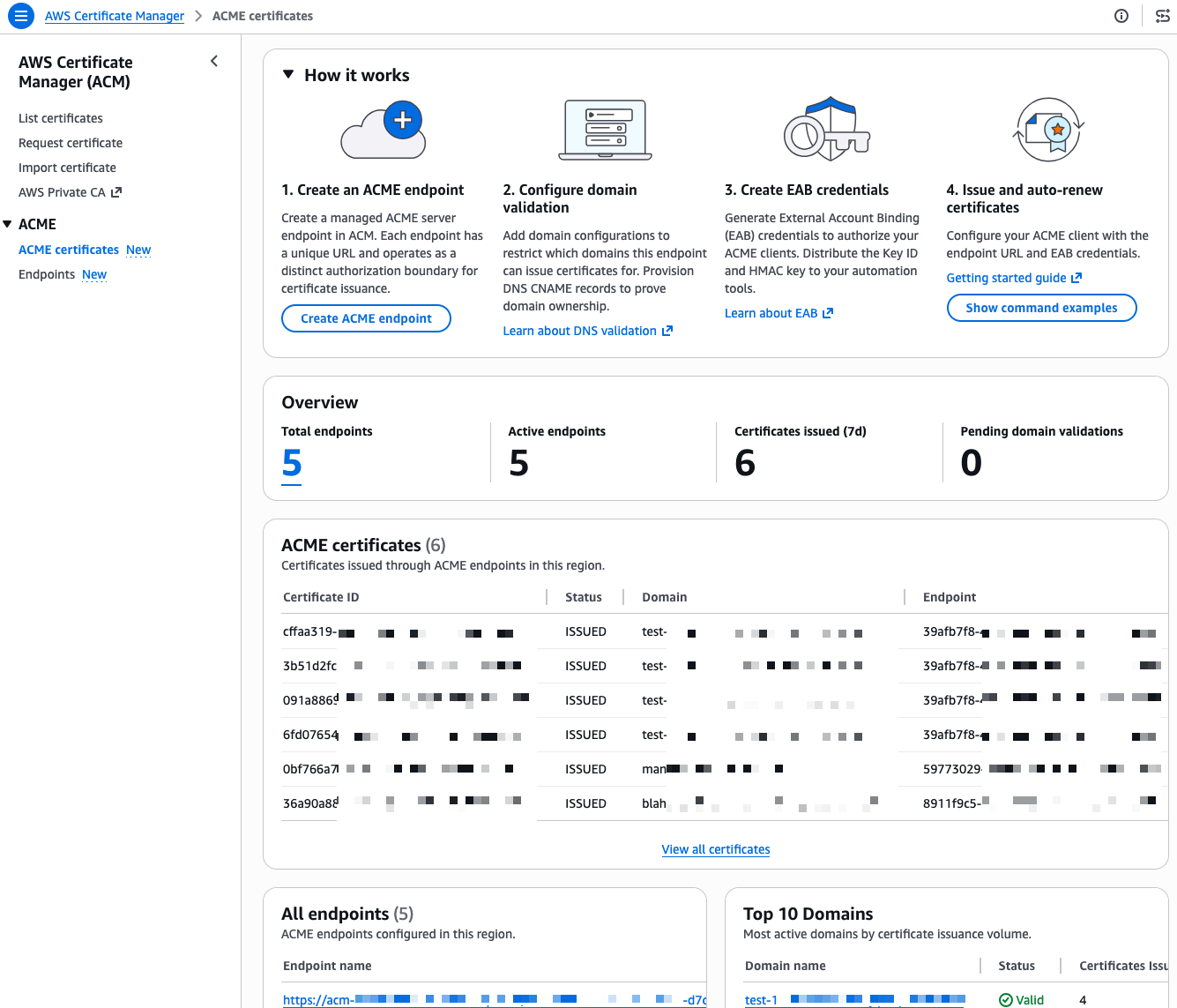
How it works To get started, you first set up a dedicated ACME endpoint, configure authorization controls using External Account Binding (EAB), validate which domains the endpoint can issue certificates for, and point your existing ACME clients to the new endpoint.
The domain validation step is important: it separates who can set up certificate issuance from who can request certificates. The PKI administrator validates domains once at the endpoint level, using DNS credentials that stay with the admin. Application owners who need certificates never touch DNS. They register with an EAB credential, and the endpoint enforces which domains and scopes they’re allowed to request. This means you can distribute certificate automation broadly across your organization without distributing DNS keys along with it.
I start this demo from the ACME certificates page in the AWS Certificate Manager console.
I already have a few endpoints and certificates in this account, I walk you through creating a new one from scratch. First, I select Create ACME endpoint.
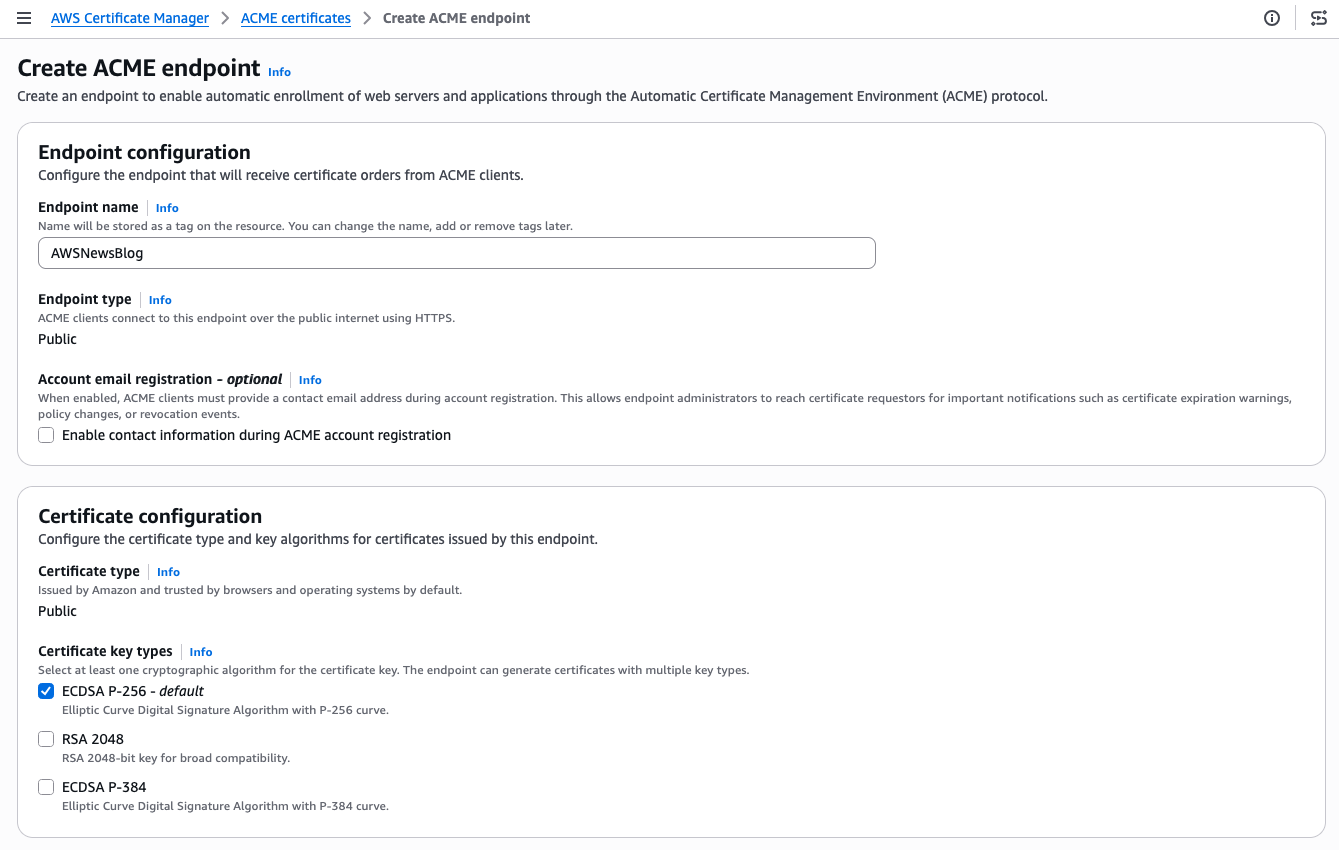
I give my endpoint a name. The Endpoint type is Public. ACME clients will connect over the public internet. The Certificate type is Public. The certificate will be issued by Amazon Trust Services and trusted by browsers and operating systems by default. For the certificate key type, I keep the default ECDSA P-256. RSA 2048 and ECDSA P-384 are also available if your clients require them.
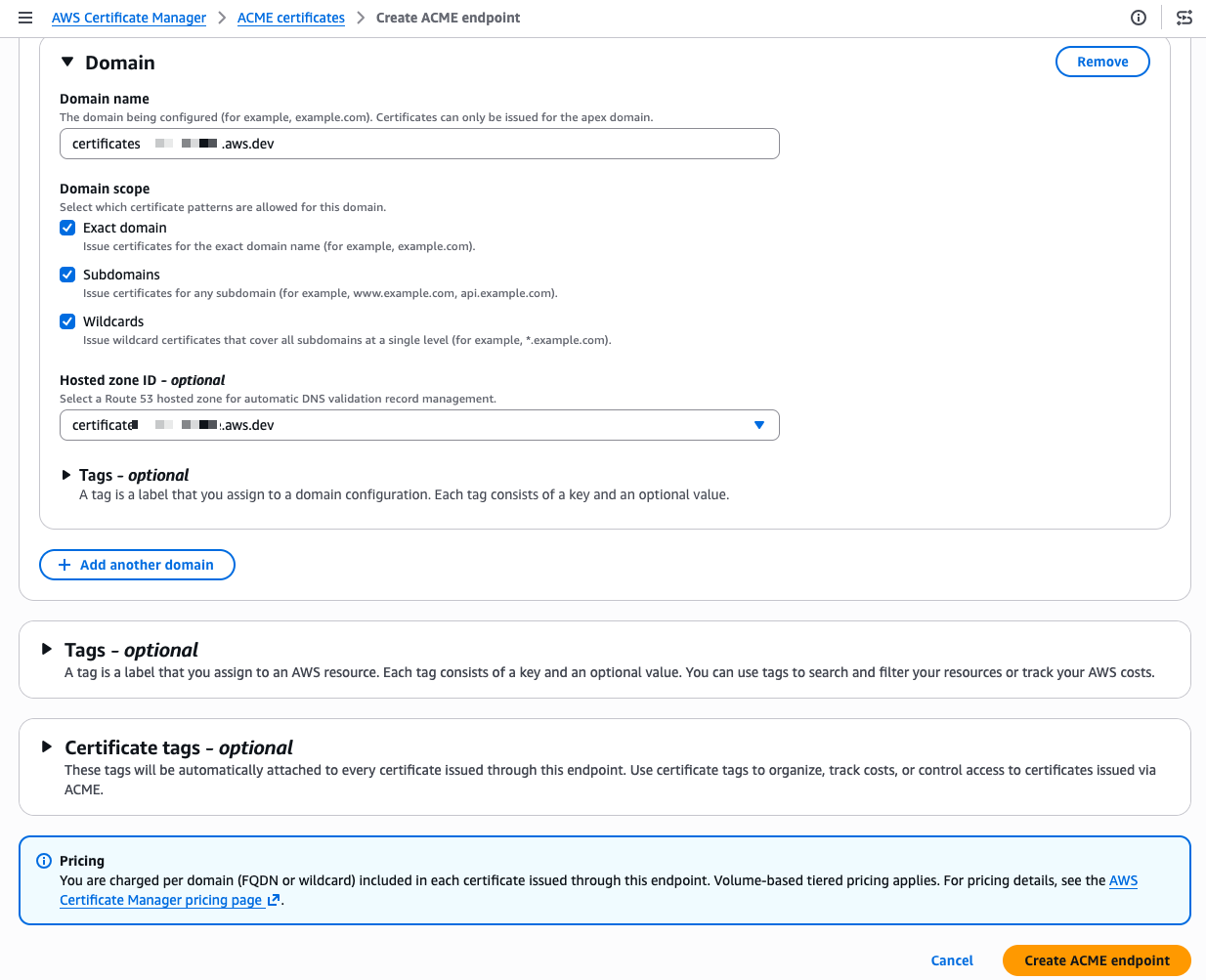
Scrolling down, I configure the domain. I enter my domain name and select the domain scope. The scope controls exactly what certificate patterns your ACME clients are allowed to request for this domain. If I check only Exact domain, clients can only request certificates for that specific domain name. Adding Subdomains allows certificates for any subdomain (for example, api.example.com or dev.example.com). Adding Wildcards allows wildcard certificates (*.example.com). By leaving a scope unchecked, you prevent any client using this endpoint from requesting that type of certificate, even if their ACME request is otherwise valid. For a production endpoint, you might enable only Exact domain and Subdomains while leaving Wildcards unchecked to enforce a stricter security posture.
I also select my Amazon Route 53 hosted zone from the drop down menu. ACM then automatically creates the DNS CNAME records needed for domain validation, so I don’t have to do it manually. When my domain is hosted outside of Route 53, I manually create the provided CNAME record at my DNS provider instead. This is a meaningful difference from typical ACME setups where each client handles its own domain verification independently.
These centralized controls give PKI administrators a single place to authenticate domains, restrict which certificate types (ECDSA or RSA) clients can request, and further limit wildcard issuance. Having these governance capabilities built in means you don’t need to purchase a separate certificate lifecycle management product or invest in building a custom policy layer yourself, both of which come at significant cost and operational overhead.
I select Create ACME endpoint
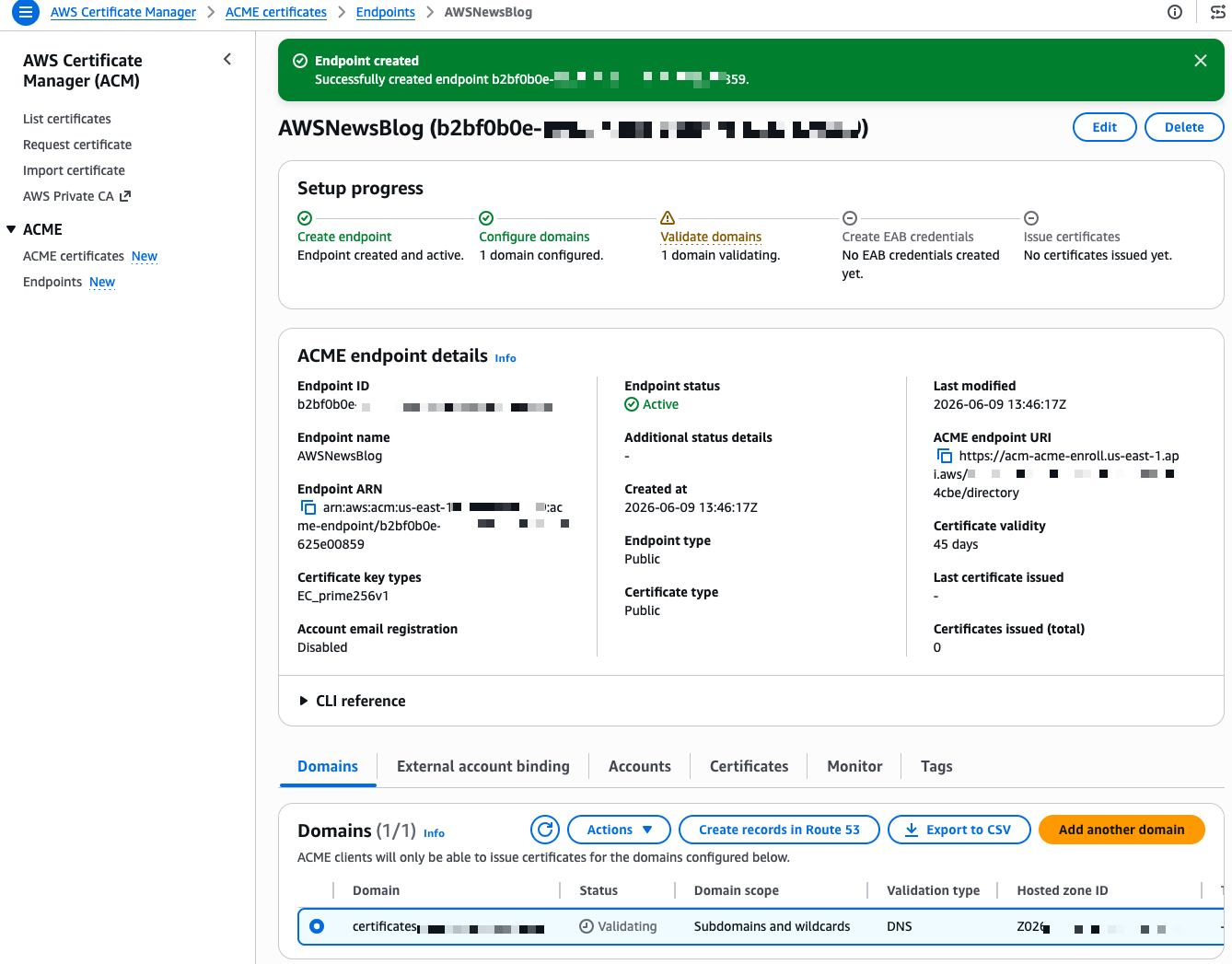
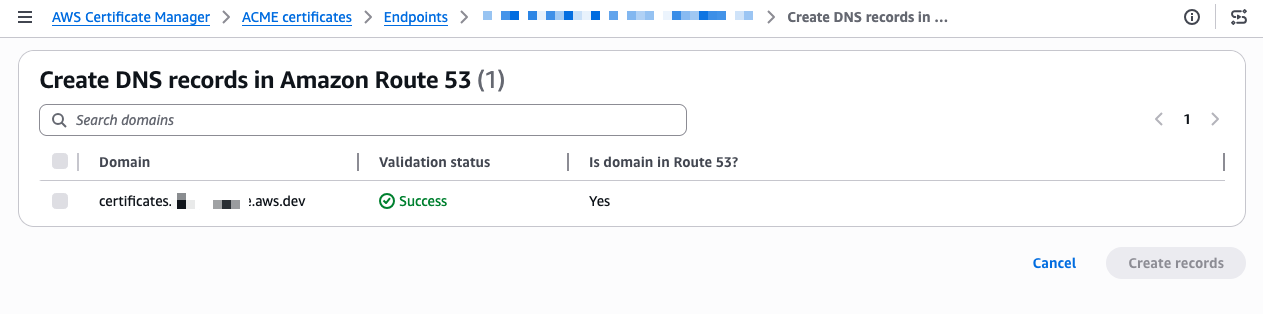
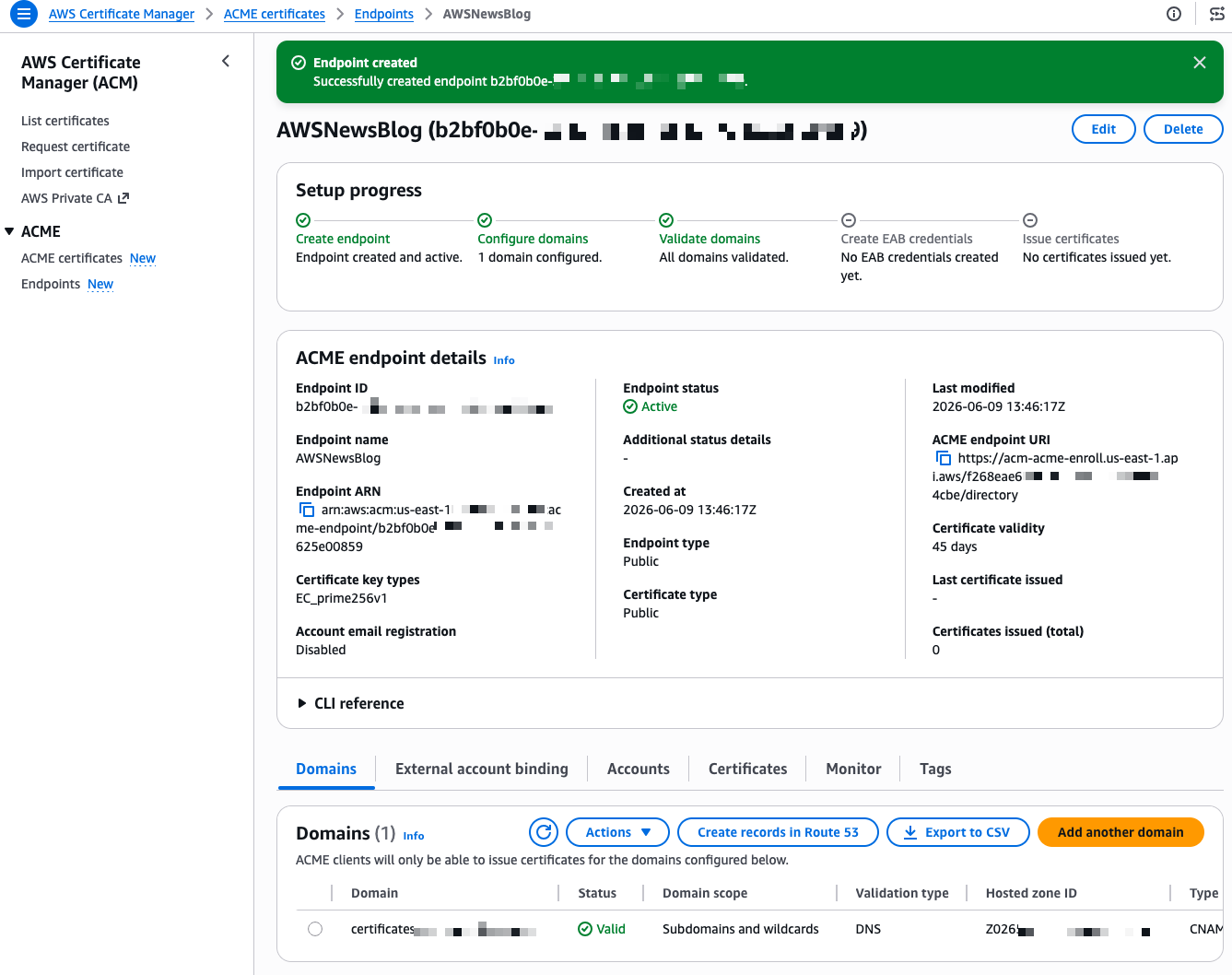
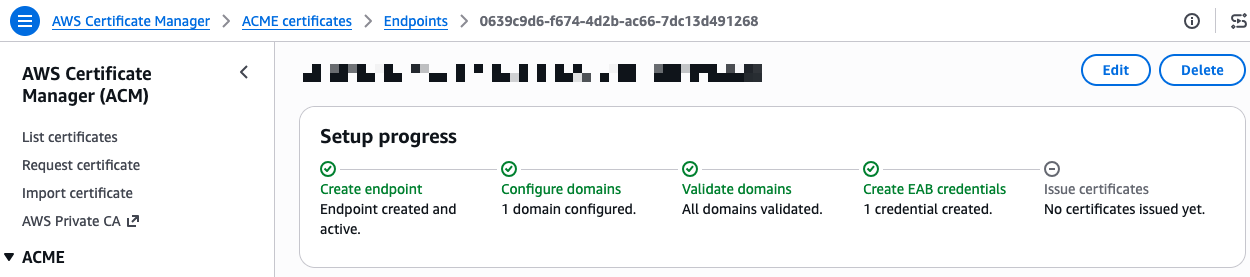
After a few seconds, the endpoint is created. The console shows a Setup progress tracker with the next steps. My domain shows a “Validating” status. The validation method is DNS validation, where ACM verifies that you control the domain by checking for a specific CNAME record. Because I selected my Route 53 hosted zone during creation, I select Create records in Route 53 to let ACM handle the DNS validation automatically.
The validation completes in a few seconds and the status changes to Success.
Now I need to create External Account Binding (EAB) credentials. EAB credentials are a key identifier and a symmetriceiifcbnurtbikvdfjkuhfnitrbvuihigbgfegvhnucdv
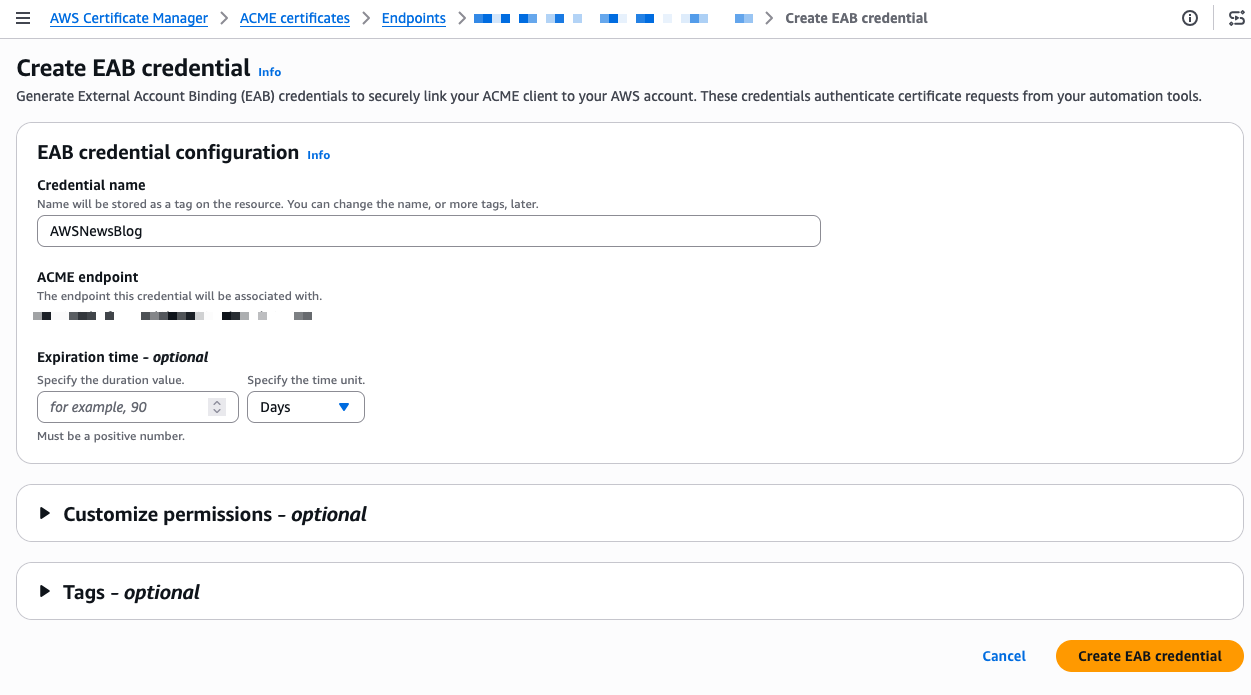
HMAC key that lets your ACME client register an account with the ACME server. Once registered, the client generates its own asymmetric key pair, which is then used to authenticate all subsequent certificate requests. On the endpoint details page, I select the External account binding tab, then select Create EAB. I give the credential a name and optionally set an expiration time, ideally no longer than needed to complete client registration.
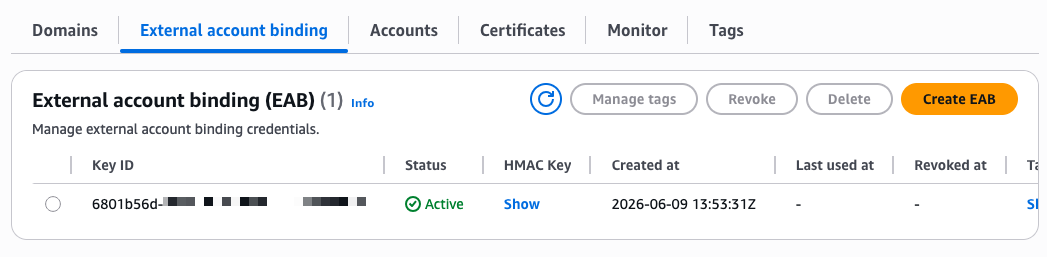
After I select Create EAB credential, the console shows the Key ID and HMAC Key. I note these values because I need them to configure my ACME client. The setup progress now shows four green checkmarks.
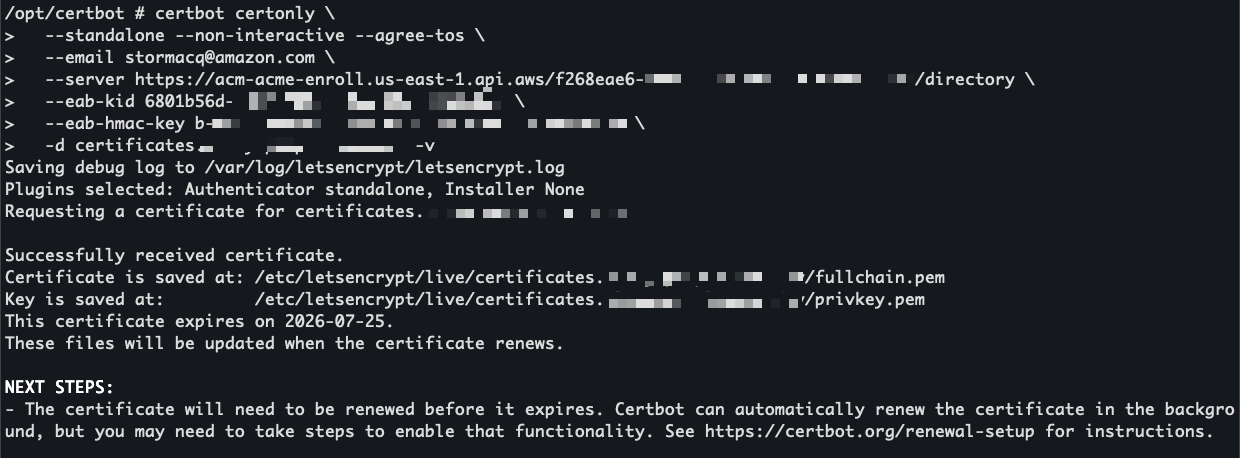
I’m ready to request a certificate. On the endpoint details page, I expand the CLI reference section. The console provides ready-to-use command examples for both Certbot and acme.sh. I copy the Certbot command and run it inside a container using the certbot/certbot image.
I replace the placeholders with my endpoint URL, EAB credentials, and domain name. The --eab-kid and --eab-hmac-key arguments are how Certbot registers with your ACME endpoint using the External Account Binding credentials I generated earlier. Each ACME client has its own syntax for this step, so check your client’s documentation for the exact flags.
Certbot contacts the ACME endpoint and returns a valid certificate signed by Amazon Trust Services.
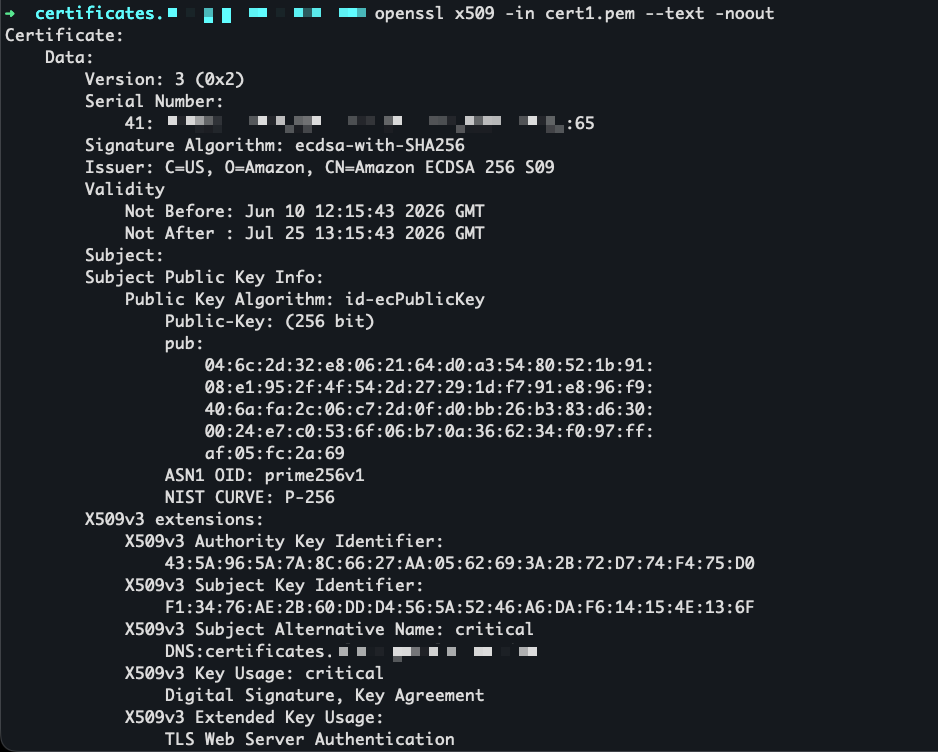
I use openssl to view the certificate before installing it.
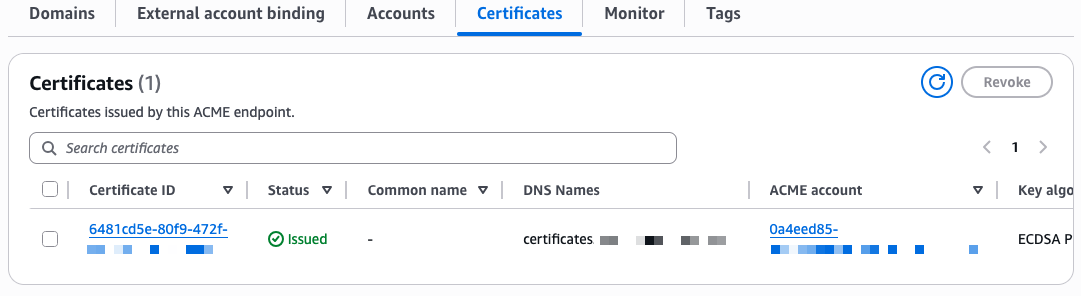
The certificate is now visible in the ACM console under the ACME certificates tab, alongside any certificates issued through the console or API.
Availability and pricing ACME support in AWS Certificate Manager is available today in all commercial AWS Regions and will be available in AWS GovCloud (US), the China Regions, and the AWS European Sovereign Cloudpartitions at a later date.
Pricing is per domain included in each certificate at the time of issuance, with a different price for fully qualified domain names and wildcards. Volume tiers are calculated based on total domain occurrences across all certificates issued per month in your AWS account. For details, see the ACM pricing page.
For teams building AI-governed systems, the EU AI Act adds compliance obligations to every stage of the development lifecycle, from documenting training data to reporting incidents in production. With phased enforcement already underway, now is the time to assess where your workflows stand.
The EU AI Act (Regulation (EU) 2024/1689) is the world’s first comprehensive AI regulation. It entered into force in August 2024 with requirements rolling out in phases through 2027. The Act applies, among others, to any organization that places an AI system on the EU market, deployers of AI systems established in the EU, or whose AI system’s output is used in the EU, regardless of where that organization is headquartered.
This guide covers what each risk tier requires, the full compliance timeline (including the 2026 Digital Omnibus adjustments), transparency obligations, penalties, and what compliance looks like for the teams building and operating AI systems.
Key takeaways
The EU AI Act uses a four-tier risk model; your obligations depend on how your system is classified.
Prohibited practices and GPAI rules are already in effect; high-risk deadlines run through 2027.
Article 50 regarding deepfake and synthetic content labeling obligations take effect August 2, 2026.
Penalties reach €35 million or 7% of global turnover, enforced by national authorities and the EU AI Office.
The four risk tiers
The AI Act takes a risk-based approach. Every AI system falls into one of four categories, and the category determines the regulatory obligations that apply. This classification drives the entire compliance process.
1. Unacceptable risk (prohibited)
AI systems in this tier are banned outright under Article 5. These prohibitions have been in effect since February 2, 2025. The prohibited practices include:
Subliminal, manipulative, or deceptive techniques that distort behavior and cause significant harm
Exploitation of vulnerabilities related to age, disability, or socioeconomic circumstances
Social scoring systems that evaluate individuals based on social behavior or personal traits
Predictive policing based solely on profiling or personality traits
Untargeted scraping of facial images from the internet or CCTV to build facial recognition databases
Emotion recognition in workplaces and educational institutions (except for medical or safety reasons)
Biometric categorization to deduce or infer certain protected characteristics (except for labelling or filtering of lawfully acquired biometric datasets)
Real-time remote biometric identification in publicly accessible spaces for law enforcement, with narrow exceptions for missing persons, imminent threats, and serious crime investigations
2. High risk (regulated)
High-risk AI systems are subject to the most extensive compliance obligations. The Act identifies two paths to high-risk classification:
Annex I systems: AI used as a safety component or product covered by existing EU product safety legislation (medical devices, machinery, vehicles) that requires a third-party conformity assessment.
Annex III systems: AI used in eight sensitive areas: biometrics, critical infrastructure, education, employment, essential public and private services, law enforcement, migration and border control, and administration of justice.
Any AI system used to profile individuals within an Annex III use case is automatically classified as high-risk, regardless of other exemptions. Providers who believe their Annex III system is not high-risk must document that assessment before placing it on the market.
This is the tier that puts the heaviest demands on your logging, testing, and documentation pipelines.
Annex III exceptions: An AI system listed under Annex III is not considered high-risk if it performs a narrow procedural task, improves a previously completed human activity, detects decision-making patterns without replacing human judgment, or performs a preparatory task for an Annex III assessment.
3. Limited risk (transparency risk)
AI systems in this tier face requirements focused on transparency and disclosure. Under Article 50, deployers must ensure that users know they are interacting with an AI system (e.g., chatbots), and providers of generative AI must mark synthetic content as AI-generated. This tier is where deepfake obligations sit, covered in detail below.
For software engineers, this comes down to marking generated content in a machine-readable way and surfacing the disclosure where users actually see it.
4. Minimal risk (unregulated)
The majority of AI systems currently on the market, including spam filters, AI-enabled games, and recommendation engines, fall here. No specific regulatory obligations apply, though the Act encourages voluntary codes of conduct.
The compliance timeline
The EU AI Act’s requirements take effect in phases, not all at once. Some obligations are already enforceable. Others will not apply until late 2027.
Date
What takes effect
August 1, 2024
AI Act enters into force (Regulation (EU) 2024/1689 published).
February 2, 2025
Prohibited AI practices under Article 5 become unlawful. AI literacy obligations begin (Article 4).
August 2, 2025
General-purpose AI (GPAI) model obligations take effect (Chapter V). Governance bodies established. Penalty provisions become applicable. Code of Practice for GPAI published.
August 2, 2026
General date of application of the AI Act. Transparency obligations under Article 50 take effect, including deepfake labeling and synthetic content marking. Member States must have at least one AI regulatory sandbox operational.
December 2, 2026*
Machine-readable marking obligations under Article 50(2) apply to AI systems, including GPAI systems, which have been placed on the market before August 2, 2026 (four-month grace period). Article 5 prohibition on AI-generated non-consensual intimate imagery and child sexual abuse material becomes applicable.
August 2, 2027
Obligations for high-risk AI systems embedded in regulated products under Annex I (Article 6(1)). GPAI models placed on the market before August 2025 must be in compliance.
December 2, 2027*
Standalone Annex III high-risk AI system requirements take full effect (risk management, conformity assessment, technical documentation, CE marking, EU database registration).
August 2, 2028*
High-risk AI systems that are components of products covered by Annex I product safety legislation.
*Omnibus adjustment: The Digital Omnibus package revised these high-risk deadlines, moving the Annex III standalone high-risk deadline from August 2026 to December 2, 2027, and the Annex I embedded high-risk deadline from August 2027 to August 2, 2028. The European Parliament approved the package on June 16, 2026.
Obligations for high-risk systems by role
The EU AI Act distinguishes between providers, deployers, importers, and distributors. Their obligations differ by role.
Providers of high-risk AI systems carry the heaviest compliance burden. Among other obligations, they must:
Risk management system: Establish and maintain a risk management process throughout the AI system’s lifecycle, not just at launch.
Data governance: Ensure that training, validation, and testing datasets are subject to appropriate data governance and management practices and are relevant, sufficiently representative, and as free of errors as possible. Where these datasets contain personal data, the GDPR also applies: you need a lawful basis, data minimization, and, for any special-category data used to detect and correct bias, the specific safeguards.
Technical documentation: Produce documentation that demonstrates compliance and provides authorities with the information to assess it. It shall contain, at minimum, the elements contained in Annex IV.
Record-keeping and documentation: Design the system to automatically log events relevant to identifying risks and tracking modifications. Providers must keep certain documents for up to 10 years at the disposal of the competent authorities.
Transparency and instructions for use: Provide deployers with clear documentation on the system’s capabilities, limitations, intended use, and human oversight requirements, which allows deployers to interpret a system’s output and use it appropriately.
Human oversight: Design the system so that deployers can implement effective human oversight during use.
Accuracy, robustness, and cybersecurity: Achieve appropriate performance levels across all three dimensions.
Quality management system: Establish and document a QMS that covers the full compliance process.
Corrective actions: Take necessary corrective action in case of suspected non-conformity of the AI system with the AI Act, including bringing it into conformity, withdrawing it, disabling it or recall it, as appropriate.
Cooperation with authorities: Provide information and documentation necessary to competent authorities and giving access to automatically generated logs, upon request, to demonstrate conformity of the AI system with the AI Act.
Authorized representatives: Providers established in third-party countries must appoint a representative established in the Union prior to making the high-risk AI system available on the Union market.
Conformity assessment: Ensure that the appropriate conformity assessment procedure is completed prior to placing the AI system on the market. Additionally, drawing up an EU declaration of conformity, affix CE marking, and register the system in the EU database before placing it on the market.
Post-market monitoring: Providers shall establish and document a post-market monitoring system in a manner that is proportionate to the nature of the AI technologies and the risks of the high-risk AI system.
Reporting: Providers shall report any serious incident to the market surveillance authorities. The AI Act establishes different terms for reporting, which vary according to the incident’s severity.
Deployers are natural or legal persons, public authorities, agencies or other bodies that use an AI system under its authority. Those using AI systems in the course of a personal non-professional activity are not considered deployers. Under Article 26, deployers of high-risk systems must:
Use the system as instructed: Operate it the way the provider’s instructions for use specify.
Assign human oversight: Put oversight in the hands of people with the competence and authority to exercise it.
Govern input data: Where the deployer controls the input data, make sure it’s relevant and sufficiently representative for the system’s intended purpose.
Monitor and escalate: Monitor the operation of the AI system, and if it starts to present a risk, notify the provider or the distributor and the market surveillance authority and suspend use.
Keep logs: Retain the logs the system generates automatically, to the extent they’re under the deployer’s control, for at least six months.
Notify the workforce: Tell affected workers and their representatives before a high-risk system goes live in the workplace.
Inform affected people: When an Annex III system makes decisions, or assists in making decisions, about individuals, those individuals have to be told. This overlaps with GDPR transparency and where the system makes solely automated decisions with legal or similarly significant effects, so coordinate the AI Act notice with your GDPR notices.
Support data protection assessments: Use the information the provider supplies to meet any data protection impact assessment obligation under the GDPR.
Cooperate with authorities: Work with competent authorities on any action they take regarding the system.
Register, if public: Public authorities must register the deployment in the EU database and shall not run a system while it isn’t.
Article 27 adds a fundamental rights impact assessment for a narrower group: public bodies, private entities providing public services, and deployers using Annex III systems for credit scoring or insurance pricing. Before first use, they document how the system will be used, who it could affect, the risks involved, and the human oversight in place, then file the results with the market surveillance authority.
For engineering teams, most of these duties come down to monitoring, log retention, and the ability to suspend a system fast. They get solved in your infrastructure, not in a policy document.
Important: Under the EU AI Act, operators in the AI-value chain can be considered both providers and deployers. Put your name on a high-risk system, modify one substantially, or repurpose a non-high-risk system into a high-risk use, and you’re reclassified as a provider with the full obligation set (Article 25).
Importers are the EU-based persons or organizations that place a non-EU provider’s high-risk AI system on the market, and Article 23 makes them a checkpoint for conformity before the system reaches EU users. Importers must:
Verify conformity before import: Confirm the provider has completed the conformity assessment, drawn up the technical documentation (Annex IV), affixed CE marking with the EU declaration of conformity and instructions for use, and appointed an authorized representative.
Block non-conforming systems: If there’s reason to believe a system isn’t in conformity, or its documentation is falsified, don’t place it on the market until it’s corrected. If the system presents a risk, inform the provider, the authorized representative, and the market surveillance authorities.
Add contact details: Put the importer’s name, registered trade name or trademark, and contact address on the system, its packaging, or its accompanying documentation.
Protect compliance in storage and transit: Make sure storage and transport conditions under the importer’s responsibility don’t compromise the system’s compliance.
Keep records for 10 years: Retain a copy of the notified-body certificate (where applicable), the instructions for use, and the EU declaration of conformity for 10 years after the system is placed on the market or put into service.
Respond to authorities: On a reasoned request, give competent authorities the information and documentation needed to demonstrate conformity, in a language they can readily understand.
Cooperate with authorities: Work with competent authorities on any action they take to reduce or mitigate the risks of a system the importer placed on the market.
An importer that puts its own name or trademark on a high-risk system, or substantially modifies one already on the market, is reclassified as a provider and takes on the full provider obligation set (Article 25).
Distributors are the other parties in the supply chain who make a high-risk system available on the EU market. Their duties under Article 24 overlap with an importer’s but focus on what happens at and after the point of sale. Distributors must:
Verify documentation before distribution: Confirm the system bears CE marking, comes with the EU declaration of conformity and instructions for use, and that the provider and importer have met their own obligations.
Block non-conforming systems: If there’s reason to believe a system isn’t in conformity, don’t make it available until it’s corrected. If it presents a risk, inform the provider or importer.
Protect compliance in storage and transit: Make sure storage and transport conditions under the distributor’s responsibility don’t compromise the system’s compliance.
Act on non-conformity after sale: If a system already made available turns out to be non-conforming, take corrective action to fix, withdraw, or recall it, or ensure the provider or importer does. If it presents a risk, immediately inform the provider or importer and the competent authorities.
Respond to authorities: On a reasoned request, provide the information and documentation on these actions needed to demonstrate conformity.
Cooperate with authorities: Work with competent authorities on any action they take regarding a system the distributor made available.
The same reclassification rule applies: a distributor that brands a high-risk system as its own or substantially modifies one already on the market becomes a provider under Article 25.
Deepfake and transparency obligations (Article 50)
Article 50 creates specific transparency requirements for AI systems that interact with people or generate synthetic content. These obligations generally apply from August 2, 2026 and are relevant regardless of the system’s risk classification.
Who must comply
Providers of AI systems that interact directly with people must ensure that individuals are informed they’re interacting with an AI system, unless this is obvious from the circumstances.
Providers of AI systems that generate synthetic content (audio, image, video, or text) must mark that output in a machine-readable format that’s detectable as AI-generated or manipulated. The marking must be effective, interoperable, robust, and reliable.
Deployers who use AI to create deepfakes must disclose that the content has been artificially generated or manipulated. The Act defines a deepfake as AI-generated or manipulated image, audio, or video content that resembles existing persons, objects, places, or events and would falsely appear authentic.
Deployers who publish AI-generated text on matters of public interest must label it as AI-generated, unless the content has been through human editorial review and a natural or legal person holds editorial responsibility.
Deployers of emotion recognition or biometric categorisation systems must inform the people exposed to the system that it’s operating, and handle their personal data in line with the GDPR.
Artistic exception regarding deepfakes: When AI-generated content is part of an evidently artistic, creative, satirical, or fictional work, only minimal and non-intrusive disclosure is required. The deepfake labeling obligation still applies, but the disclosure format can be lighter.
The Code of Practice for transparency
The European Commission developed a Code of Practice on marking and labeling AI-generated content to operationalize Articles 50(2) through 50(5). The code provides practical and technical guidance for real-world implementation of the marking and disclosure requirements. Its final version was published on June 10, 2026.
General-purpose AI model obligations
Chapter V of the Act creates a separate set of obligations for providers of general-purpose AI (GPAI) models. These rules have been applicable since August 2, 2025 (models placed on the market before that date have until August 2, 2027 to comply). The European Commission has published guidelines to support providers in meeting these requirements.
General-purpose AI models are the broad, multi-purpose models that show significant generality, perform a wide range of distinct tasks, and can be used directly as well as integrated into other AI systems.
All GPAI model providers
Every provider of a GPAI model must draw up and maintain technical documentation (which shall contain at minimum the information set out in Annex VI), provide information and documentation to downstream providers integrating the model, establish a policy to respect the EU Copyright Directive, and publish a sufficiently detailed summary of the content used for training.
Providers of free and open-license GPAI models (where parameters, architecture, and usage information are publicly available) do not need to comply with the obligations regarding technical documentation and provision of information to downstream providers, unless the model presents a systemic risk.
GPAI models with systemic risk
A GPAI model is presumed to carry systemic risk if it was trained using more than 10²⁵ floating point operations (FLOPs) of compute. That bar was set to capture the frontier models of the day: GPT-4 is widely estimated to sit above it, while the earlier GPT-3 was trained on roughly 30 times less. The Commission can also designate other models as systemic on criteria like the number of end users, high-impact capabilities, or output modalities.
Providers of systemic-risk models carry every GPAI obligation above, plus four more:
Model evaluation: Run model evaluations, including adversarial testing.
Risk mitigation: Assess and mitigate the systemic risks the model could pose.
Incident reporting: Track and report serious incidents to the AI Office.
Cybersecurity: Maintain an adequate level of protection for the model.
A voluntary Code of Practice for general-purpose AI models was published in July 2025. Following a code of practice creates a presumption of conformity until European harmonized standards are in place.
Penalties and enforcement
The EU AI Act establishes a three-tier penalty structure under Article 99, designed to be effective, proportionate, and dissuasive.
Violation
Maximum fine
Turnover threshold
Prohibited AI practices (Article 5)
€35 million
7% of global annual turnover
High-risk AI system non-compliance (specific provisions)
€15 million
3% of global annual turnover
Supplying incorrect or misleading information to authorities
€7.5 million
1% of global annual turnover
Enforcement is split between the European AI Office, which oversees GPAI model providers, and national competent authorities in each Member State, which handle all other operators.
Each Member State must designate at least one national authority for implementation and market surveillance. The penalty provisions are designed to account for the interests of small and medium-sized enterprises and startups, and Member States report annually to the Commission on fines issued.
What compliance looks like for engineering teams
The EU AI Act’s requirements are written in regulatory language, but they translate to concrete engineering concerns. If your team builds or deploys AI systems that serve EU users, here’s where the Act’s obligations intersect with your development workflow.
Inventory and classification come first
Compliance starts with knowing what you have. Every AI system the organization builds, uses, or procures needs to be cataloged and classified against the Act’s risk tiers. Record, for each system, whether it processes personal data and link the entry to your GDPR records of processing (Article 30) so the AI inventory and the privacy record stay aligned.
This is not a legal exercise alone. Engineering teams are typically the only ones who understand the actual capabilities, data flows, and deployment contexts of the systems they build. If your organization has an AI governance framework in place, the AI inventory is usually its foundation.
Audit trails are non-negotiable
The Act requires automatic event logging for high-risk systems and structured documentation across almost every tier. This means every decision an AI system makes, the categories of data sources it accesses, and every action it takes needs to be logged in a way that is auditable.
Teams already shipping AI agents need structured event capture of system actions, including timestamp, session context, the tool or rule invoked, and the agent or service identity, scoped to system-health and security telemetry rather than individual worker performance. Exporting these logs to existing SIEM and compliance systems closes the gap between agent behavior and audit requirements.
Prepare your risk management system
Article 9 requires a continuous risk management process, including control measures for risks that can’t be removed by design.
The ability to enforce policies is the mechanism that makes your chosen controls binding at the moment the agent acts, therefore acting as a risk mitigating strategy. This can happen at the agent level, by applying policies and rules to sandboxed agents, and at the tool level, with policies applied to the gateway that manages agent tool access.
Runtime isolation supports human oversight
The EU AI Act requires that high-risk AI systems be designed for human oversight, and that deployers can intervene during operation. For agentic workloads, where AI acts autonomously, this maps directly to runtime isolation: running agents inside sandboxed environments where network access, filesystem scope, and tool permissions are policy-controlled.
If an agent exceeds its intended scope, isolation constrains the blast radius. This is the mechanism that makes oversight enforceable at the infrastructure level.
Transparency can be instrumented
Article 50’s deepfake and synthetic content marking requirements are a metadata problem. Providers need to embed machine-readable markers in generated content, and deployers need to surface human-readable disclosures.
For teams building generative AI systems, this means integrating content provenance marking (such as C2PA or IPTC standards) into the generation pipeline. Where generated content depicts a real, identifiable person, it is also personal data under the GDPR, so the marking is necessary but not sufficient and the usual lawful-basis and rights obligations still apply. The AI governance controls your organization uses can enforce these policies at the platform layer rather than relying on each application to implement them independently.
Use the official compliance tools
The European Commission has launched the AI Act Service Desk, a single information platform that includes an official Compliance Checker to help organizations determine which obligations apply to their AI systems, an AI Act Explorer for navigating the full regulation text, and a helpdesk for submitting questions. These tools are free, official, and available in English, French, and German (with all 24 EU languages planned for 2026).
Start building compliance into your AI infrastructure
EU AI Act compliance is not a document you file. It’s a set of technical controls, organizational processes, and audit practices that need to be embedded in how your team builds and operates AI systems.
To make things easier, Docker AI Governance supports operationalizing these requirements. It does not replace the human oversight, classification, and legal accountability the AI Act assigns to providers and deployers, and customer code, configurations, and telemetry are not used to train Docker’s or third-party models. Instead, Docker AI Governance includes sandbox-based runtime isolation for blast-radius risk mitigation and real time monitoring, policy enforcement across network, filesystem, and MCP tool access, and structured audit logging that exports to existing SIEM and compliance systems.
Explore Docker AI Governance to see how runtime policy, audit trails, and agent isolation support the regulatory controls the EU AI Act requires.
Frequently asked questions
Does the EU AI Act apply to companies outside the EU?
Yes. Under Article 2, the EU AI Act applies to providers and deployers of AI systems regardless of whether they’re established in the EU. You are in scope if you place an AI system on the EU market, or if the system’s output is used in the EU.
Is there an official EU AI Act compliance checker?
The European Commission’s AI Act Service Desk includes a Compliance Checker tool that helps organizations determine which obligations apply to their AI systems. It walks through a series of questions about the system’s purpose, deployment context, and risk profile to identify relevant articles and requirements.
What are the EU AI Act deepfake requirements?
Under Article 50, providers of AI systems that generate synthetic audio, image, video, or text must mark the output in a machine-readable format as AI-generated. Deployers who use AI to create deepfakes (content resembling existing persons or events that would falsely appear authentic) must disclose that the content is artificially generated, even when the content is lawful. Artistic, creative, and satirical uses require only minimal disclosure.
These obligations take effect on August 2, 2026. Where a deepfake depicts a real, identifiable person, that content is also personal data under the GDPR, so labeling is necessary but not sufficient.
What is the difference between the AI Act and the Cyber Resilience Act?
The EU Cyber Resilience Act (CRA) targets products with digital elements and focuses on cybersecurity requirements across their lifecycle. The AI Act specifically targets AI systems and AI models, with requirements that scale based on risk classification. A product could be subject to both regulations, for example an AI-powered medical device that is both a product with digital elements (CRA) and a high-risk AI system (AI Act).
When do the high-risk AI system rules actually take effect?
The timeline depends on the type of high-risk system. Under the Digital Omnibus package, approved by the European Parliament on June 16, 2026, standalone Annex III high-risk systems must comply by December 2, 2027. Annex I embedded high-risk systems (products covered by EU product safety legislation) must comply by August 2, 2028. Check the official implementation timeline for the latest confirmed dates.
At re:Invent 2025, we previewedAWS Security Agent (now part of AWS Continuum), a frontier agent that proactively secures your applications throughout the development lifecycle across all your environments. You can perform on-demand penetration testing customized to your application, discovering and reporting security risks verified through exploitability testing.
Today, we’re introducing more features based on customer feedback:
Code review updates (Preview): You can now use pull request scanning with remediation, security requirements packs, and simulated validation. New integrations support GitHub, GitLab, Bitbucket, and Confluence.
Threat modeling (Preview) : AWS Security Agent analyzes your design documents or application source code, understands the full context of your application architecture and identifies threats with recommended mitigations using the STRIDE framework.
Kiro power, Claude Code plugin, and MCP integration: You can run code reviews, generate threat models, and remediate findings directly from your IDE, CLI, or any AI-powered IDE through an open MCP integration, with results surfacing inline without any context switching.
Let’s take a closer look at each launch!
Code review updates You can now connect to GitLab and Bitbucket in addition to GitHub— supporting both SaaS and self-hosted versions, so you can trigger scans regardless of where code lives. You can also integrate Confluence to reference your existing documentation as context for reviews.
To get started, choose Enable code review or update your code review setting in the Security Agent console.
AWS Security Agent introduces deep, reasoning-based analysis on every pull request as well as full repository to identify complex vulnerabilities that go beyond pattern-matching. It checks against your organizational security requirements and common security risks to catch what other tools can’t. To get started, access the Security Agent web application and run your code review.
You’ll receive fix commits and remediation guidance directly in your GitHub, GitLab, or Bitbucket workflow, while your security teams configure the repositories to be monitored and intervene on critical issues. AWS Security Agent validates findings in simulated environments to demonstrate proof of exploitability. This embeds security expertise across all repositories, reducing security-related delays in the development pipeline.
To learn more about new code review features, visit Create a code review in the AWS Security Agent User Guide.
Design review updates You can continuously validate your security requirements across every design and code review with managed compliance packs: AWS Well Architected Framework, NIST CSF, PCI DSS, and AWS best practices, or import your own organizational requirements directly from internal documents or Confluence. Every finding maps back to your compliance posture, so teams stay audit-ready as they build.
Threat modeling AWS Security Agent generates threat models based on your design documentation or code repository, creates and build context about the application, including data flows, architecture, and trust boundaries. It maps out all components of your application, identifies potential threat actors and attack vectors, determines where weaknesses may exist, and prioritizes threats so you know what to address first.
To get started, choose Enable threat model and Connect source code repository in the Security Agent console.
Kiro power and Claude Code plugin for Security Agent AWS Security Agent introduces a new Kiro power and Claude Code plugin and can be integrated with any AI IDE through an open MCP integration to secure your applications. You can trigger threat models and code reviews directly from your IDE, with results surfacing inline without any context switching.
To get started, install the Kiro power, and run your prompts. The Kiro power uses the AWS Security Agent MCP server. You can get started with the power by asking “Set up AWS Security Agent“. Kiro will check if you have an Agent Space and ask if you would like to use the existing one or create a new one.
With the Kiro power for Security Agent, you can catch vulnerabilities on every pull request as you build and scan an entire repository to surface accumulated risk by asking “Run a full security scan on this repo“. The Security Agent power includes an Agent hook to evaluate if a code review diff scan should be started after the Kiro agent has completed its turn. Before deploying to production, you can run a penetration test from your CLI to find what most scanners miss. Security Agent closes the loop by validating every finding and generating ready-to-implement code fixes.
You can pull the findings back into your development environment by asking “help me remediate my findings“. The Kiro power for AWS Security Agent will download findings to your local workspace, prioritize the most critical finding, and offer to start a bugfix spec session. You can iterate on fixing the findings using their familiar IDE with their existing tooling, steering, powers, and MCP servers.
You can also run threat models through the Kiro power in the IDE by asking “Build a threat model for this application“. The generated threat model is saved to .security-agent/threat_model.md.
Now available AWS Security Agent understands the full security context across your software development lifecycle by covering design-time security (design reviews and threat modeling in preview), development-time security (code review in preview), and deployment-time security (penetration testing in GA), in a single, unified agentic offering. To learn more, visit the AWS Security Agent product page and the technical documentation.
These features are now available in AWS commercial Regions where AWS Security Agent is available. For Regional availability and the future roadmap, visit the AWS Capabilities by Region. For detailed pricing information and to access our 2-month free trial offer, please visit the AWS Security Agent pricing page.
AWS WAF now includes AI traffic monetization capability that gives digital content owners and publishers a way to charge AI bots and agents for access to protected web content directly at the network edge. The capability helps content owners and publishers set per-request pricing by content path, bot category, or verification tier without modifying their origin infrastructure or writing application code. Content owners can define granular access policies per agent type, collect payments in stablecoins to their preferred wallet, and monitor revenue and bot activity from a single dashboard.
AI bot traffic now accounts for more than 50% of web traffic for many content providers, with AI-specific crawlers growing more than 300% year-over-year. Unlike traditional search engine crawlers, which index content and return measurable referral traffic back to publisher websites, AI bots consume the same content to generate summaries and responses in AI interfaces, with little to no traffic sent back to the original source. Publishers bear the infrastructure costs of serving that traffic without the page views, ad impressions, or subscription conversions that typically offset those costs. AWS WAF Bot Control already gives customers visibility into bot activity and the ability to block or rate-limit traffic, but setting pricing and collecting payment from AI agents has not been possible until now. AI traffic monetization is a new Bot Control capability that closes that gap, giving content owners and publishers a way to configure pricing rules directly through the AWS WAF console and collect payments from AI agents through third-party payment integrations, without building custom payment infrastructure or negotiating individual licensing agreements. Payment settlement and verification flows are provided by Coinbase’s x402 Facilitator. Integration with Stripe for direct account payments and Machine Payments Protocol (MPP) support is coming soon.
Getting Started with AI Traffic Monetization Before configuring monetization, confirm that AWS WAF Bot Control is enabled at Common or Targeted level on the web ACL associated with your CloudFront distribution. Bot Control provides the agent classification that monetization rules depend on. If you have not set this up yet, visit Adding the AWS WAF Bot Control managed rule group to your web ACL documentation. In the AWS Management Console, go to WAF & Shield and choose Protection packs (web ACLs) in the left navigation pane to get started.
A protection pack is the core configuration unit for AI traffic monetization. It defines which content paths are monetized, what each agent verification tier is charged, which payment methods you accept, and what license terms apply. To create one, choose Create protection pack (web ACL).
In Tell us about your app, select one or more app categories that describe your content (for example, Content & publishing systems, E-commerce & transaction platforms, or Enterprise & business applications), and choose an App focus. AWS WAF uses these selections to recommend suitable security protections for your configuration.
In Select resources to protect, choose Add resources to associate regional or global resources such as CloudFront distributions with this protection pack. You can skip this step and add resources later.
In Choose initial protections, select from AWS WAF managed rule packages based on your app category and resource selections. You can also choose individual rules instead of packages.
In Name and describe, provide a name and optional description for the protection pack.
Optionally, expand Customize protection pack (web ACL) to configure additional settings including pricing tiers, payment methods, content scope, and license terms.
When finished, choose Create protection pack (web ACL).
Once your protection pack is in place, review the AI traffic analysis dashboard to understand the impact of AI bot traffic on your content before setting your pricing strategy. In the WAF & Shield console, go to AI traffic analysis in the left navigation pane. Select your protection pack (web ACL) from the dropdown to populate the dashboard.
The AI traffic analysis dashboard breaks down traffic into four categories visible in the bot traffic overview panel: All bot requests, AI bot requests, Verified AI bot traffic, and Unverified AI bot traffic. The dashboard surfaces infrastructure impact metrics including bandwidth consumed, estimated monthly cost, and peak request rates. A per-path heatmap shows which content paths receive the most AI bot activity by hour, giving you the data you need to make informed pricing decisions.
AWS WAF Bot Control classifies over 650 distinct AI bot and agent types including GPTBot, Claude-Web, and Perplexity-Bot, and assigns each a verification tier:
Verified: Agent identity confirmed through Web Bot Auth (WBA) Ed25519 cryptographic signature, or sourced from a documented IP range with a known set of user-agents and domain names.
Unverified: Agent recognized through user-agent matching, behavioral fingerprinting, and IP reputation, but identity not cryptographically confirmed.
Once you have reviewed your traffic patterns, return to Protection packs (web ACLs), select your protection pack from the list, and choose Configure AI monetization from the right panel to set pricing and access policies. Each protection pack defines the pricing, agent policies, accepted payment methods, and license terms that apply to a defined set of content paths. You can create multiple protection packs and apply different pricing to different content zones within the same distribution. Once created, associate the protection pack with your web ACL by opening the web ACL and choosing Add protection pack.
For each agent verification tier within the pack, you can assign one of six actions: Monetize (return a 402 with pricing), Allow (grant free access), Block (deny access entirely), Count (log without charging), CAPTCHA (present a puzzle to verify a human sender), or Challenge (run a silent check to verify the client is a browser, not a bot).
In the Edit monetization configuration page, configure the following:
Under Payment settlement, select one or more blockchain networks for stablecoin payments. Any wallet address on the supported networks is accepted, whether self-managed or hosted by a wallet provider such as Coinbase. For each network, provide your wallet address and set a Base price per page in USDC. You can add multiple networks using Add network. AWS does not process payments or take a fee on content revenue; disbursement is self-managed or managed by your wallet provider.
When a Monetize rule matches an incoming request, AWS WAF returns an HTTP 402 Payment Required response. The response body contains a machine-readable price manifest in JSON format using the x402 open protocol for machine-to-machine payments. The manifest includes the content price in USDC, accepted blockchain networks such as Base and Solana, the destination wallet address, the maximum payment timeout, and the payment scheme.
Any x402-compatible agent runtime can complete this flow autonomously. The client submits a signed payment authorization on their payment network of choice. AWS WAF verifies it, fetches the content, integrates with third-party facilitator services for settling the payment on-chain, and serves the response.
Note that the Monetize action is supported exclusively for web ACLs associated with Amazon CloudFront distributions. Adding a Monetize rule to a regional web ACL is not supported.
Since the Currency mode toggle is available directly in the monetization configuration page, you can switch between Real and Test mode at any time. Before going live, use test mode on non-production traffic to validate pricing, wallet configuration, and x402 payment flows. Note that test mode still enforces x402 payments, but those payments can be made on testnets such as Base Sepolia or Solana Devnet using test funds obtained from faucets such as faucet.circle.com. To activate test mode, toggle Currency mode to Test in your protection pack configuration. AWS WAF returns real price manifests and runs the full payment flow identically to production on the configured test chain. All events are logged with CurrencyMode: TEST. When satisfied with the configuration, toggle Currency mode back to Real to begin processing real payments.
Once you have switched Currency mode to Real, navigate to AI access monetization in the left navigation pane to track monetization outcomes in real time. Note that the AI access monetization dashboard only reflects activity from real currency mode and does not display test transactions.
The Revenue dashboard shows Total revenue, revenue broken down by Verified bots and Unverified bots, and Avg. per request. The Top revenue sources panel groups earnings by bot category, and the AI access patterns panel ranks content paths by revenue generated. Use the Settlements tab to reconcile payments by provider and review payment method distribution and failed payment attempts.
Now Available AI traffic monetization is available now for Amazon CloudFront customers at no additional charge beyond standard AWS WAF pricing. The capability is available in all edge locations where AWS WAF web ACLs are associated with Amazon CloudFront distributions.
As a developer advocate working with web and mobile application developers, I’ve often heard about the need to maintain consistent user authentication in the unlikely event of a regional service interruption. The increasing use of agentic AI, microservices, automation, and service accounts has sparked a similar need for machine-to-machine authentication. Today, I’m excited to share two important updates to Amazon Cognito: multi-Region replication for improved resilience, and support for customer managed keys for more control encryption control.
Many applications rely on Amazon Cognito to handle user and machine-to-machine authentication, and to manage user profiles. When building for high availability, having consistent data across different AWS Regions is a key approach, and until now, achieving that consistency came with significant challenges. Engineering teams spent significant time building and maintaining custom replication solutions to synchronize configurations across Regions. Manual export and import of user data between Regions created security risks from potential data exposure and introduced opportunities for data inconsistencies. During regional transitions, end users experienced disruptions like forced password resets and re-authentication. For machine-to-machine communications, teams had to create new app clients in the secondary region, which meant reconfiguring their applications and updating OAuth-protected resources to accept access tokens issued by the new regional issuer. These challenges made it difficult to maintain uninterrupted operations across Regions.
With multi-Region replication, Amazon Cognito automatically maintains a synchronized copy of your user data and machine secrets in a secondary AWS Region of your choice. The replication flows in one direction, from your primary Region to the secondary Region. This includes user profiles, credentials, and pool configurations. The secondary Region operates in read-only mode, focusing on maintaining authentication capabilities. Existing sessions continue uninterrupted.
When you need to direct traffic to the secondary Region, your existing users can continue signing in with their existing credentials without disruption, and currently signed-in users remain authenticated because both regions recognize access tokens issued by either region. Multi-Region replication supports all authentication methods, including federated sign-in through social providers (Amazon, Google, Apple, Facebook), Security Assertion Markup Language (SAML) and OpenID Connect (OIDC) integrations, and API authorization flows. This approach maintains availability for both customer-facing applications and machine-to-machine communications in your backend services. While authentication continues without interruption, operations like new user registration or profile updates are not available during failover.
Before configuring multi-Region replication, you must configure a multi-Region customer managed key stored in AWS Key Management Service (AWS KMS) to encrypt your user data at rest. These keys provide consistent encryption across Regions while giving you control over your encryption strategy.
How this works in practice I start this demo with an existing Cognito user pool in the us-west-2 (Oregon) Region. I want to configure replication to us-east-1 (Northern Virginia). I also have a customer managed key replicated in these two Regions.
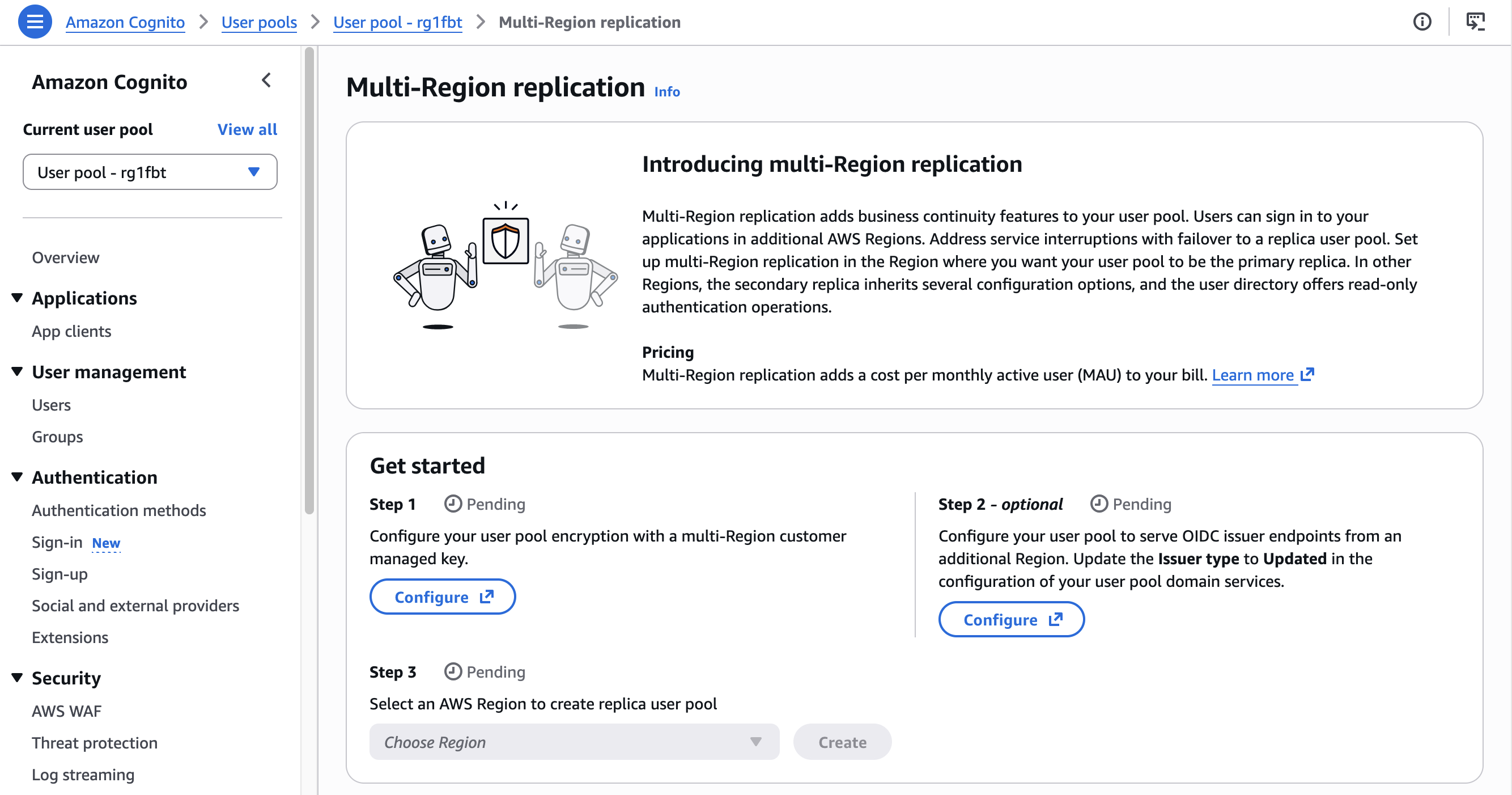
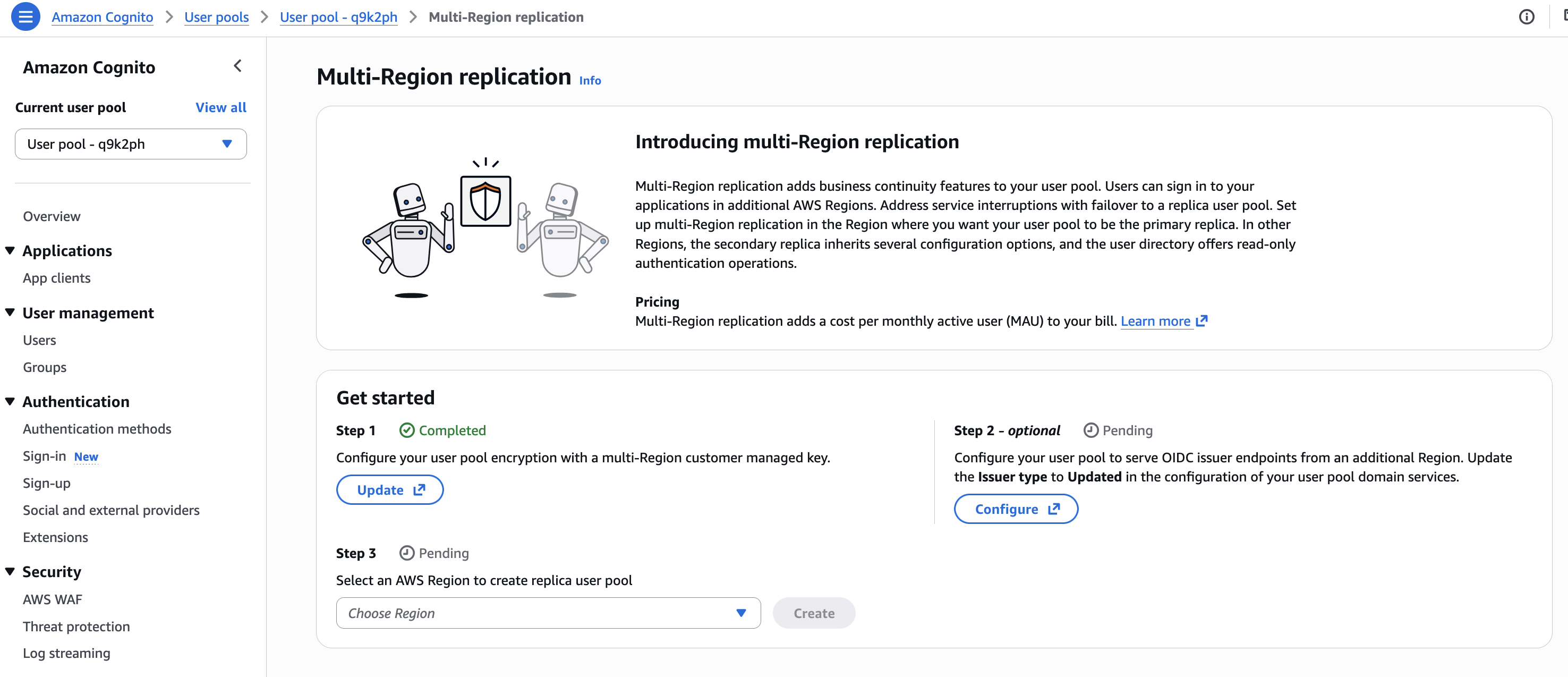
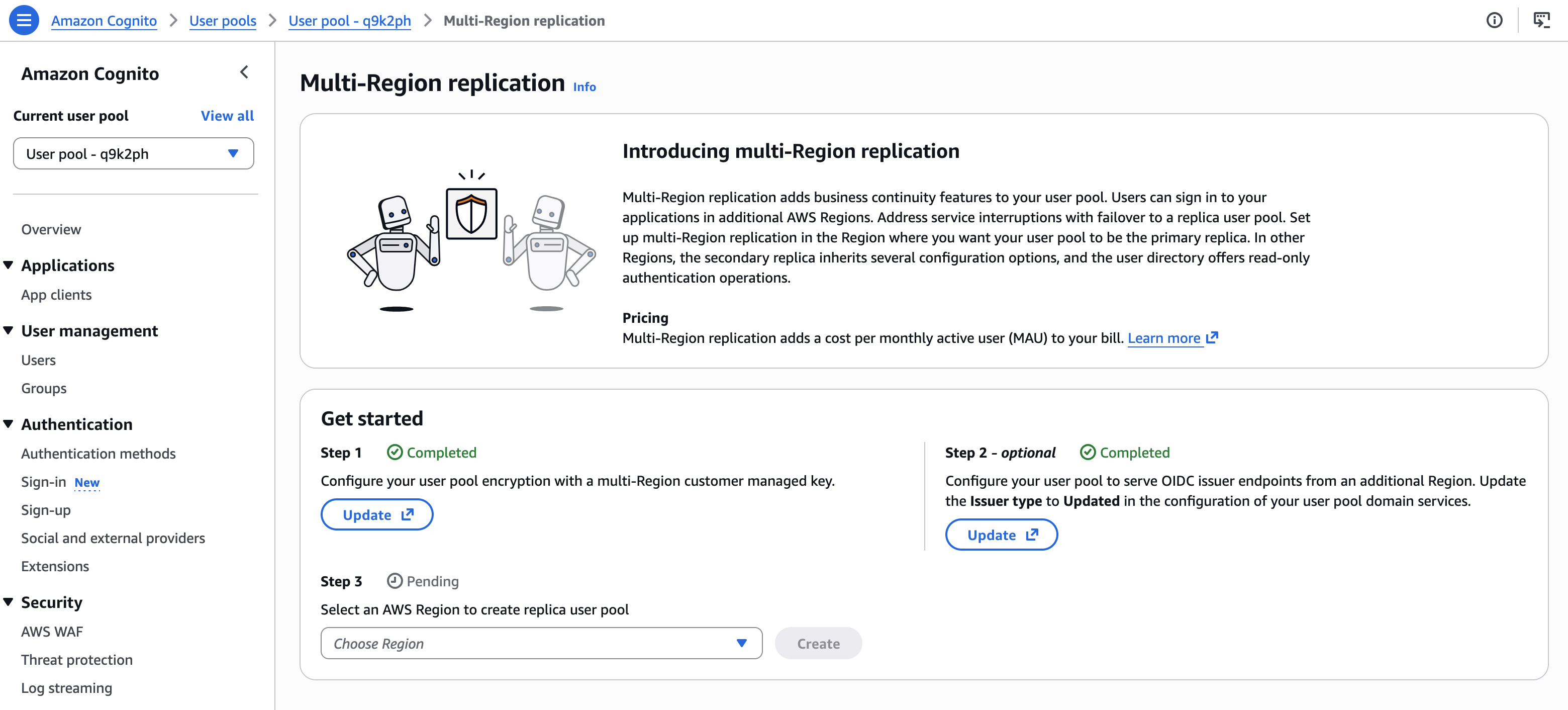
Configuring multi-Region replication is just three steps. The AWS Management Console guides me through the steps: set up a custom key for encryption, configure multi-region OIDC endpoints, and configure the replication itself.
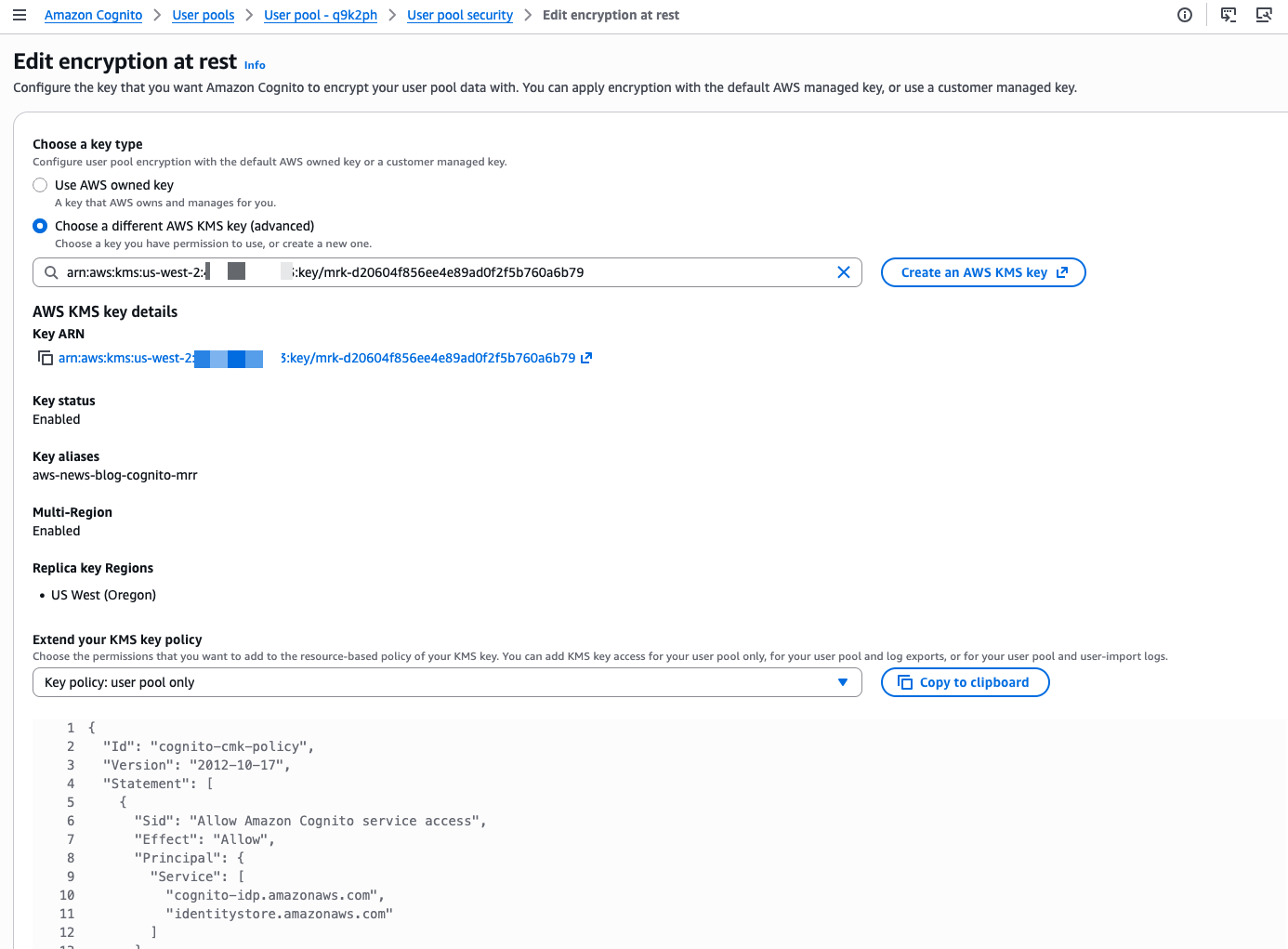
First, I set up a custom AWS KMS key to encrypt the data at rest.
I select the custom key I created. I also update the key policy to allow Amazon Cognito to access and use the key. The console shows the correct IAM policy statements to add to my key policy.
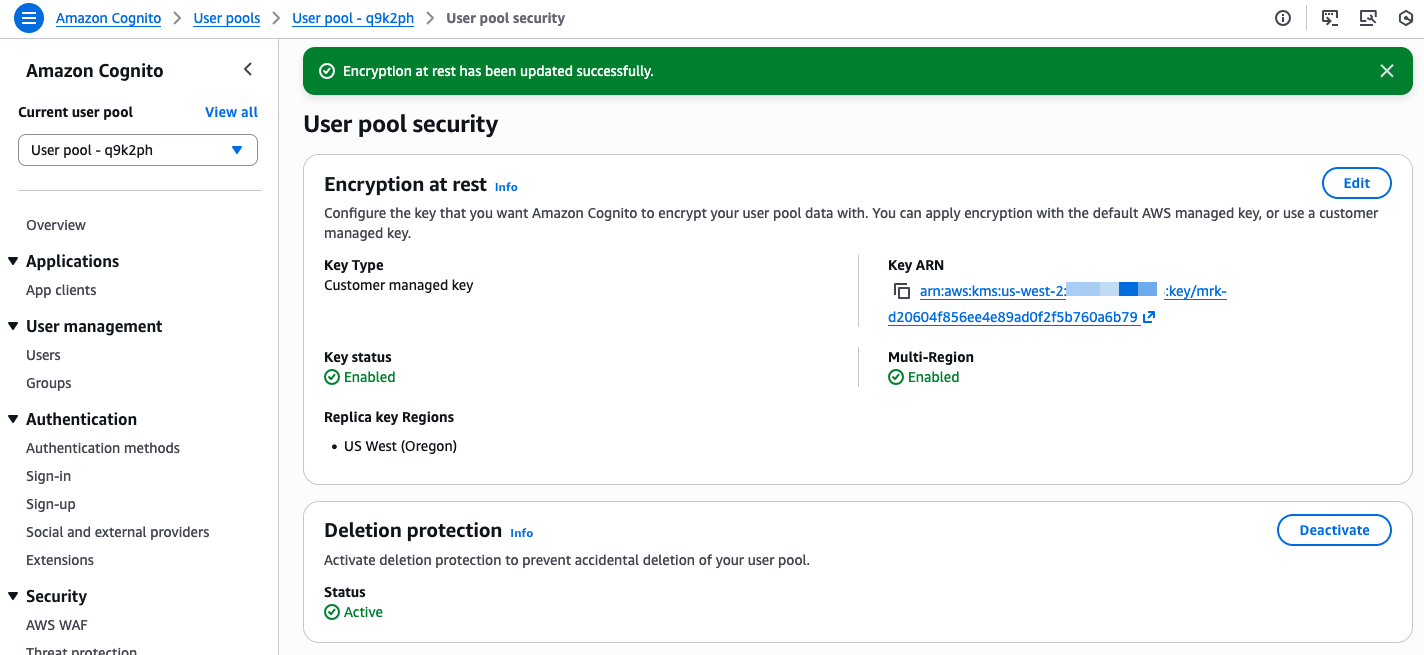
The console confirms when the custom key is selected and correctly configured.
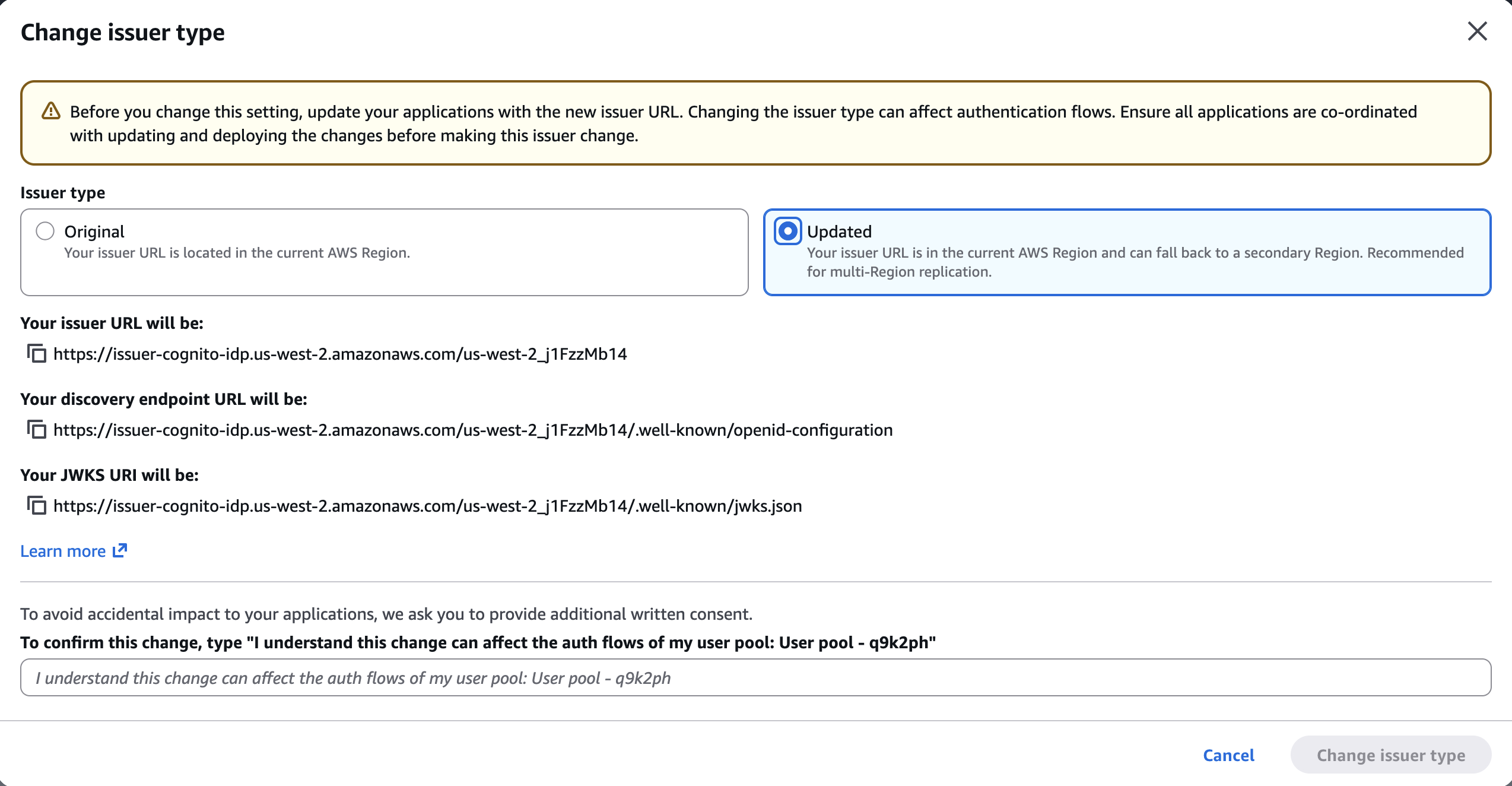
Second, I follow the console instructions to configure the OIDC issuer type. On Step 2 – optional, I choose Configure.
I make sure to update my client applications with these new endpoints. This is a required change that will need a redeployment of server-side applications and an update submission for mobile apps on the App Store and Google Play. If I don’t update the endpoints, my users will experience disruptions because requests to the old endpoints will no longer be routed correctly.
On the next screen, I select Updated. I take note of the new URLs. I confirm the changes and choose Change issuer type.
Finally, I select the target Region for replication. Only Regions where the custom encryption key is replicated are available for selection. After having chosen the target Region, I choose Create..
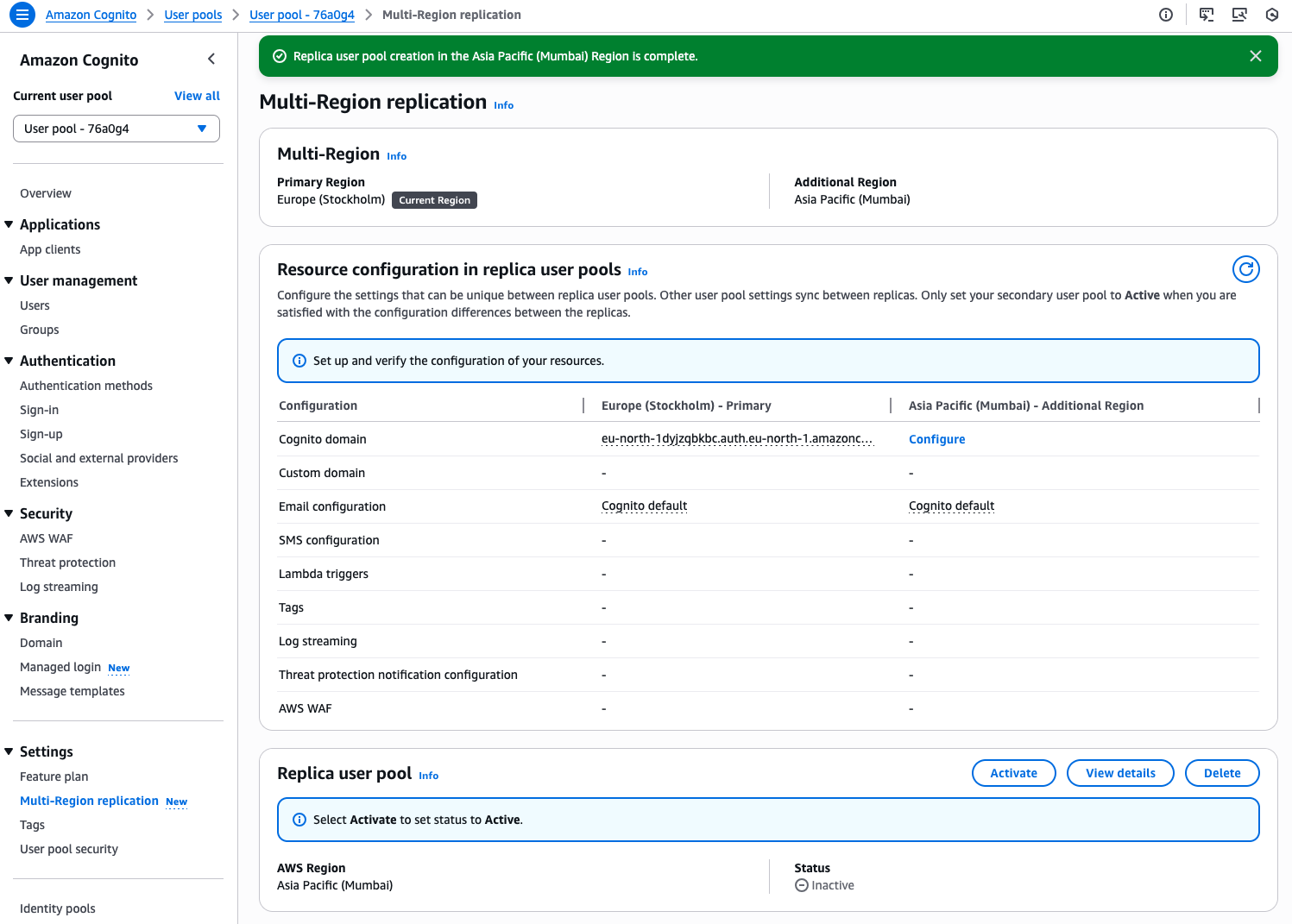
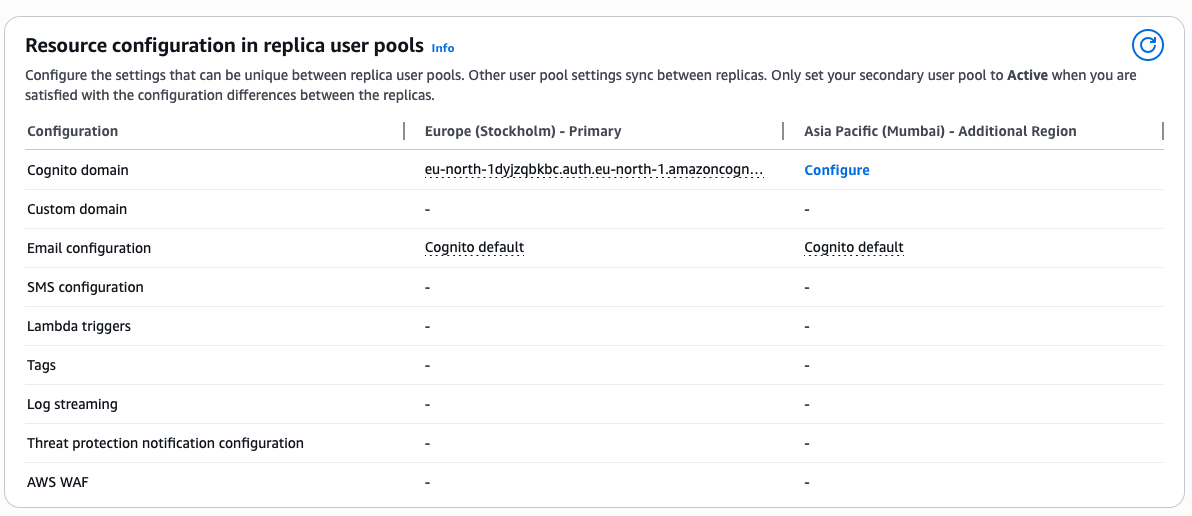
The service prepares the replication. The time needed depends on the amount of data in the user pool.
When the replicated user pool is ready, I manually Activate it.
The replication status becomes Active. It is ready to direct traffic to the replica.
Additional configurations The console helps me to keep track of additional configurations I have to plan. When I’m using Lambda functions for custom authentication flows or SMS or email notifications, I must also deploy and configure these resources in the new Region.
Similarly, log streaming or AWS WAF configuration must be manually configured in the target Region before I start directing authentication traffic to it.
Health checks and failover Both primary and secondary regional endpoints remain active and ready to serve your traffic at all times. To monitor system health and manage failovers, you design a strategy that aligns with your application’s specific requirements and security posture. You can implement health checks to monitor the status of authentication services in your primary Region and define criteria for when to initiate failover. These checks might look for error rates, latency patterns, or specific service alerts.
When your monitoring system detects issues meeting your failover criteria, you can redirect traffic to the secondary Region through DNS updates. This approach gives you control over the failover process while maintaining security. Consider testing your failover strategy during off-peak hours by redirecting a small portion of traffic to verify that authentication continues working as expected in the secondary Region.
When using managed login and federation with custom domains, you can also use the built-in traffic routing feature by providing an Amazon Route 53 health check ID.
Pricing and availability Multi-Region replication is available today as an add-on feature for Amazon Cognito customers using Essentials and Plus tier. For user authentication, the add-on costs $0.0045 per monthly active user per replica Region for Essentials tier customers and $0.006 per monthly active user per replica region for Plus tier customers. For machine-to-machine (M2M) authentication, the add-on is a 30% charge on top of the standard volume-based pricing for successful tokens issued. For detailed pricing information, see Amazon Cognito pricing.
Multi-Region replication is available in the following Regions: US East (Ohio, N. Virginia), US West (N. California, Oregon), Asia Pacific (Mumbai, Seoul, Singapore, Sydney, Tokyo), Canada (Central), Europe (Frankfurt, Ireland, London, Paris, Stockholm), and South America (São Paulo).
Any of these Regions can be used as the source or the destination for the replication.
Support for customer managed keys is available for the Essentials and Plus tiers. It is available in the following Regions: US East (Ohio, N. Virginia), US West (N. California, Oregon), Africa (Cape Town), Asia Pacific (Hong Kong, Hyderabad, Jakarta, Malaysia, Melbourne, Mumbai, New Zealand, Osaka, Seoul, Singapore, Sydney, Thailand, Tokyo), Canada (Central), Canada West (Calgary), Europe (Frankfurt, Ireland, London, Milan, Paris, Spain, Stockholm, Zurich), Israel (Tel Aviv), Mexico (Central), South America (São Paulo), and AWS GovCloud (US-East, US-West)
From my conversations with customers, maintaining business continuity during regional incidents while meeting security requirements is a high priority. Multi-Region replication provides the capability to build more resilient applications without managing complex replication logic yourself. The automatic synchronization of user data and configurations reduces operational overhead while maintaining security.
For customers in regulated industries, the new support for customer managed keys provides additional control over data encryption. You can now use your own encryption keys to protect user data at rest, helping you meet regulatory requirements in industries like healthcare and financial services.
To get started with multi-Region replication and customer managed key encryption, visit the Amazon Cognito console or see the documentation for detailed setup instructions. I look forward to hearing how you use this feature to strengthen your application architecture.

 Connexion