
❌

Vue lecture

AWS Weekly Roundup: OpenAI GPT-6 Astra on Amazon Bedrock, Amazon Quick desktop GA, Kiro for students, and more (September 14, 2026)

There’s a particular energy to mid-September in New York. Pumpkin spice lattes are flowing, temperatures are dropping, and it’s nearly sweater weather. The city is back at full speed, and so is the AWS launch calendar. This week that energy showed up in a new frontier model on Amazon Bedrock, a desktop app for Amazon Quick, and a reminder that the developers seeing the biggest gains from AI agents aren’t just using better tools — they’re working differently.

Let’s dive in.

Headlines
OpenAI GPT-6 Astra is now generally available on Amazon Bedrock – GPT-6 Astra is OpenAI’s latest and most capable model to date, and you can now run it on Amazon Bedrock. It brings deeper reasoning and judgment, professional-quality writing and design, and advanced computer and browser use to demanding business workflows. The model supports a context window of up to 1 million input tokens, so you can send it large codebases, long contracts, or extensive document collections and ask it to reconcile competing inputs.
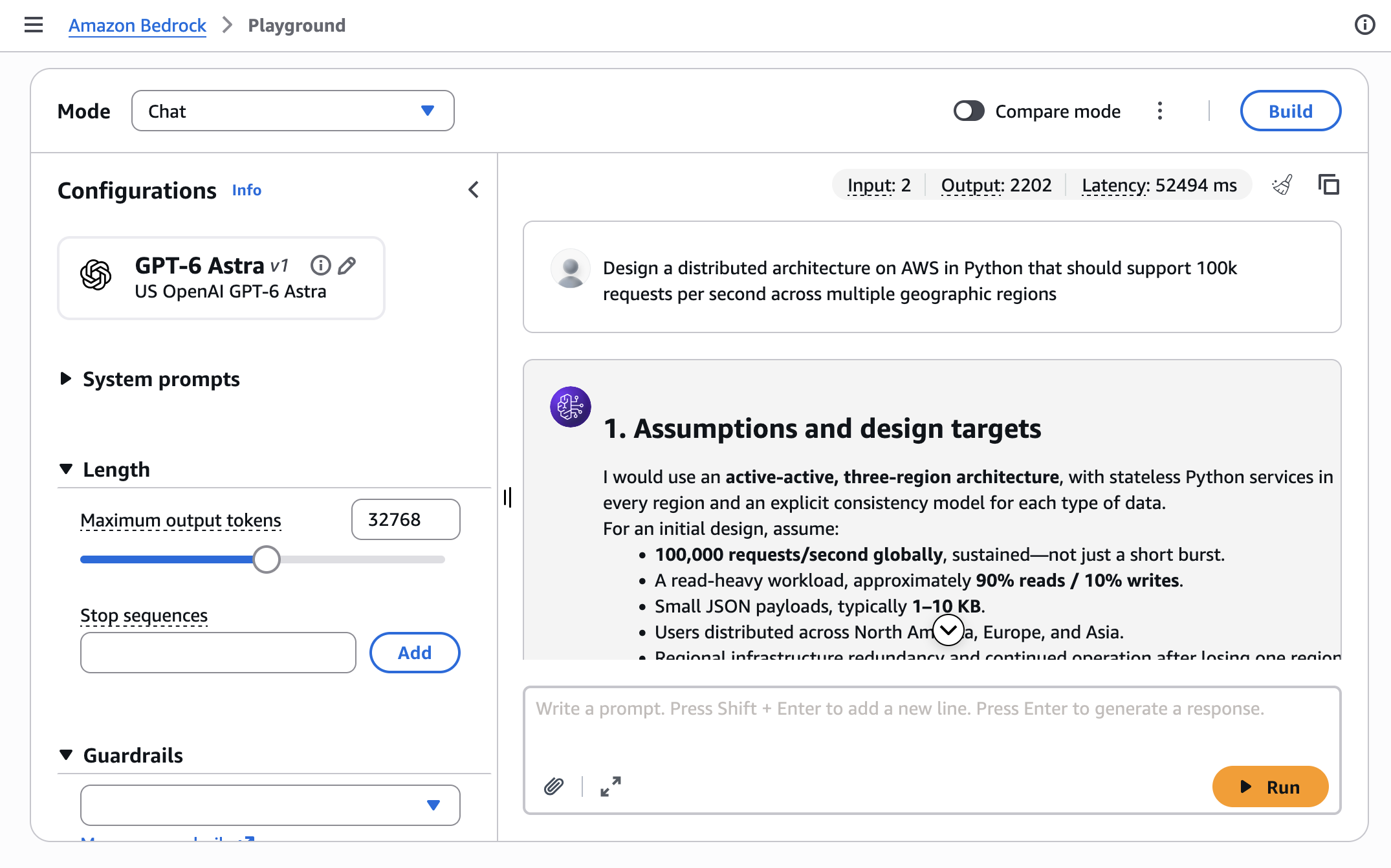
You can call GPT-6 Astra through supported Amazon Bedrock APIs, or configure ChatGPT Work and Codex to use the model on Amazon Bedrock. Alongside the launch, OpenAI is introducing new enterprise plugins for ChatGPT Work that extend Astra’s browser-use capabilities across common business applications. Established AWS controls help you secure workloads, govern access, and audit model invocation activity, and your inference data isn’t used for model training. Read more

Last week’s launches
Here are some launches and updates from this past week that caught my attention:

  • Amazon Quick desktop app is now generally available on macOS and Windows – The Amazon Quick desktop app brings Amazon Quick to your computer, where it can work with local files and stay connected to your calendar, email, and business apps in the background. Conversations, context, and agents stay synchronized across desktop and mobile, so work you start on one surface carries over to the other. With this release, Quick agents also keep running after you close your computer, which means you can start a long-running task before you leave the office, add input from the mobile app on the way home, and review the result when you get there. Existing Quick users can download the desktop app, and the mobile app is available from the Apple App Store and Google Play. Read more
  • AWS Lambda now supports a 90-minute function timeout on Lambda Managed Instances – You can now configure a function timeout of up to 90 minutes for asynchronous and event source mapping (ESM) invocations on Lambda Managed Instances, a 6x increase from the previous 15-minute limit. That opens the door to data processing, media transcoding, financial calculations, AI inference, and batch jobs that need longer continuous execution, without splitting the work across multiple functions. Synchronous invocations keep the existing 15-minute maximum. The longer timeout also applies to steps inside Lambda durable functions, which can still run for up to a year when invoked asynchronously. Read more
  • Amazon EBS Volume Clones now copies volumes across accounts – Amazon Elastic Block Store (Amazon EBS) Volume Clones can now copy a volume into another AWS account and re-encrypt it with an AWS Key Management Service (AWS KMS) key in the target account. If you keep production and development in separate accounts, you can share a volume with AWS Resource Access Manager (AWS RAM) and let the target account create a fresh copy in the same Availability Zone, for example, cloning a production database volume into an isolated development account. Cross-account copy works for all volume types, including unencrypted volumes and volumes encrypted with customer managed keys. Read more
  • Second-generation single-rack AWS Outposts is now generally available – The new single-rack AWS Outposts is a self-contained 42U rack that puts compute, storage, and networking into one compact unit for locations that need low latency, local data processing, or data residency, and don’t have room for a larger footprint. A single rack delivers up to 2,688 vCPU and 100 TB of Amazon EBS storage, and supports the latest x86-powered Amazon EC2 instances, including general purpose (M7i, M8i), compute-optimized (C7i, C8i), memory-optimized (R7i, R8i), and Outposts accelerated networking instances. You get the same APIs, console, automation, governance, and security controls as multi-rack Outposts and AWS Regions. Read more
  • Amazon OpenSearch Serverless is now available on v0 by Vercel – You can now describe a search or AI application in natural language inside v0 by Vercel and get a full-stack app backed by Amazon OpenSearch Serverless. v0 provisions a collection, indexes your data, and uses the OpenSearch Serverless endpoint for full-text search and vector search for retrieval-augmented generation (RAG) workloads, without leaving the v0 interface. OpenSearch Serverless scales capacity up and down for you, so you can focus on the application instead of cluster management. You can provision under a new AWS account or link an existing one. Read more
  • AWS Transform for .NET modernization is now generally available via CLI – You can trigger an AWS-managed .NET modernization in AWS Transform custom with a single CLI command, then run it interactively or script it into an existing pipeline. The CLI sits alongside the existing AWS Transform for .NET experiences in the web application, Visual Studio IDE, Kiro Power, and MCP agents. Use it to upgrade language versions, migrate frameworks, optimize performance, and analyze codebases with transformations you can run as-is or customize. The .NET modernization transformation includes 50,000 free agent minutes per month. Read more

For a full list of AWS announcements, be sure to keep an eye on the What’s New with AWS page.

Other AWS news
Here are some additional posts and resources that you might find interesting:

  • Clare Liguori on frontier engineering – If you already use an AI coding assistant but don’t feel like you’re shipping much faster, start here. Clare Liguori, Senior Principal Engineer at AWS, published a practitioner’s manifesto on frontier engineering: ten principles, drawn from teams across Amazon, for changing how you build software with AI agents. The argument is direct. Software development has split in two, people who changed how they work with agents, and people who only changed their coding tools. Frontier engineering is not vibe coding. You spend the first weeks writing steering files, refactoring the codebase, and learning to decompose work for agents. Those weeks feel slower. The weeks after feel dramatically faster, because you’re no longer building the software directly — you’re building the agent setup that builds the software.
  • A free year of Kiro for students around the world – The Kiro Students program is expanding from 11 universities to 121 new schools across 16 countries. Eligible students get one year of Kiro with 1,000 credits per month and full access to paid features such as premium models and Kiro Web, no credit card and no trial timer. You can work in the IDE, the CLI, Kiro Web in a browser, or Kiro Crew. If you’re a student, sign up with your university email.
  • The state of AI for security: measuring what matters for trust – Security teams are using AI for triage, threat modeling, incident response, and code review, but a tool that flags everything doesn’t save time. In The state of AI for security, Anshumali Shrivastava and Neha Rungta introduce Deception Benchmark, a new evaluation that tests whether a model can tell a real vulnerability from code that looks risky but is actually safe. The benchmark includes 14,822 samples across 16 languages and more than 70 Common Weakness Enumeration (CWE) categories. Under standard prompting, precision landed in the mid-50s, about as likely to be inaccurate as accurate, and none of the 12 models tested kept both false positives and false negatives below 10 percent. The post links to the dataset, whitepaper, and submission workflow for verified scoring.
  • Build full-stack AWS applications in minutes with AI-powered scaffolding – Version 1.0 of the Nx Plugin for AWS is an open source toolkit of deterministic generators for APIs, websites, databases, and AI agents, plus the AWS infrastructure to run them. Each generator writes working, deployable code with security, observability, and type-safety already in place, so an AI assistant can assemble the foundation and spend its effort on your application logic. Bingo Industries used it to take a multi-agent operations chatbot from idea to production in less than 3 weeks. The plugin is open source on GitHub. Create a workspace with pnpm create @aws/nx-workspace and point your coding agent at the included MCP server.
  • The oldest architecture in computing – On All Things Distributed, Werner Vogels starts from a question customers always ask “Will AI take my job?”, and lands on memory. After spending time with Kiro Crew, he traces a line from Jeff Hawkins’ A Thousand Brains to how Crew stores, consolidates, and forgets across markdown files, a vector database, and a key-value index. His conclusion: the brain is the oldest architecture in computing, and the people who think hardest about how it works will build the next tools. Now, go build.

For a full list of AWS blog posts, be sure to keep an eye on the AWS Blogs page.

Upcoming AWS events
Check your calendar and sign up for upcoming AWS events:

Join the AWS Builder Center to connect with builders, share solutions, and access content that supports your development. Browse here for upcoming AWS-led in-person and virtual events and developer-focused events.

That’s all for this week. Check back next Monday for another Weekly Roundup!

— Micah

This post is part of our Weekly Roundup series. Check back each week for a quick roundup of interesting news and announcements from AWS!
  •  

AWS Weekly Roundup: EC2 application status checks, IAM role manager, OpenAI Daybreak on Bedrock, and more (August 17, 2026)

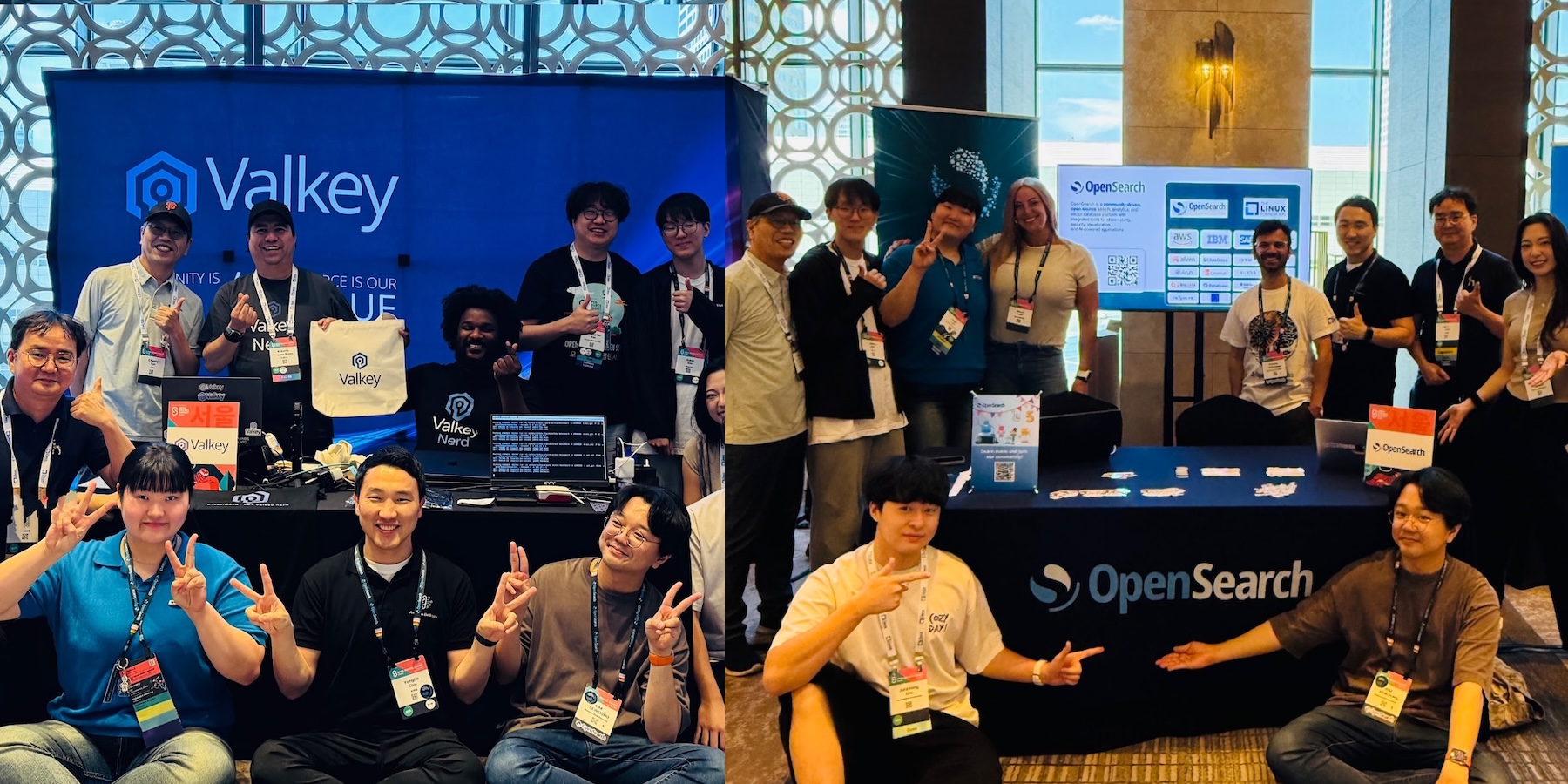
Last week, AWS contributors joined the OpenSearch and Valkey communities at Open Source Summit Korea 2026 and MCP DevSummit Seoul 2026 to meet open source developers and contributors. At the four-day event, community leaders and users of these Linux Foundation open source projects gathered to share knowledge, collaborate on solutions, and push the projects forward.

Leaders of the Korean OpenSearch communities volunteered to participate in the booth, and also had time to network and interact in the user group meetup.

OpenSearch is an open source, enterprise-grade search and observability suite that brings order to unstructured data at scale. On June 9, 2026, OpenSearch 3.7 introduced new tools designed to query, alert, and track SLOs across logs, traces, and metrics through a single interface and retrieve vectors up to 5.5x faster for improved search performance. Since July 30, 2026, you can run OpenSearch version 3.7 on Amazon OpenSearch Service for improvements in vector search performance, search relevance, and Query Insights.

Valkey is an open source high-performance key/value datastore that supports a variety of workloads such as caching, message queues, and it can act as a primary database. On May 19, 2026, Valkey 9.1 introduced a redesigned I/O threading model that improves throughput by up to 17% and reduces memory usage for strings under 128 bytes by up to 20%. Since June 23, 2026, you can run Valkey 9.1 in Amazon ElastiCache for node-based clusters, delivering higher throughput, improved memory efficiency, and stronger access control for multi-tenant workloads.

You can connect with AWS contributors at upcoming OpenSearch and Valkey community events.

Last week’s launches
Here are some launches that got my attention:

For a full list of AWS announcements, be sure to keep an eye on the What’s New with AWS page.

Other AWS news
Here are some additional projects and news items you may find interesting:

  • The deprecation of email validation in AWS Certificate Manager: ACM will discontinue support for email-validated public certificates by September 30, 2027. If you use email validation for your ACM public certificates, you need to migrate to DNS validation before that date. For Amazon CloudFront distributions, HTTP validation is also available.
  • The next-generation AWS VPN Client with CLI support and admin controls: You can use a new AWS VPN Client built on OpenVPN3. With the new client, you get full backward compatibility with existing AWS Client VPN endpoints while delivering the automation capabilities and security posture that enterprise networking teams have been asking for.
  • Oracle Exadata on Exascale for Oracle AI Database@AWS: ExaDB-XS brings Exadata-class performance and availability through a consumption-based model. With ExaDB-XS, you can scale compute and storage independently in small increments and pay only for what you consume.

For a full list of AWS blog posts, be sure to keep an eye on the AWS Blogs page.

Learn more about AWS, browse and join upcoming AWS-led in-person and virtual events, startup events, and developer-focused events including AWS Summits and AWS Community Days. Join the AWS Builder Center to connect with builders, share solutions, and access content that supports your development.

That is all for this week. Check back next Monday for another Weekly Roundup!

— Channy

  •  

AWS Weekly Roundup: Claude Sonnet 5 on AWS, Amazon WorkSpaces for AI agents, AWS service availability updates, and more (July 6, 2026)

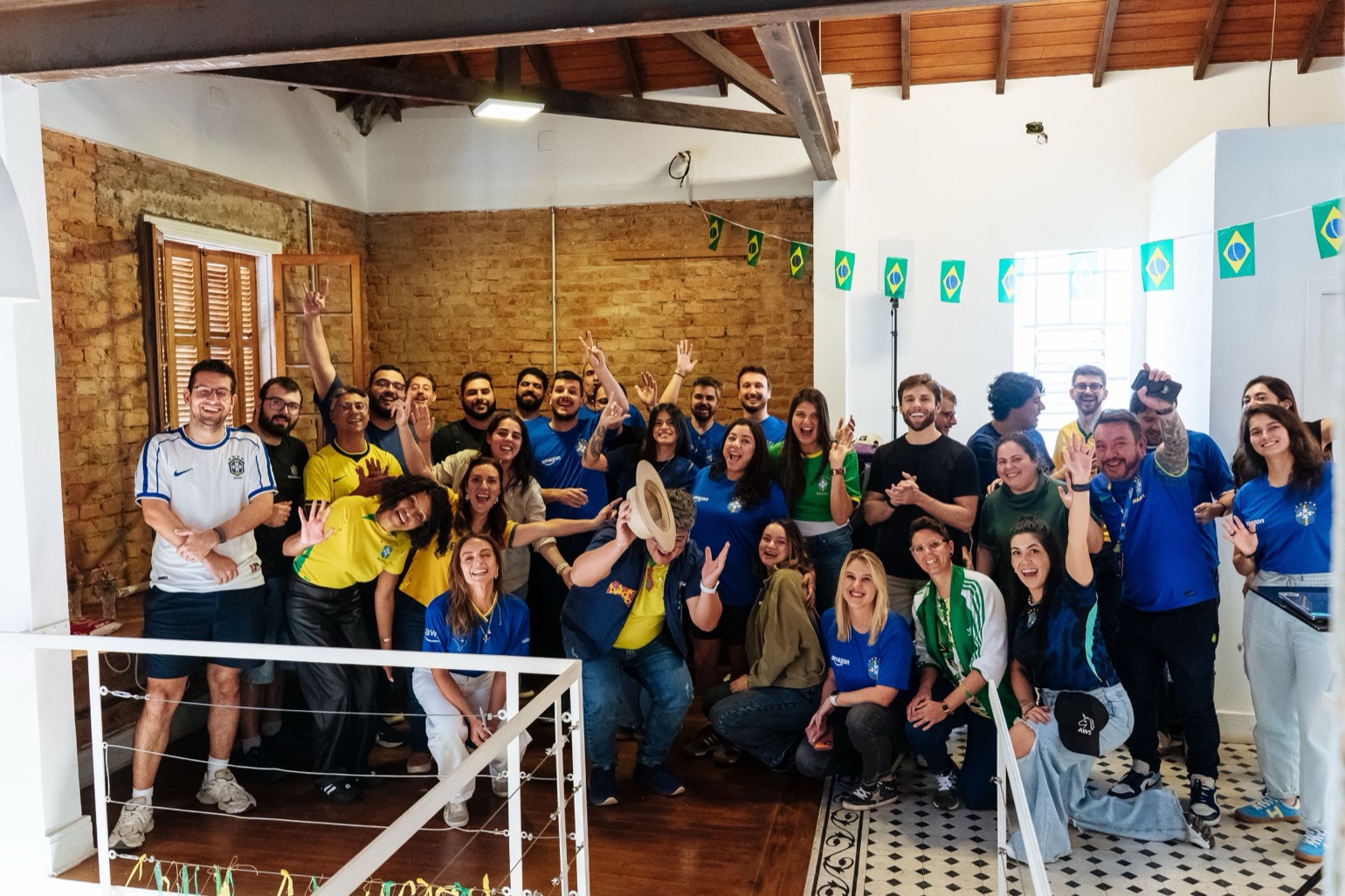
A couple of editions ago I wrote about what I find so energizing about working with startups. Last week I got a fresh dose of it: I spent a few days with the AWS Startups team, listening to stories of founders talking about the problems they’re actually solving. One story that stayed with me came from Marco Negreiros, founder of EyeCare Health, a Brazilian healthtech expanding access to eye care. He shared a striking fact: more than 70% of Brazilian municipalities don’t have a single ophthalmologist. His answer was to put a vision test on the one device almost everyone already carries, the smartphone, so a basic eye screening no longer depends on living near a clinic. Watching a founder turn a gap that big into something that concrete is exactly why I love this space.

AWS Startups team get-together with founders in Brazil

This week, I’ll take a closer look at some key launches, and then cover the quarterly AWS Service Availability updates.

Last week’s launches
Here are some of the launches covered from this past week in the AWS News Blog:

Here are some launches and updates that caught my attention:

For a full list of AWS announcements, be sure to keep an eye on the What’s New with AWS page.

AWS Service Availability Updates
When the availability of an AWS service or feature changes, we provide customers guidance in AWS Product Lifecycle Changes on available alternatives and support for migration so that disruptions to your operations are minimized. The following lifecycle changes were updated on June 30, 2026.

Services moving to Maintenance (no longer accessible to new customers starting July 30, 2026):

Services entering Sunset:

Services reaching End of Support (as of June 30, 2026):

  • Amazon Chime SDK – Carrier Voice Focus
  • Amazon SageMaker AI – Ground Truth Plus

We understand that changes in availability can impact your operations. For specific guidance, consult the relevant service documentation or contact AWS Support.

Upcoming AWS events
Check your calendar and sign up for upcoming AWS events:

  • AWS Summits – AWS Summits are free events that bring the cloud and AI community together to connect, learn, and explore the latest technologies. Browse the full calendar to find a Summit near you in the second half of 2026.
  • AWS Community Days – Community-led conferences where content is planned, sourced, and delivered by community leaders. If you’re in Latin America, don’t miss AWS Community Day Belo Horizonte on August 22. Registration is open at awscommunityday.com.br.

Join the AWS Builder Center to connect with builders, share solutions, and access content that supports your development. Browse here for upcoming AWS-led in-person and virtual events and developer-focused events.

That’s all for this week. Check back next Monday for another Weekly Roundup!

– Daniel Abib

This post is part of our Weekly Roundup series. Check back each week for a quick roundup of interesting news and announcements from AWS!
  •  

AWS Weekly Roundup: Agentic CX designer for Amazon Connect Customer, EC2 AMI Watermarks, Open Governance for MySQL, and more (June 29, 2026)

It has been a busy stretch on the AWS Summit circuit. At the New York City Summit, I delivered a workshop called Building AI architectures with AWS Serverless, and it was a lot of fun watching builders wire up agents and serverless services to solve real problems in a single afternoon. This week I am heading down to the Washington, DC Summit, which always puts a spotlight on innovation in the public sector. If you are going to be there, come say hello.

A question I hear a lot at these events is how teams can put AI to work without waiting on a long engineering backlog, and this week’s biggest launch speaks directly to that, with Amazon Connect Customer introducing a no-code way for business teams to design AI powered customer experiences themselves. Now, let’s get into this week’s AWS news.

Headlines
Amazon Connect Customer launched the Agentic CX designer (NLX) in preview, a no-code canvas for designing and deploying AI powered self service experiences. Business teams can build and launch voice and digital experiences that bring agentic and deterministic AI together in one governed flow, going from design to testing and simulation to production ready experiences in weeks rather than months. The launch also includes Live Sync in preview, a patented technology that drives a customer’s web or mobile experience in real time as they speak or type. A caller can complete a form or pull up the right product page without ever leaving the conversation. To see how this reshapes who designs customer experience, read the blog post on how the business user is the new architect of customer experience.

Last week’s launches
Here are some launches and updates from this past week that caught my attention:

  • AWS Lambda MicroVMs – A new serverless compute primitive that gives each user or job VM level isolation with near instant launch and resume speeds, plus the ability to suspend and resume execution for up to 8 hours. Built on Firecracker, it is made for running user or AI generated code in multi-tenant applications without managing virtualization infrastructure or trading off isolation, speed, and state.
  • Amazon EC2 AMI Watermarks – Lets you embed custom identifiers in your private AMIs that automatically carry forward to every derived AMI across copies, Regions, and account shares. You can combine watermarks with Allowed AMIs and Declarative Policies to restrict launches to approved images, available at no additional cost in all AWS Regions.
  • AWS Outposts self-service lifecycle management – Adds self service configuration, quoting, ordering, subscription management, renewal, and decommissioning directly from the console, CLI, and API. A new quoting tool generates real time cost estimates in seconds and surfaces account and regional constraints before you submit an order.
  • Amazon MSK AI Agent Skills – Gives AI coding assistants like Kiro, Claude Code, and Cursor expert, up-to-date guidance for operating Amazon MSK, covering troubleshooting, sizing, configuring, monitoring, and migrating external Kafka clusters to MSK Express. Tasks that once required specialized knowledge become a guided experience developers can complete on their own.
  • Amazon OpenSearch Service AI-assisted migrations – Migration Assistant now includes an agent guided experience that helps you move self managed Apache Solr, Elasticsearch, or OpenSearch deployments to OpenSearch Serverless or Managed Clusters using tools like Kiro and Claude Code, with new live traffic capture and replay support for Solr.
  • Amazon GuardDuty AI-powered investigations (preview) – Automatically analyzes findings and accounts to help you separate true threats from benign activity, examining context and related activity from the last 90 days with knowledge graphs and threat intelligence. Each investigation returns a disposition assessment with confidence scoring, MITRE ATT&CK classification, and actionable recommendations in minutes.

For a full list of AWS announcements, be sure to keep an eye on the What’s New with AWS page.

Other AWS news
Here are some additional posts and resources that you might find interesting:

  • Open Governance for MySQL – Oracle announced a community governance model for MySQL that gives organizations outside Oracle a defined role in the project, including four non Oracle seats on a new Steering Committee and a public GitHub presence. AWS holds a seat and shares why it supports the move and how it already contributes fixes upstream for everyone running MySQL.
  • A new way to keep your AWS Certification current -You can now maintain an eligible AWS Certification for an additional year by completing curated training and hands on labs on AWS Skill Builder instead of retaking a full exam. The option is available today in open beta for several Associate and Professional certifications, with more coming later this year.
  • The All Builders Welcome Grant insider’s guide for 2026 applicants – A community guide on AWS Builder Center that walks early career builders through applying for the grant, which covers a full conference pass, airfare, and hotel for AWS re:Invent 2026. Applications are open now and close on July 14.

For a full list of AWS blog posts, be sure to keep an eye on the AWS Blogs page.

Looking for ways to connect with builders in person? Check out the AWS Summits coming to a city near you, find a local AWS Community Day led by user groups around the world, and explore tutorials, community content, and ways to grow your skills over at the AWS Builder Center.

That’s all for this week. Check back next Monday for another Weekly Roundup!

-Micah

  •  

AWS Weekly Roundup: Claude Opus 4.8 on AWS, Aurora MySQL with Kiro Powers, and more (June 1, 2026)

In my last Week in Review post, I shared what I’d been hearing from customers in the AI-Driven Development Lifecycle (AI-DLC) workshops I’ve been delivering. Last week I was back at it, this time in Denver for a two-day AI-DLC workshop, where I helped facilitate 17 teams to deliver nearly 20 separate use cases in just two days. The pace of acceleration that AI-DLC unlocks—especially when paired with tools like Claude Code on Amazon Bedrock—is fundamentally changing how businesses operate. Traditional roles within software development teams are collapsing into smaller, AI-augmented squads, and the paradigm shift is beginning to take place right in front of us. To learn more about how to utilize various AI tools, visit the GitHub repository of AI-DLC workflow.

This shift is also reshaping how AWS account teams (solutions architects, customer solutions managers, and technical account managers) collaborate with customers. It’s becoming less about handing off advisory design documents and more about building alongside them in real time. It’s a genuinely exciting moment to be in the middle of the change, and this week’s headline launch — Anthropic’s most capable model yet, now on AWS, is going to push that pace even further.

Now, let’s get into this week’s AWS news…

Headlines
Claude Opus 4.8 on AWS – Anthropic’s most capable generally available model is now accessible through both Amazon Bedrock and the Claude Platform on AWS. Opus 4.8 is built for agentic coding, knowledge work, and extended autonomous task execution — it sustains longer autonomous sessions with deeper reasoning, recovers from errors, and synthesizes information across lengthy documents. For coding workloads, it reads codebases like an engineer, plans before it edits, and holds context across long sessions. On Amazon Bedrock, you get AWS-managed features like Guardrails, Knowledge Bases, and data residency; on the Claude Platform on AWS, you get Anthropic’s native APIs unified with AWS billing. To learn more, visit the deep-dive blog post.

Last week’s launches
Here are some launches and updates from this past week that caught my attention:

  • Introducing the next generation of AWS Resilience Hub – A reimagined Resilience Hub gives SREs and developers a unified framework to define resilience standards, evaluate applications against them, and demonstrate compliance across an entire portfolio. It introduces modular resilience policies (covering service-level objectives (SLOs), multi-AZ/Region DR, and data recovery), business-oriented application modeling, generative AI-powered assessments aligned with the Well-Architected and Resilience Analysis Frameworks, and automatic dependency discovery via DNS query log analysis. Integration with AWS Organizations enables organization-wide resilience management from a single delegated administrator account.
  • Introducing the next generation of Amazon OpenSearch Serverless for building agentic AI applications – Amazon OpenSearch Serverless is now a fully managed search and vector engine purpose-built for agentic AI applications. It scales from zero to thousands of requests per second—roughly 20x faster than the prior generation—delivers up to 60% cost savings versus peak-provisioned clusters, and adds GPU acceleration plus new SEARCH and VECTORSEARCH collection types. Native integrations with Vercel, Kiro, Claude Code, and Cursor through OpenSearch Agent Skills make it straightforward to plug into your agent stack.
  • New assessment capabilities in AWS Transform – AWS Transform expands with new tools to help you build migration business cases and evaluate TCO before moving workloads to AWS. You can ingest data from RVTools exports, CMDB data, the AWS Transform discovery tool, and third-party discovery tools, then run what-if scenarios across region, utilization, and service mapping for EC2, FSx, S3, SQL Server on EC2, and virtual desktops. The release also adds Agentic Readiness Analysis (ARA) and Modernization Analysis (MODA), which scan code repositories in 5 to 30 minutes per repo to surface severity-tagged findings with file-level evidence and AWS-mapped remediation guidance.
  • Amazon Aurora MySQL with Kiro Powers — Aurora MySQL now integrates with Kiro Powers, drawing from a curated repository of pre-packaged MCP servers, steering files, and hooks validated by Kiro partners. Developers can execute both data plane tasks (queries, schema management) and control plane tasks (cluster management) in natural language, with dynamic guidance for Aurora MySQL Serverless scaling, RDS-to-Aurora migration, and replication setup. The companion Database Blog post explains how the agent produces the API calls, SQL, and configuration for you to review and run — available via one-click install from the Kiro IDE or webpage.
  • Amazon WorkSpaces Applications now supports Windows Desktop OS – You can now bring your own Windows Desktop licenses to Amazon WorkSpaces Applications and stream full Windows desktops and applications from AWS-hosted dedicated hardware. BYOL eliminates OS fees (you pay only for compute and streaming infrastructure), supports eligible Microsoft 365 Apps for enterprise, and gives users a matching experience between local and remote environments — same workflows, shortcuts, and navigation in both.

For a full list of AWS announcements, be sure to keep an eye on the What’s New with AWS page.

Other AWS news
Here are some additional posts and resources that you might find interesting:

For a full list of AWS blog posts, be sure to keep an eye on the AWS Blogs page.

Learn more about AWS, browse and join upcoming AWS-led in-person and virtual events, startup events, and developer-focused events as well as AWS Summits and AWS Community Days. Join the AWS Builder Center to connect with builders, share solutions, and access content that supports your development.

That’s all for this week. Check back next Monday for another Weekly Roundup!

-Micah

  •